Artwork
Barbarian Royalty Worshiping the Buddha

Barbarian Royalty Worshiping the Buddha is an unspecified painting by Unknown. It dates from 1850 and is held in the collection of the Cleveland Museum of Art.
About this work
Overview
The work is a tall, narrow painted panel depicting a procession of robed figures in hats, arranged in two uneven rows, bowing toward a central seated figure elevated on a platform. The central figure is clothed in a red robe, surrounded by a golden halo, and holds a small object in his hands. Clouds and swirling forms fill the background, while the left margin contains dense black ink script.
Subject & Meaning
The composition suggests a scene of reverence, likely representing a group of foreign dignitaries or “barbarian” royalty paying homage to the Buddha. The halo and red garment identify the seated individual as a Buddhist saint, and the act of bowing with clasped hands conveys devotion or supplication.
Technique & Style
The painting combines color washes for the figures and background with precise ink calligraphy along the margin. The use of a golden halo and stylized clouds reflects conventions of Buddhist iconography, while the linear arrangement of the bowing figures recalls narrative scrolls of East Asian court art.
History & Provenance
The artist and date of the panel are not recorded in the surviving documentation. The script on the left side may be a poem or explanatory note, but its content has not been fully deciphered. The piece is part of the collection of the Cleveland Museum of Art, where it is displayed among other works of Buddhist and Asian painting.
Context
Such paintings were often produced for religious or diplomatic purposes, illustrating the acceptance of Buddhism by foreign rulers. The depiction of non‑Chinese attire and hats indicates an intention to portray outsiders acknowledging the spiritual authority of the Buddha.
Artist & collection

 Domestic Scene
 Giacomo and Cardinal Marco, investing Andrea, Abbot of San Zeno, with his Benefice
 The Nymph of Fontainebleau
 Portrait of a Woman
 Madonna and Child with Saints in the Enclosed Garden
 Venus and Minerva
 Family Group of Four on Sofa
 Wall painting from Room H of the Villa of P. Fannius Synistor at Boscoreale
 Landscape with Bamboo
 Landscape with Bamboo
 "In Exchange for Tea" with Wen Zhengming’s Calligraphy of The Heart Sutra
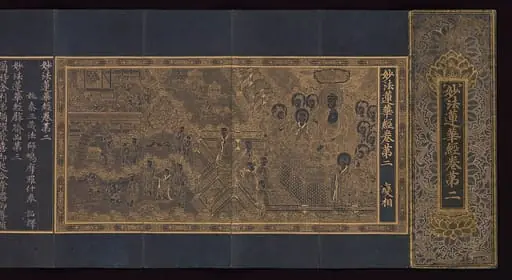 법화경변상도 고려|Illustrated manuscript of the Lotus Sutra (Miaofa lianhua jing), Volume 2
 Ink Flowers
 Rain-coming Pavilion by the Stone Bridge at Mt. Tiantai
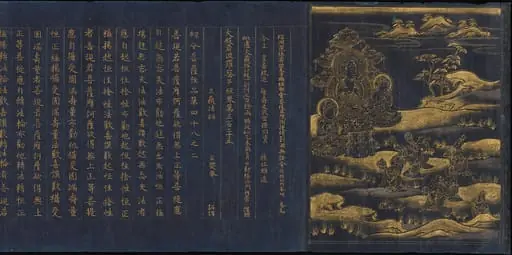 大般若経(中尊寺経)|Great Wisdom Sutra (Daihannya-kyō) from the Chūsonji Temple Sutra Collection (Chūsonji-kyō)
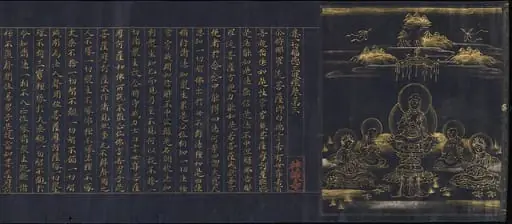 集一切福徳三昧経.|Illustrated Frontispiece to the Sutra of Enlightenment through the Accumulation of Merit and Virtue, the So-called Jingoji Sutra
 元王振鵬龍舟圖 卷
 Untitled
 Saying Farewell at Xunyang (Song of the Pipa)
 Barbarian Royalty Worshiping the Buddha