Artwork
Bhairava
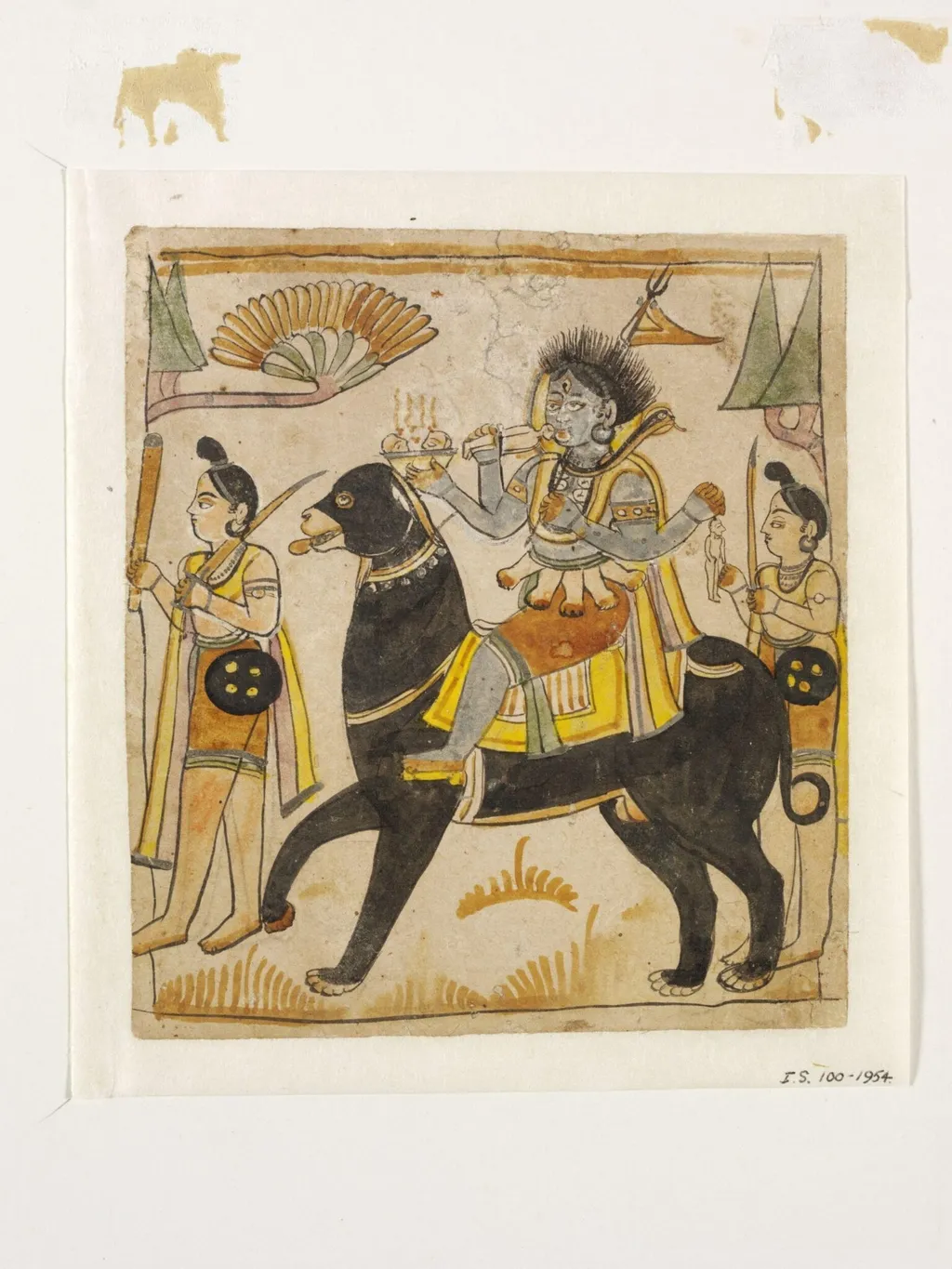
Bhairava is a paint painting by Unknown. It dates from 1900 and is held in the collection of the Victoria and Albert Museum.
About this work
Overview
The composition is lively, with vivid yellow‑orange garments, a cup, a staff, and assorted background motifs such as a fan, flag and foliage.
This fragment of a larger scroll, executed in opaque watercolor on paper, portrays the Hindu deity Bhairava in motion. He is shown astride a black animal—interpreted as a dog in the original description and a horse in visual notes—flanked by two Bairagi attendants brandishing drawn swords. The composition is lively, with vivid yellow‑orange garments, a cup, a staff, and assorted background motifs such as a fan, flag and foliage.
Subject & Meaning
The central figure represents Bhairava, a fierce aspect of Shiva associated with protection and the dissolution of obstacles. His mount, traditionally a dog, underscores his role as a guardian of the threshold between worlds. The accompanying Bairagis, ascetic devotees, hold swords in a ceremonial posture, suggesting a protective entourage and the deity’s martial attributes.
Technique & Style
Rendered in opaque watercolor, the work employs a flat yet richly pigmented palette dominated by yellows, oranges and deep blacks. The medium allows for solid color fields and fine line work that delineates clothing, animal tack and background symbols. The fragment’s brushwork reflects the decorative scroll tradition of North Indian court painting, emphasizing narrative clarity over atmospheric depth.
History & Provenance
The piece originates from an artist belonging to the Jadu Patus caste, a community historically linked to manuscript illumination in the region. It entered the market as part of a larger collection (catalogued IS. 90 to 128‑1954) and was acquired from the antiquarian firm Maggs Bros. for £150, indicating its early‑20th‑century circulation among European collectors of Indian art.
Context
Bhairava imagery appears frequently in devotional and courtly visual culture, often integrated into scrolls that narrated mythic episodes. The fragment’s compositional elements—bright attire, ceremonial objects, and dynamic posture—align with similar works held at institutions such as the Victoria and Albert Museum, illustrating a shared aesthetic among contemporaneous Indian watercolor scrolls.
Artist & collection

 Domestic Scene
 Giacomo and Cardinal Marco, investing Andrea, Abbot of San Zeno, with his Benefice
 The Nymph of Fontainebleau
 Portrait of a Woman
 Madonna and Child with Saints in the Enclosed Garden
 Venus and Minerva
 Family Group of Four on Sofa
 Wall painting from Room H of the Villa of P. Fannius Synistor at Boscoreale