Artwork
Rati
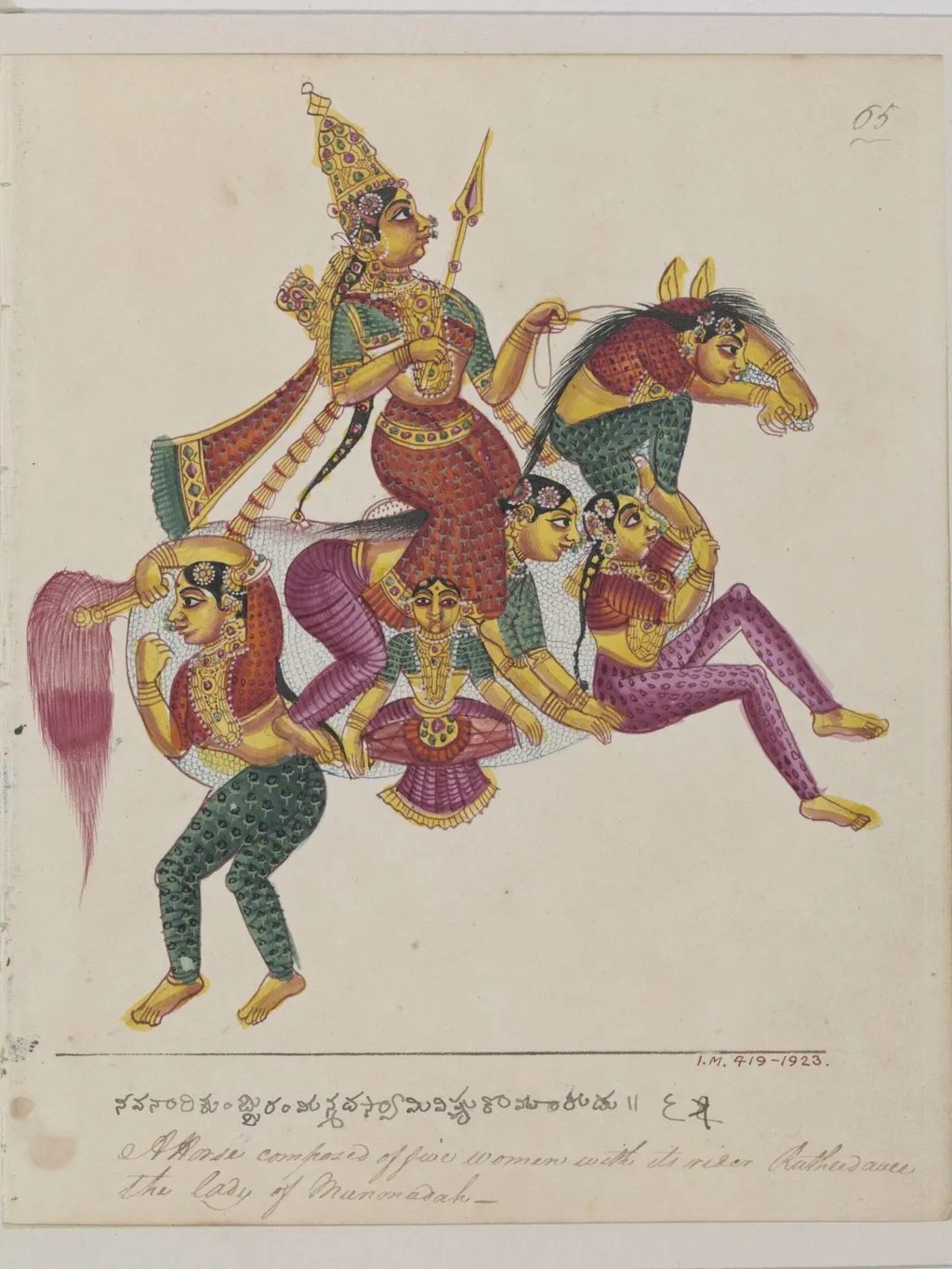
Rati is a paint painting by the Romanticist artist Unknown. It dates from 1820 and is held in the collection of the Victoria and Albert Museum.
About this work
Overview
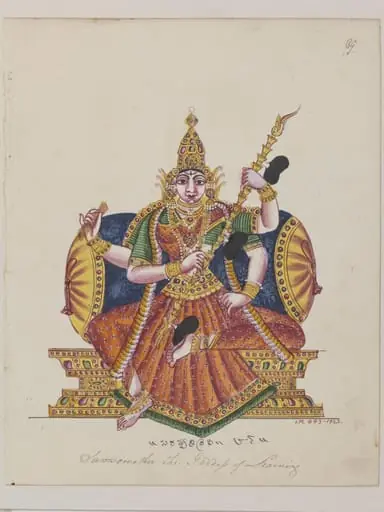
This painting is one of a hundred South Indian works created circa 1820, illustrating Hindu deities in a distinctive regional style.
This painting is one of a hundred South Indian works created circa 1820, illustrating Hindu deities in a distinctive regional style. It portrays Rati, the goddess of love and desire, mounted on a fantastical steed composed of five women. The composition is part of a devotional series, likely used in ritual or narrative contexts, blending mythological symbolism with vivid, stylized representation characteristic of late pre-colonial South Indian art.
Subject & Meaning
Rati, consort of Kama (the god of love), is depicted as a powerful, dynamic figure, armed with a spear and crowned with elaborate jewelry. Her mount, formed by five women, symbolizes the collective energy of desire and passion. The horse’s head, also a woman with a fierce gaze, suggests the uncontrollable force of erotic longing. The imagery reflects a metaphysical interpretation of love as both divine and tumultuous, rooted in Tantric and Puranic traditions.
Technique & Style
The work employs bold, saturated pigments—especially reds and golds—applied with fine brushwork to intricate patterns on garments and ornaments. Figures are rendered with elongated proportions and stylized features, typical of South Indian manuscript illustration. The composition is densely packed, with overlapping forms and rhythmic lines that convey motion. Gold leaf accents highlight crowns and jewelry, enhancing the sacred and ornamental character of the scene.
History & Provenance
Created around 1820, likely in the Tamil or Andhra region, this painting belongs to a larger set commissioned for devotional use. Such series were often produced for royal patrons or temple communities. The group was later collected by British officials or missionaries during the colonial period and eventually entered institutional collections, including the Victoria and Albert Museum, where similar works are preserved as examples of regional artistic traditions.
Context
These paintings emerged during a period of cultural continuity under British colonial rule, when traditional Hindu iconographic programs persisted despite political change. The depiction of deities in dynamic, symbolic forms reflects an enduring local aesthetic, distinct from Mughal or Western influences. The use of female bodies to construct the divine steed aligns with esoteric interpretations of the body as a vessel of spiritual power in South Indian religious thought.
Legacy
The series to which this painting belongs remains a rare surviving example of 19th-century South Indian devotional illustration. Its unusual iconography has drawn scholarly attention for its fusion of myth, gender symbolism, and visual innovation. While not widely exhibited, it contributes to broader understandings of how Hindu deities were visually interpreted in regional contexts beyond mainstream North Indian traditions.
Artist & collection

 Domestic Scene
 Giacomo and Cardinal Marco, investing Andrea, Abbot of San Zeno, with his Benefice
 The Nymph of Fontainebleau
 Portrait of a Woman
 Madonna and Child with Saints in the Enclosed Garden
 Venus and Minerva
 Family Group of Four on Sofa
 Wall painting from Room H of the Villa of P. Fannius Synistor at Boscoreale
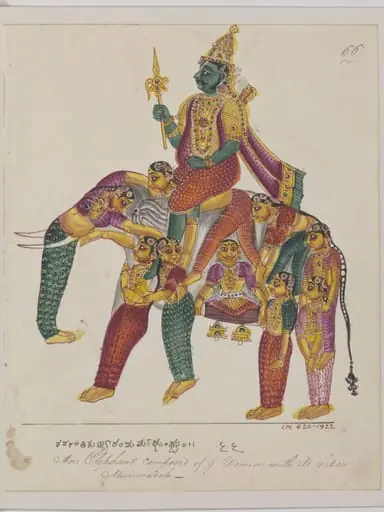 Manmatha or Kama, the God of Love
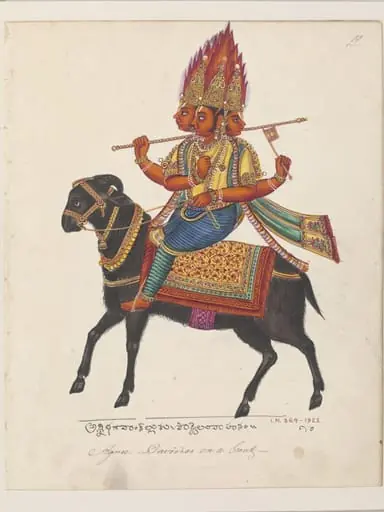 The Vedic god Agni, the god of fire and guardian of the south-east
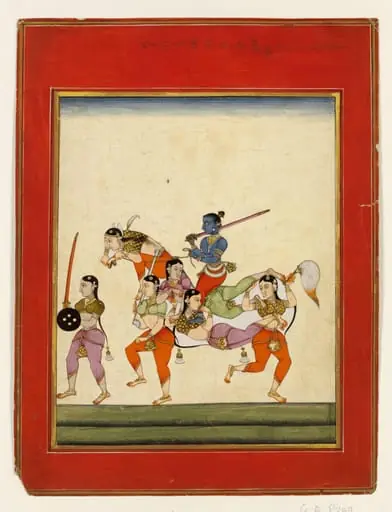 Vishnu
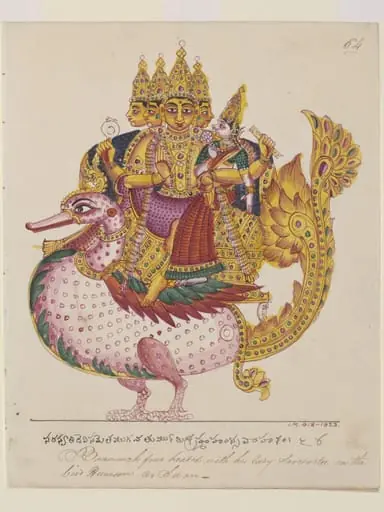 Brahma
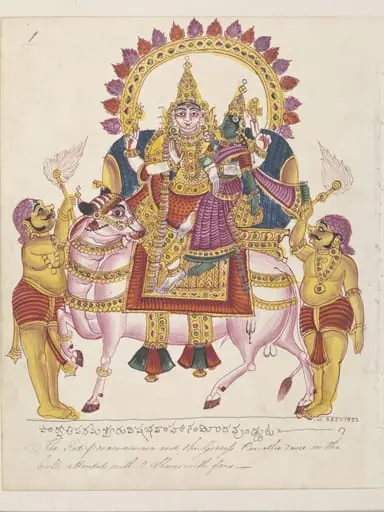 Shiva and Parvati on the bull Nandi
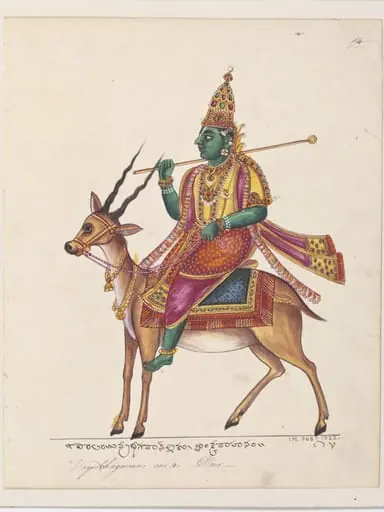 Vayu, the god of the wind and guardian of the north-west, riding on a deer.
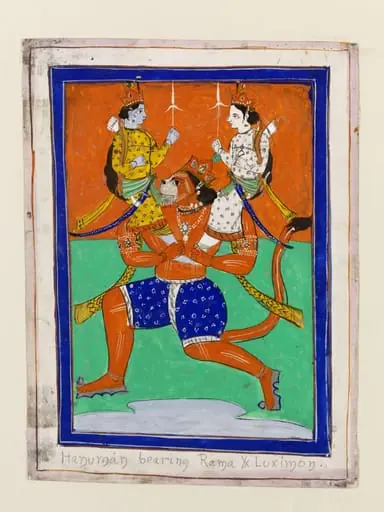 Hanuman, Rama and Laksmana
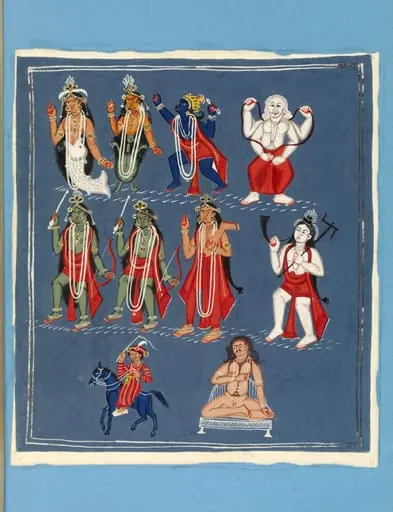 Ten avataras of Vishnu
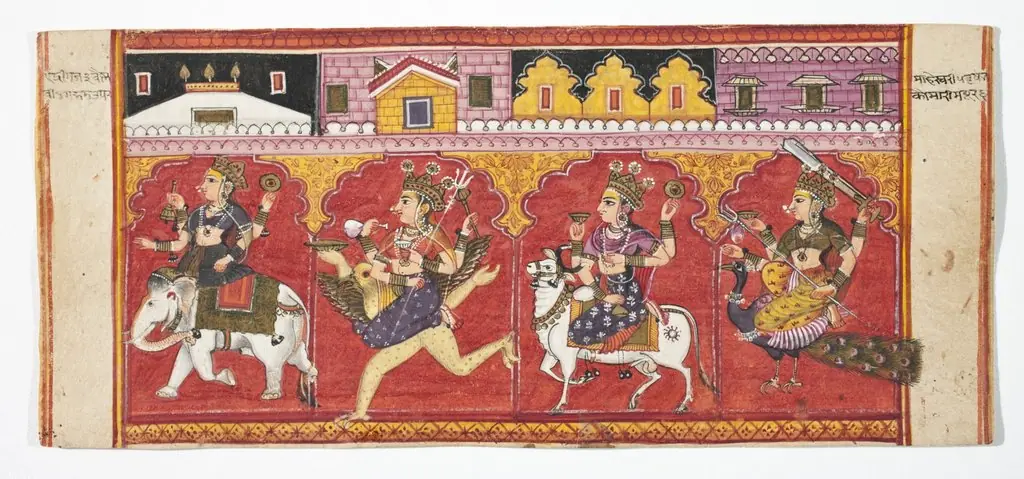 Legend of Durga
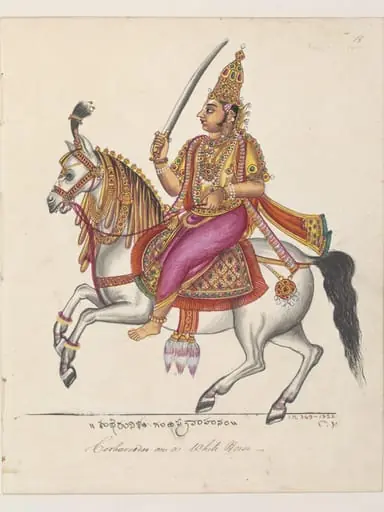 Kubera, the god of wealth and guardian of the north, riding on a horse
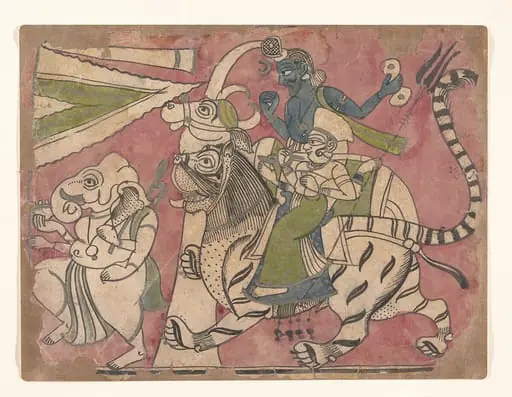 Untitled
 Sarasvati, the goddess of learning, speech and music