Artwork
Caesarea -
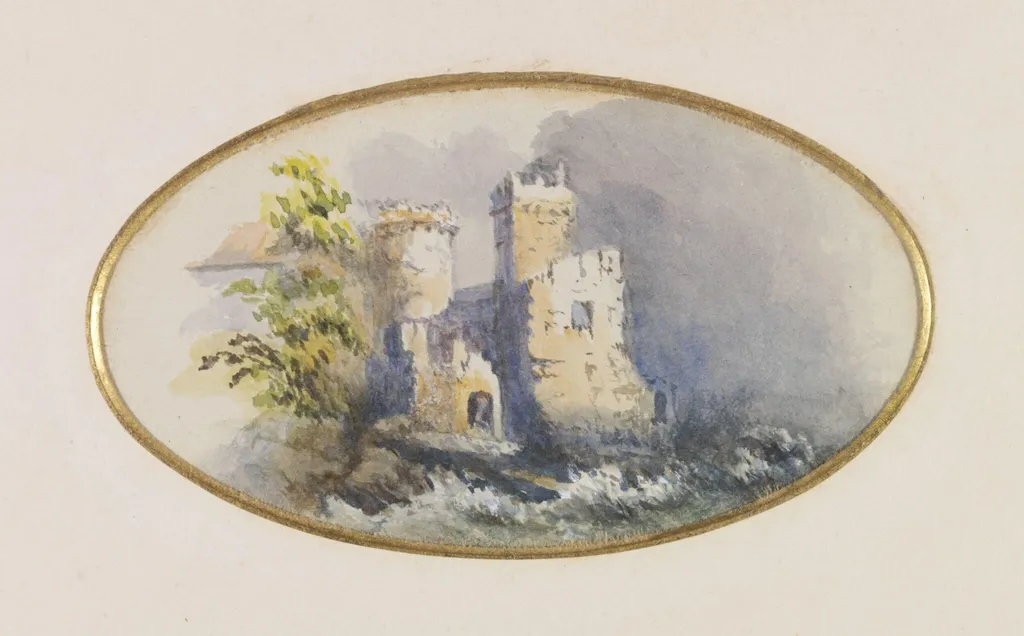
Caesarea - is a watercolor work on paper by the Romanticist artist Unknown. It dates from 1845 and is held in the collection of the Victoria and Albert Museum.
About this work
Overview
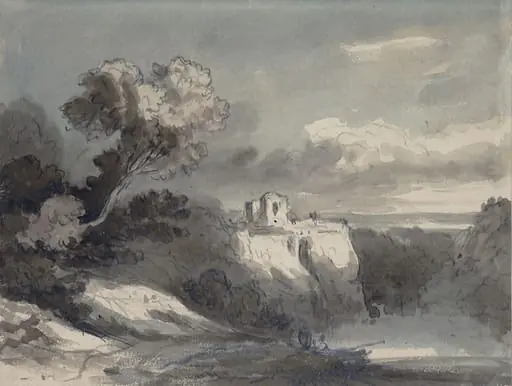
This watercolor is one of twelve oval-format landscapes bound in a maroon Morocco case with gilt embellishments, collectively titled *Eastern Sketches*. The work depicts a coastal ruin site with minimal human presence, rendered in delicate washes that emphasize atmospheric softness. Its small scale and intimate composition suggest a personal travel record rather than a public commission.
Subject & Meaning
The scene features two ancient stone towers—one tall and square, the other shorter and circular—partially collapsed along a rocky shore.
The scene features two ancient stone towers—one tall and square, the other shorter and circular—partially collapsed along a rocky shore. A solitary figure in long coat and hat stands near a narrow archway, suggesting contemplation or passage. The ruined architecture, combined with the turbulent sea and sparse vegetation, evokes a mood of quiet decay and temporal erosion, aligning with 19th-century fascination with antiquity’s remnants.
Technique & Style
The artist employed light, transparent watercolor washes to suggest distance and mist, allowing the ruins to dissolve into the background. Textural contrast is key: rough stone surfaces, choppy water, and smooth fabric folds are rendered with subtle brushwork. Greens and yellows in the vegetation are muted, reinforcing the scene’s subdued, observational tone rather than dramatic emphasis.
History & Provenance
The work was once attributed to Sir John Gardner Wilkinson, a noted Egyptologist and sketcher, as recorded in the Searight Archive. While this attribution remains unconfirmed, the piece fits within the tradition of British travelers documenting Eastern sites during the early 1800s. Its inclusion in a bound album implies it was part of a private collection, possibly compiled for personal or scholarly use.
Context
Created during a period when European artists increasingly traveled to the Eastern Mediterranean, this watercolor reflects a growing interest in ancient ruins as subjects of aesthetic and historical inquiry. The Romantic movement’s emphasis on nature’s dominance over human achievement is evident here, where weathered stone and sea dominate the composition, and human presence is reduced to a solitary, almost insignificant figure.
Legacy
As part of a small, unpublished album, this watercolor offers insight into the quiet, observational practices of amateur travelers rather than the grand narratives of official expeditions. Its survival in a preserved case suggests it was valued for its personal record of place, contributing to a broader, understudied corpus of 19th-century topographical watercolors outside the academic canon.
Artist & collection

 Domestic Scene
 Giacomo and Cardinal Marco, investing Andrea, Abbot of San Zeno, with his Benefice
 The Nymph of Fontainebleau
 Portrait of a Woman
 Madonna and Child with Saints in the Enclosed Garden
 Venus and Minerva
 Family Group of Four on Sofa
 Wall painting from Room H of the Villa of P. Fannius Synistor at Boscoreale
 Philadelphia -
 Hampstead Heath, from near Well Walk
 Landscape with tower on a rock
 The Water Organ in the Gardens of the Villa d'Este, Tivoli
 The Attack
 Untitled
 Landscape with river and mountains
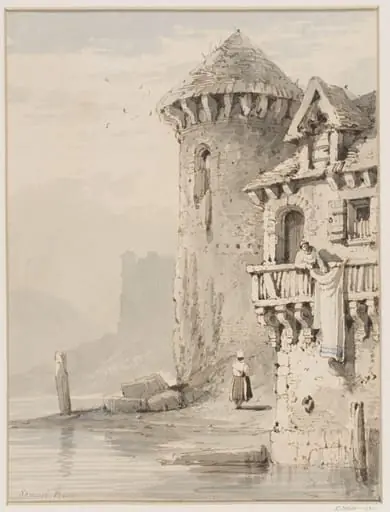 Drawing
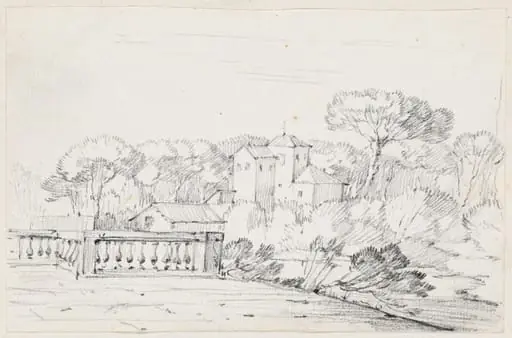 Terrace by a River with a Villa and Trees Beyond
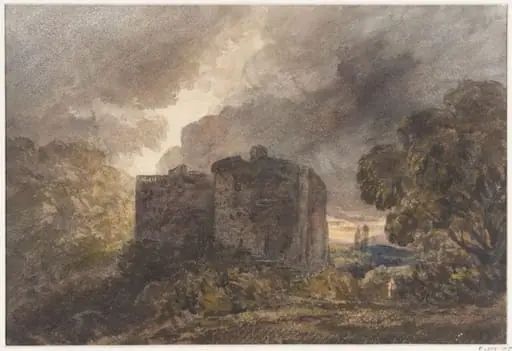 Landscape with Ruined Castle
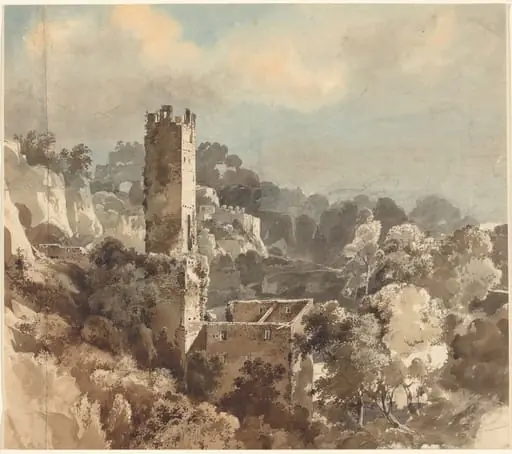 Ruins of a Fortified Tower among Wooded Hills
 Landscape with Castle on a Cliff