Artwork
Captain James Tod riding an elephant with his companions and escort
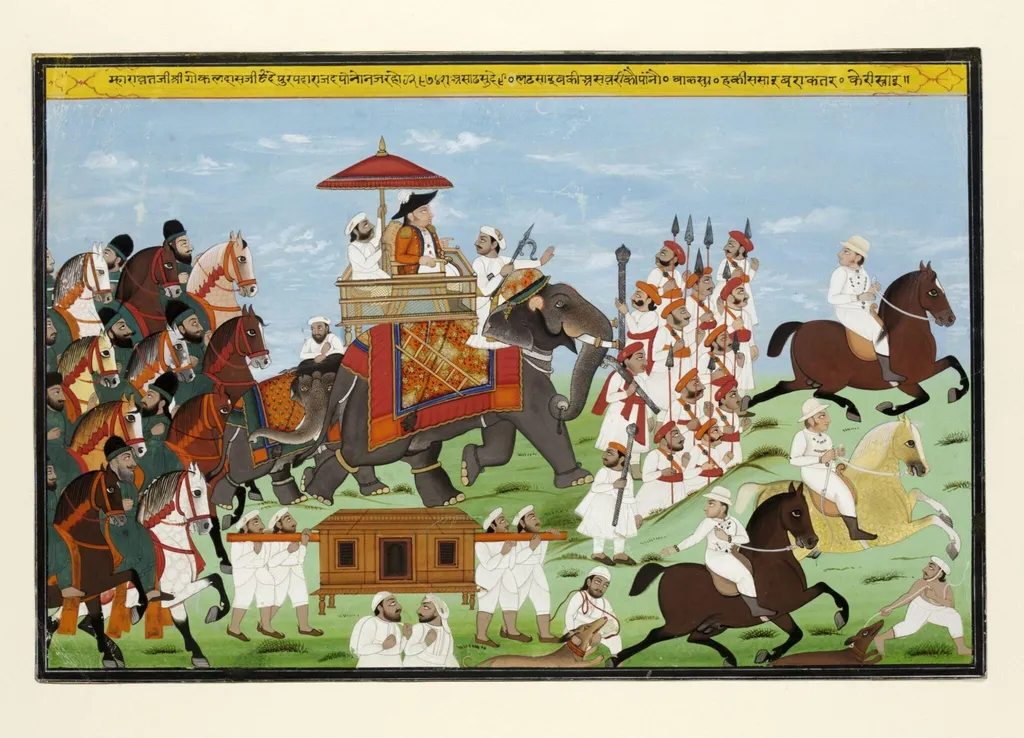
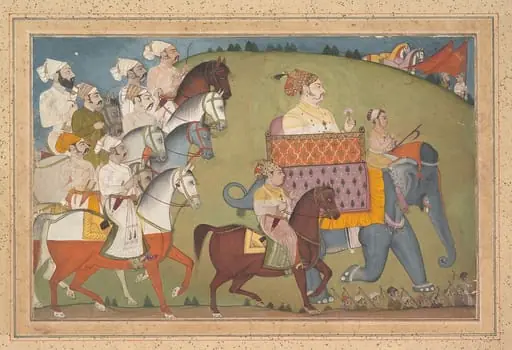
Captain James Tod riding an elephant with his companions and escort is a paint painting by the Romanticist artist Unknown. It dates from 1820 and is held in the collection of the Victoria and Albert Museum. This painting depicts Captain James Tod, later Colonel, seated atop an elephant during a procession through a rugged, vegetated landscape.
About this work
Overview
This painting depicts Captain James Tod, later Colonel, seated atop an elephant during a procession through a rugged, vegetated landscape.
This painting depicts Captain James Tod, later Colonel, seated atop an elephant during a procession through a rugged, vegetated landscape. He is accompanied by four British officers on horseback and a group of attendants carrying a palanquin. The scene reflects the movement of British officials through Rajput territories in the early 1800s. The work is likely a derivative version of a lost original by Chokha, produced by a local artist trained in the Udaipur style.
Subject & Meaning
The composition captures a moment of diplomatic travel, illustrating Tod’s role as a British agent navigating regional politics. His elevated position on the elephant, a symbol of authority in Indian courts, signals both status and cultural adaptation. The presence of local bearers and the palanquin suggests a hybrid form of procession, blending British military presence with indigenous ceremonial norms, reinforcing alliances through visual protocol.
Technique & Style
Executed in watercolor and opaque pigments, the painting follows the flattened perspective and detailed patterning typical of early 19th-century Rajasthani court art. Figures are rendered with precise linework, while the landscape is stylized rather than naturalistic. The use of muted greens and earth tones, along with the careful depiction of textiles and equipment, reflects the conventions of Udaipur workshops, though with less refinement than the attributed original by Chokha.
History & Provenance
The painting was presented to Rawat Gokul Das of Devgarh, indicating its function as a diplomatic gift or record of a visit. It is not the original composition but a contemporary copy, likely made by a lesser-known artist in Udaipur. The original, now in the Victoria and Albert Museum (IM.447-1914), is credited to Chokha, an artist active in both Udaipur and Devgarh, suggesting this version was produced to meet local demand for such imagery.
Context
During the early 1800s, British officers like Tod traveled extensively across Rajput states as political agents, often relying on local artists to document their journeys. These images served both as personal mementos and as tools of political representation. The blending of British figures within Indian artistic traditions reflects the complex cultural negotiations of colonial presence, where visual language became a medium of mutual recognition.
Legacy
This painting contributes to a small corpus of works that record British officials in Indian settings through indigenous artistic lenses. Though not by a major hand, its existence underscores the widespread circulation of Chokha’s compositions and the adaptability of regional workshops. It remains a tangible artifact of cross-cultural encounter, preserving the visual diplomacy of an era when British presence was negotiated through local customs and aesthetics.
Artist & collection

 Domestic Scene
 Giacomo and Cardinal Marco, investing Andrea, Abbot of San Zeno, with his Benefice
 The Nymph of Fontainebleau
 Portrait of a Woman
 Madonna and Child with Saints in the Enclosed Garden
 Venus and Minerva
 Family Group of Four on Sofa
 Wall painting from Room H of the Villa of P. Fannius Synistor at Boscoreale