Artwork
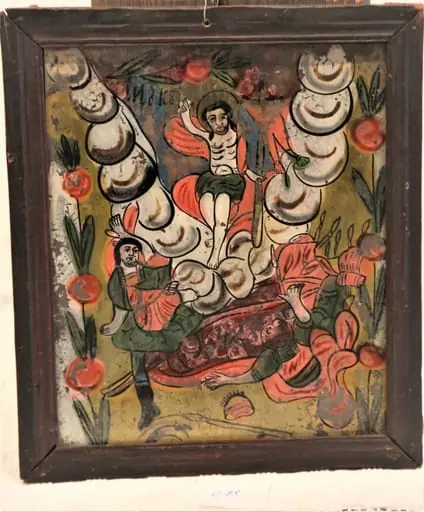
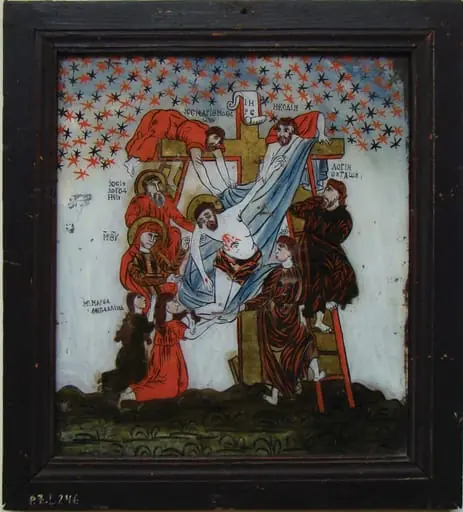
Coborârea de pe cruce
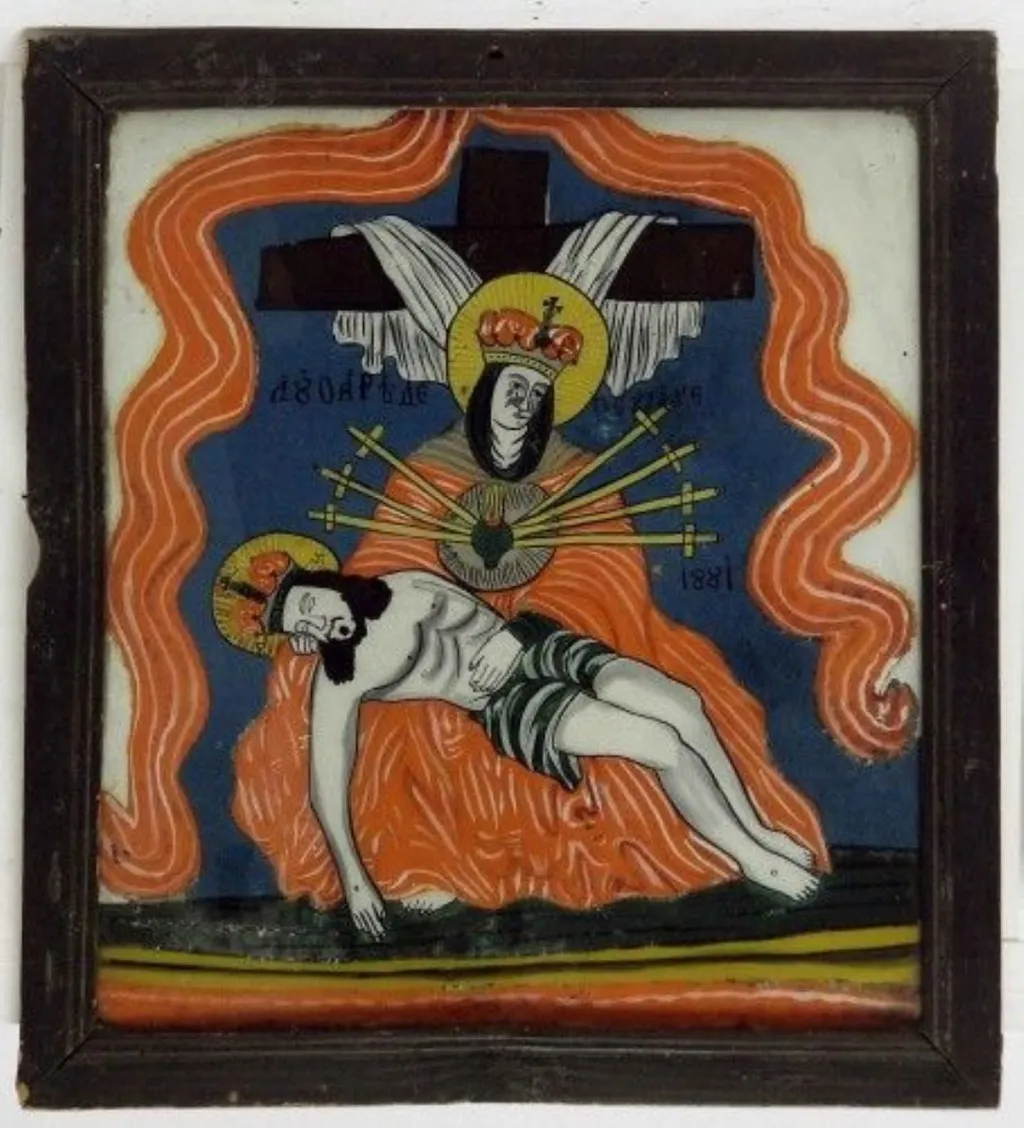
Coborârea de pe cruce is a drawing by the Impressionist artist Unknown. It dates from 1881 and is held in the collection of the Romanian Peasant Museum. The composition presents a reclined figure with arms extended, its head turned away, crowned with thorns.
About this work
Overview
The composition presents a reclined figure with arms extended, its head turned away, crowned with thorns. Hovering above is a second, radiant figure bearing a halo and a cross, its head surrounded by emanating rays. The backdrop consists of a vivid blue sky punctuated by orange‑white flames, rendered in a flattened, stylized manner that emphasizes symbolic over naturalistic representation.
Subject & Meaning
The prone figure is commonly interpreted as a representation of Christ after the crucifixion, his crown of thorns and turned gaze suggesting death or surrender. The hovering figure, illuminated and holding a cross, functions as a divine overseer, perhaps symbolizing the resurrected Christ or a celestial guardian, underscoring themes of sacrifice, redemption, and spiritual vigilance.
Technique & Style
The work employs a graphic, two‑dimensional approach, with bold color fields and minimal modeling. Flat planes of blue and fiery orange contrast sharply, while the halos and rays are suggested through simple line work rather than detailed shading, evoking a medieval or iconographic aesthetic rather than realistic depth.
Context
The visual language aligns with Eastern Orthodox iconography, where saints and Christ are often depicted with stylized halos, crowns of thorns, and symbolic fire. The use of a bright, unmodulated background and the lack of perspective reflect a devotional purpose, intended to convey theological ideas rather than depict a specific historical moment.
Legacy
While the piece’s authorship remains unidentified, its formal qualities echo a tradition of religious imagery that prioritizes symbolic clarity over naturalism. Such works continue to inform contemporary understandings of how visual shorthand can convey complex theological narratives within a concise visual framework.
Artist & collection

 Domestic Scene
 Giacomo and Cardinal Marco, investing Andrea, Abbot of San Zeno, with his Benefice
 The Nymph of Fontainebleau
 Portrait of a Woman
 Madonna and Child with Saints in the Enclosed Garden
 Venus and Minerva
 Family Group of Four on Sofa
 Wall painting from Room H of the Villa of P. Fannius Synistor at Boscoreale