Artwork
Răstignirea lui Iisus
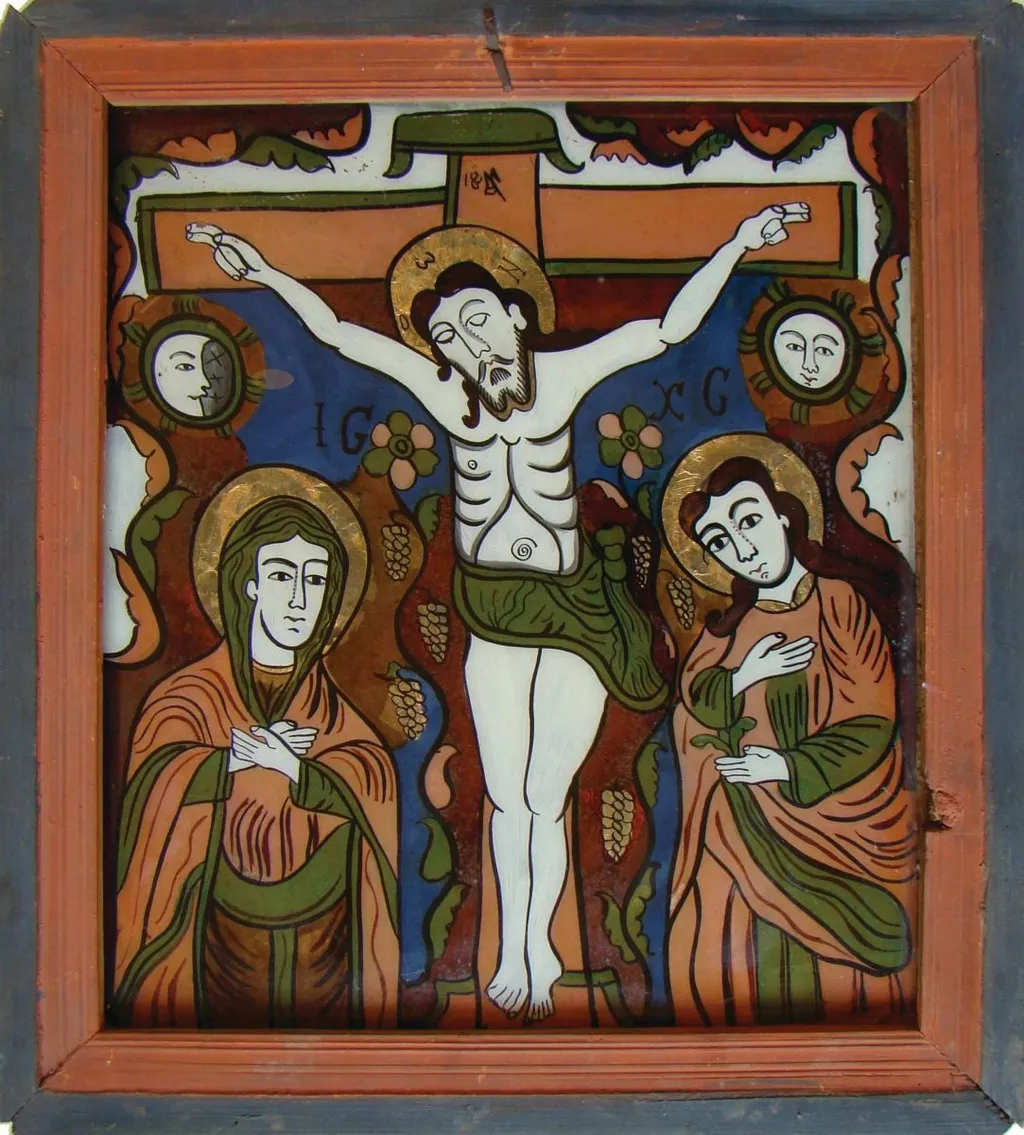
Răstignirea lui Iisus is a drawing by the Romanticist artist Unknown. It dates from 1827 and is held in the collection of the Alba Iulia Orthodox Archdiocese.
About this work
Overview
This painting depicts the crucifixion of Jesus Christ, rendered in a non-naturalistic style that emphasizes symbolic form over realistic representation.
This painting depicts the crucifixion of Jesus Christ, rendered in a non-naturalistic style that emphasizes symbolic form over realistic representation. The central figure is shown nailed to a vertical cross, flanked by two figures below who gaze upward. The composition is flattened, with no attempt at perspective or three-dimensional modeling. Bold outlines and vivid, unmodulated colors define the forms, creating a visual rhythm that prioritizes spiritual presence over physical realism.
Subject & Meaning
The scene portrays the moment of Christ’s crucifixion, a core event in Christian theology. The presence of halos around all three figures suggests their sacred status, possibly indicating the Virgin Mary and John the Apostle as witnesses. The stylized rendering and lack of emotional expression convey a sense of timeless solemnity rather than immediate suffering, aligning with devotional traditions that emphasize divine sacrifice over human pain.
Technique & Style
The artist employs flat planes of color, sharp contours, and minimal shading, rejecting chiaroscuro and anatomical accuracy. Gold halos encircle the heads, reinforcing holiness without naturalistic light sources. Background elements like stylized flowers and grapes are rendered as decorative motifs rather than realistic flora. The absence of cross-hatching or gradation creates a two-dimensional surface, characteristic of iconographic traditions that favor symbolic clarity over illusionistic depth.
History & Provenance
The work’s origin is undocumented, but its visual language aligns with late medieval or early Renaissance religious panel paintings from Eastern Europe or the Balkans. The use of gold leaf for halos and the simplified forms suggest influence from Byzantine iconography. It likely served a liturgical or private devotional purpose, though its specific commission, creator, and early ownership remain unknown.
Context
Created in a period when religious imagery prioritized spiritual instruction over naturalism, this work reflects a broader tradition in which sacred figures were depicted with standardized forms to aid contemplation. The bright, symbolic colors and flat composition echo liturgical art used in churches and homes, where clarity and reverence outweighed realism. Such images were meant to evoke faith, not to imitate the visible world.
Legacy
Though not attributed to a known master, the painting contributes to a continuum of devotional art that values symbolic representation. Its stylistic choices—flatness, halos, bold outlines—resonate with enduring ecclesiastical traditions across Eastern Christianity. It stands as an example of how religious narratives were preserved and transmitted through visual conventions, long after the rise of Renaissance naturalism.
Artist & collection
 Domestic Scene
 Giacomo and Cardinal Marco, investing Andrea, Abbot of San Zeno, with his Benefice
 The Nymph of Fontainebleau
 Portrait of a Woman
 Madonna and Child with Saints in the Enclosed Garden
 Venus and Minerva
 Family Group of Four on Sofa
 Wall painting from Room H of the Villa of P. Fannius Synistor at Boscoreale
 Înălțarea lui Iisus Hristos la ceruri; Răstignirea lui Iisus Hristos
 Necredința lui Toma
 Răstignirea și învierea Mântuitorului Iisus Hristos
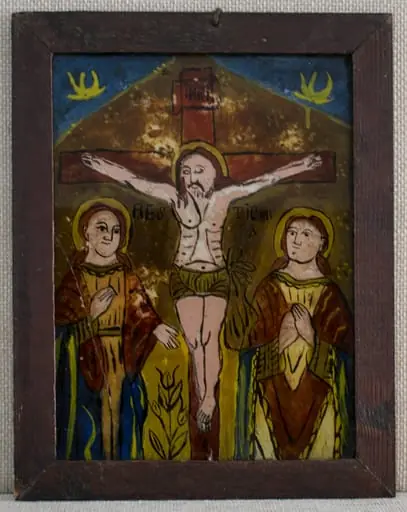 Icoana este pictată "în oglindă", pe un suport de sticlă de formă dreptunghiulară în ax vertical. Scena Răstignirii este redată într-o manieră specifică zonei Nicula - Gherla,(faza târzie, de decadență a acestei arte),după stil(în special desenul ochilor) putând fi atribuită lui Gheorghe Feur sau fiice sale Mariana. Crucea simplă, dreaptă, este axul de simetrie al compoziței, Isus răstignit are corpul destul de bine proporționat, anatomia studiată, ochii închiși, capul ușor aplecat pe umărul stâng, părul lung,castaniu roșcat, redat ca o meșă stângace, înconjurat de nimbul simplu, trasat cu mai mare atenție decât în icoanele vechi. În jurul mijlocului are un veșmânt bogat. De o parte și de alta a crucii, în prim plan, Fecioara Maria și Ioan Evanghelistul, 3/4, din ușor semiprofil, amândoi cu expresii nedefinite, fețele rotunde, diforme, bărbiile exagerat de mari. Vestimentația aproape identică, predomină roșul stins accentuat de alb și verdele amestecat cu albastru. Inscripția cu majuscule negre, dezordonat, sub brațele crucii se pierde pe fond. Câmpul în nuanțe de brun roșcat, voit sau din neglijență în degrade, se completează cu pământul galben violent(1/3 inferior) cu un contur de floare la baza crucii. Brațele crucii sunt delimitate într-un triunghi de culoare, făcând loc în colțurile superioare la două zone de albastru decorate cu o floare stilizată galbenă. Desenul nesigur este ușor estompat de cromatica ce încearcă o imitație(studiată sau nu) a realizărilor vechilor iconari de la Nicula. Rama, realizată din patru șipci de brad, culoare brun, îmbinate oblic la colțuri. Pe spate are bătut un dos din placaj. Colțul stâng este crăpat. Izvodul este identic cu cel utilizat la nr 27199.
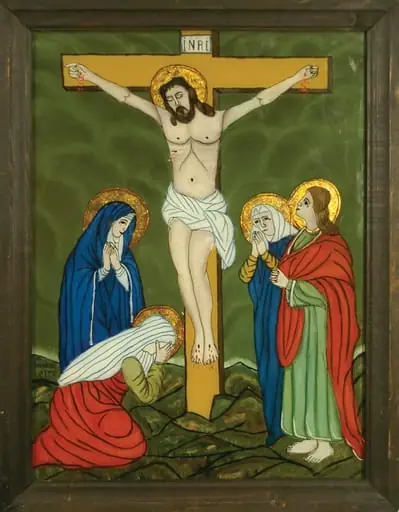 Răstignirea lui Iisus
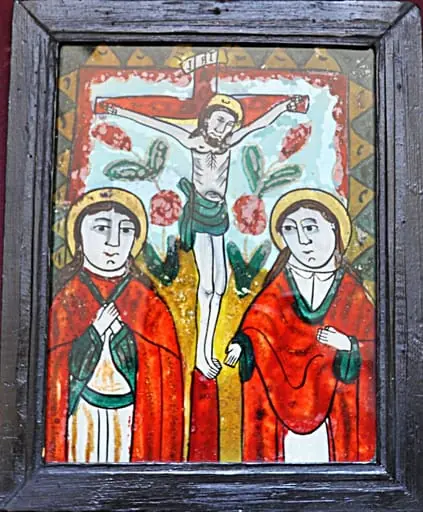 Isus pe cruce
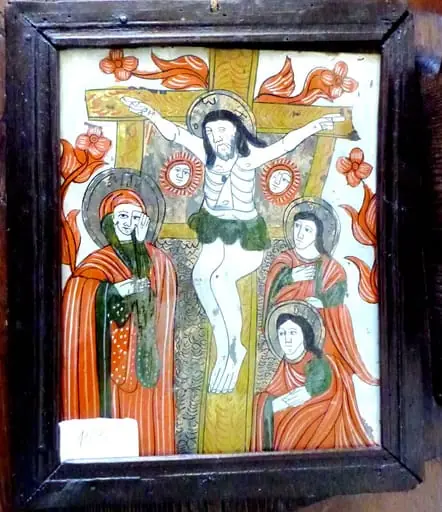 Răstigmirea