Artwork
Compositional Sketches after Raphael and other artists (verso)
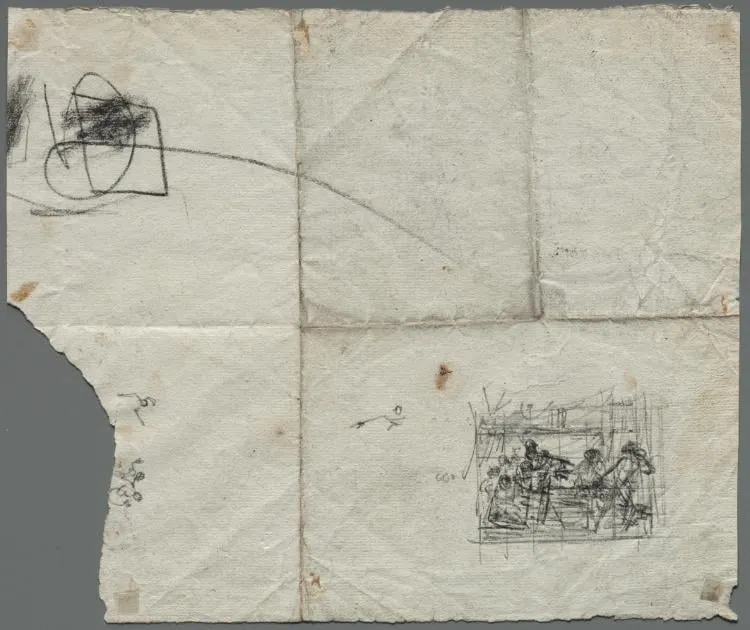
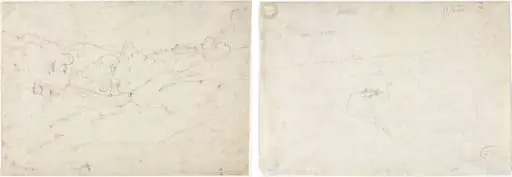
Compositional Sketches after Raphael and other artists (verso) is a drawing by the Romanticist artist Unknown. It dates from 1800 and is held in the collection of the Cleveland Museum of Art. A fragmentary sheet of paper bears faint, hurried drawings on its verso, likely from a study notebook.
About this work
Overview
One corner contains a small, indistinct group of figures, possibly a copied composition; the left side features ambiguous, non-representational marks.
A fragmentary sheet of paper bears faint, hurried drawings on its verso, likely from a study notebook. One corner contains a small, indistinct group of figures, possibly a copied composition; the left side features ambiguous, non-representational marks. The paper is damaged—torn at the edge and stained with brown discolorations—suggesting use, storage, or handling over time. Its modest scale and condition imply it was never intended as a finished work.
Subject & Meaning
The figures in the corner appear to be a reduced, approximate rendering of a larger composition, possibly derived from Raphael or another Renaissance master. Their simplified forms suggest an artist working through visual memory or practicing gesture and arrangement. The surrounding scribbles lack narrative or spatial coherence, indicating spontaneous annotation or trial lines rather than deliberate imagery.
Technique & Style
The drawing employs light, rapid strokes in a medium likely graphite or chalk, with minimal shading or detail. Forms are suggested rather than defined, reflecting an observational or rehearsal mode rather than polished execution. The loose handling and absence of contour precision align with preparatory sketching practices common among artists studying established compositions.
History & Provenance
The sheet’s condition—tears, stains, and wear—points to prolonged use and informal storage. No signature or inscription is visible, and its origin remains undocumented. It may have belonged to a student, assistant, or lesser-known artist engaged in copying Renaissance models during the 16th or 17th century, though its exact provenance is untraceable.
Context
During the Renaissance and early modern period, artists routinely used scraps and loose sheets to study compositions by masters like Raphael. These studies, often annotated or altered, served as pedagogical tools or memory aids. Such fragments were rarely preserved unless later recognized as evidence of artistic process, making this piece a quiet relic of habitual practice.
Legacy
Though unremarkable in isolation, this sketch reflects a widespread artistic habit: the reuse of materials for learning and experimentation. Its survival, despite damage and obscurity, offers insight into the informal, iterative nature of artistic training. It stands as a testament to the quiet labor behind canonical works, preserved not by design but by accident.
Artist & collection

 Domestic Scene
 Giacomo and Cardinal Marco, investing Andrea, Abbot of San Zeno, with his Benefice
 The Nymph of Fontainebleau
 Portrait of a Woman
 Madonna and Child with Saints in the Enclosed Garden
 Venus and Minerva
 Family Group of Four on Sofa
 Wall painting from Room H of the Villa of P. Fannius Synistor at Boscoreale
![Figure on Horseback and Other Studies [verso], by Winslow Homer](https://artifactworldgallery.com/img/winslow-homer--figure-on-horseback-and-other-studies-verso--3909dbf700a8f786-w320.webp)