Artwork
Derwentwater from Castle Crag
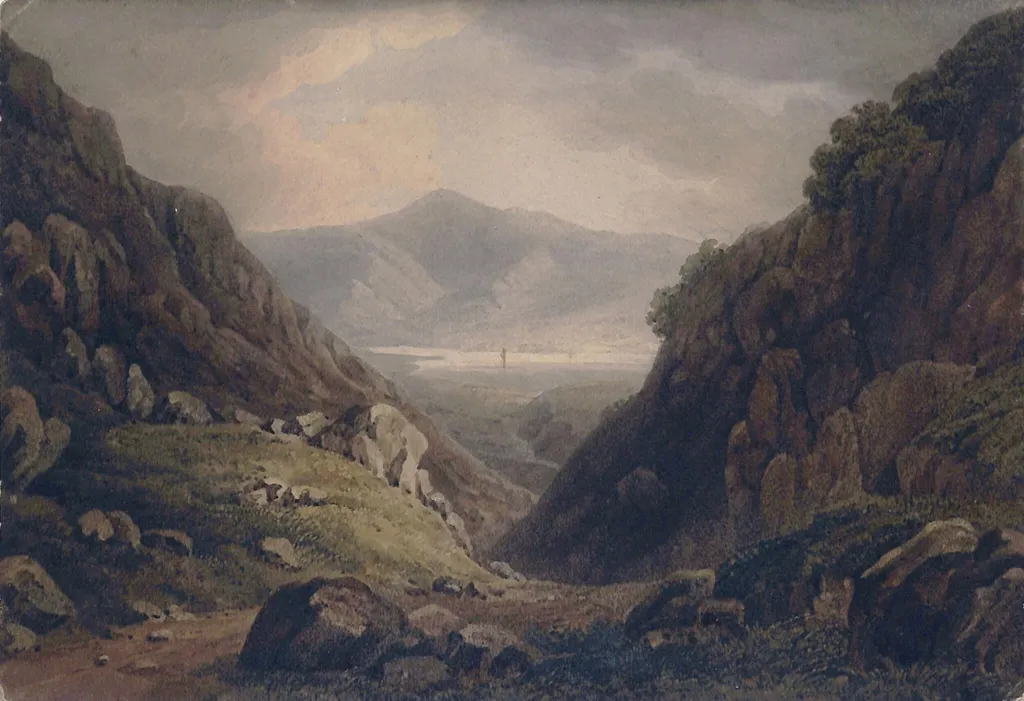
Derwentwater from Castle Crag is a watercolor work on paper by the Baroque artist Unknown. It dates from 1700 and is held in the collection of the Victoria and Albert Museum. This watercolour, dated around 1700, captures a view of Derwentwater from the slopes of Castle Crag in Cumbria’s Lake District.
About this work
Overview
The composition emphasizes natural forms, with the lake acting as a reflective ribbon through a narrow valley, framed by elevated terrain on either side.
This watercolour, dated around 1700, captures a view of Derwentwater from the slopes of Castle Crag in Cumbria’s Lake District. Executed in delicate washes, the work presents a quiet, unembellished landscape without human figures or architectural intrusion. The composition emphasizes natural forms, with the lake acting as a reflective ribbon through a narrow valley, framed by elevated terrain on either side.
Subject & Meaning
The scene offers a topographical record of a remote northern English valley, valued for its untouched character. There is no overt narrative or symbolic intent; instead, the painting functions as a visual observation, likely made during a personal excursion. The focus on geological structure and atmospheric conditions suggests an early interest in landscape as a subject worthy of careful study, independent of idealized or romanticized conventions.
Technique & Style
The artist employed transparent watercolour washes to build subtle tonal gradations, using muted earth tones—olive greens, soft browns, and cool grays—to render rock, foliage, and sky. Light is carefully modulated to suggest volume in the cliffs and depth in the valley. The water’s surface mirrors the sky’s pale clouds, enhancing spatial coherence. Brushwork is restrained, prioritizing atmospheric effect over detail, typical of early topographical watercolours.
History & Provenance
The work’s origin is undocumented, and the artist remains anonymous. It likely belonged to a private collector or amateur naturalist of the early 18th century, a period when watercolour was gaining use for recording landscapes outside formal artistic circles. Its survival suggests it was preserved as a personal record rather than a public commission. The Victoria and Albert Museum holds similar works from this era, indicating its place within a broader tradition of English topographical art.
Context
In the early 1700s, landscape depiction in Britain was shifting from idealized classical scenes toward direct observation of local terrain. This watercolour reflects that transition, aligning with growing interest in regional geography and natural history. Unlike continental traditions, British artists often worked in watercolour for its portability and immediacy, making it ideal for field studies in remote areas like the Lake District.
Legacy
Though unsigned and uncelebrated in its time, this work contributes to the foundation of British watercolour landscape practice. It exemplifies the quiet, observational approach that later artists like Turner and Constable would expand upon. Its preservation underscores the value placed on regional scenery during the formative years of landscape art in England, before the rise of the picturesque movement.
Artist & collection

 Domestic Scene
 Giacomo and Cardinal Marco, investing Andrea, Abbot of San Zeno, with his Benefice
 The Nymph of Fontainebleau
 Portrait of a Woman
 Madonna and Child with Saints in the Enclosed Garden
 Venus and Minerva
 Family Group of Four on Sofa
 Wall painting from Room H of the Villa of P. Fannius Synistor at Boscoreale
 Road leading to Pont Aberglaslyn: View looking into the Vale of Festiniog, North Wales
 Ghirimeer on the Upper Lake of Killarney
 River scene: cattle in shallows
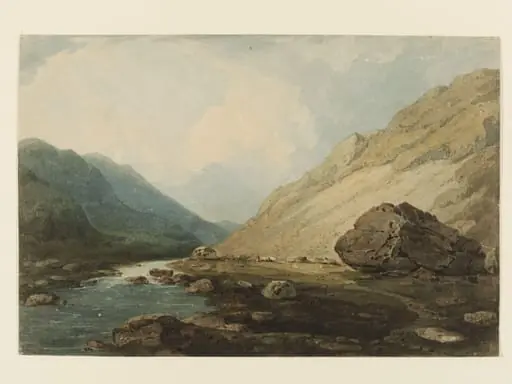 View in the Pass of Llanberis, Wales
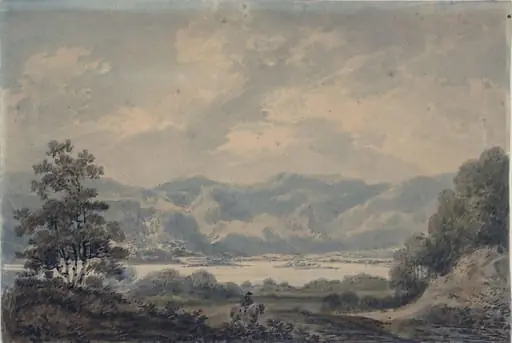 Windermere
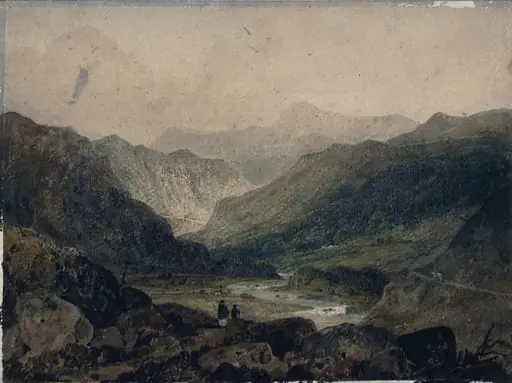 Distant View of Snowdon
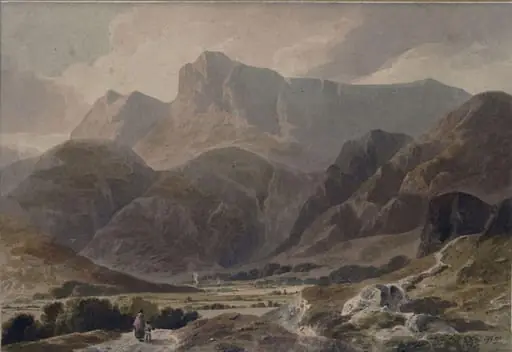 Langdale Pikes in Cumbria
![Landscape View [?in North Wales], by John Glover](https://artifactworldgallery.com/img/john-glover--landscape-view-in-north-wales--a6780e3d0b73ec67-w320.webp) Landscape View [?in North Wales]
Landscape View [?in North Wales]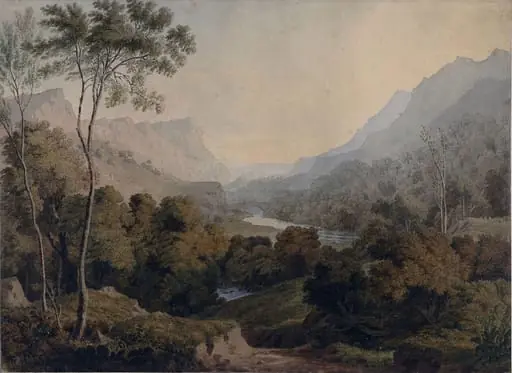 View on the Conwy, near Llanwrstm, Carnarvonshire
 Loch Awe and Ben Cruachan