Artwork
Durga and Ganesha
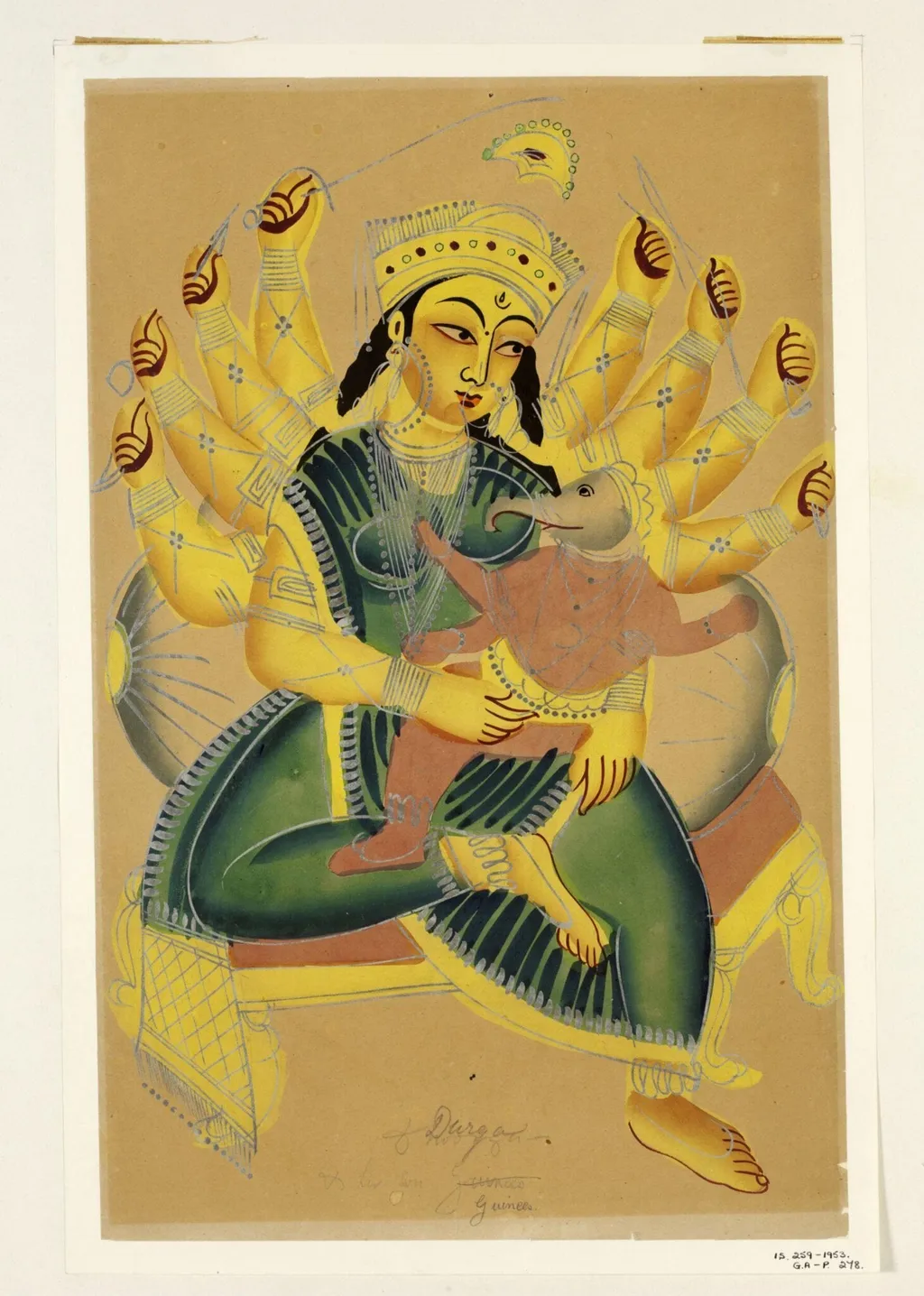
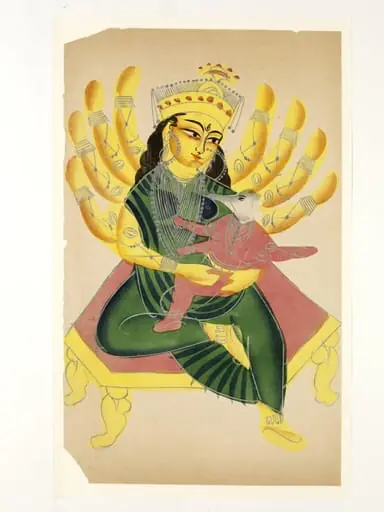
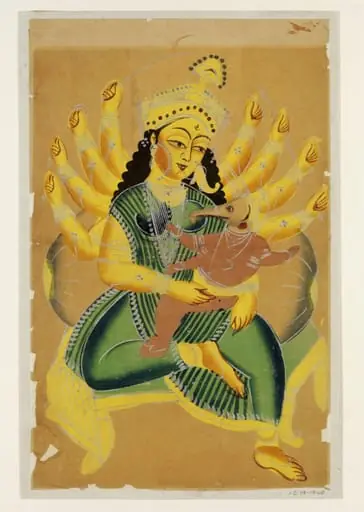
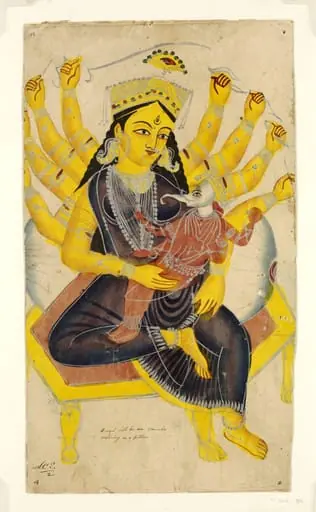
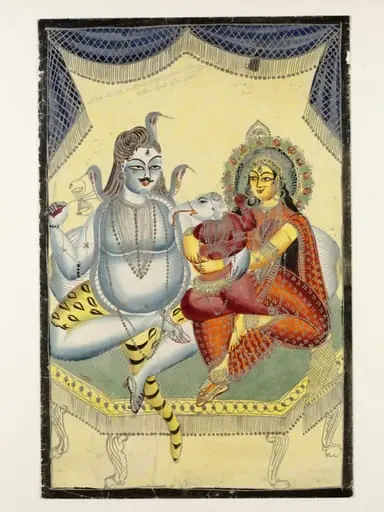
Durga and Ganesha is a paint painting by the Impressionist artist Unknown. It dates from 1880 and is held in the collection of the Victoria and Albert Museum. This 1880 painting, executed in opaque watercolour and tin alloy on paper, depicts the Hindu goddess Durga cradling her son Ganesha.
About this work
Overview
This 1880 painting, executed in opaque watercolour and tin alloy on paper, depicts the Hindu goddess Durga cradling her son Ganesha. Originating from the Kalighat tradition in Bengal, it reflects a devotional subject rendered with local artistic conventions. The use of tin alloy for jewelry adds a metallic sheen, distinguishing it from typical pigment-only works of the period.
Subject & Meaning
Durga, a powerful deity symbolizing protection and cosmic order, is shown holding Ganesha, the remover of obstacles and god of wisdom. Their intimate embrace conveys divine maternal care, blending strength with tenderness. The composition reinforces their familial bond within Hindu cosmology, where divine figures often appear in relational contexts rather than isolated heroism.
Technique & Style
Bold outlines and flattened space reflect the influence of folk and scroll painting traditions, prioritizing symbolic clarity over naturalism.
The artist employed opaque watercolour for the figures and background, with tin alloy applied to Durga’s jewelry and arm ornaments to create reflective highlights. The green sari with silver detailing and the yellow-hued skin tones follow Kalighat’s stylized palette. Bold outlines and flattened space reflect the influence of folk and scroll painting traditions, prioritizing symbolic clarity over naturalism.
History & Provenance
Produced in the Kalighat neighborhood of Kolkata, this work likely originated as a devotional object or pilgrim souvenir sold near the Kalighat Temple. Such paintings were made rapidly by artisan families for a local, predominantly Hindu clientele. The use of tin alloy suggests a deliberate enhancement for visual impact, possibly to appeal to worshippers seeking luminous representations of the divine.
Context
In late 19th-century Bengal, Kalighat paintings emerged as a response to urbanization and changing religious practices. Artists adapted traditional iconography for a growing middle class, blending mythological themes with accessible aesthetics. This piece reflects a moment when sacred imagery was being reimagined for domestic and commercial spaces, distinct from temple sculpture or manuscript illumination.
Legacy
Works like this helped preserve and disseminate Hindu iconography during colonial rule, influencing later revivals of Indian folk art. Though initially dismissed as commercial, Kalighat paintings are now recognized for their expressive economy and cultural resonance. This piece exemplifies how devotional art adapted to new materials and audiences without losing its spiritual core.
Artist & collection

 Domestic Scene
 Giacomo and Cardinal Marco, investing Andrea, Abbot of San Zeno, with his Benefice
 The Nymph of Fontainebleau
 Portrait of a Woman
 Madonna and Child with Saints in the Enclosed Garden
 Venus and Minerva
 Family Group of Four on Sofa
 Wall painting from Room H of the Villa of P. Fannius Synistor at Boscoreale