Artwork
Durga and Mahishasura
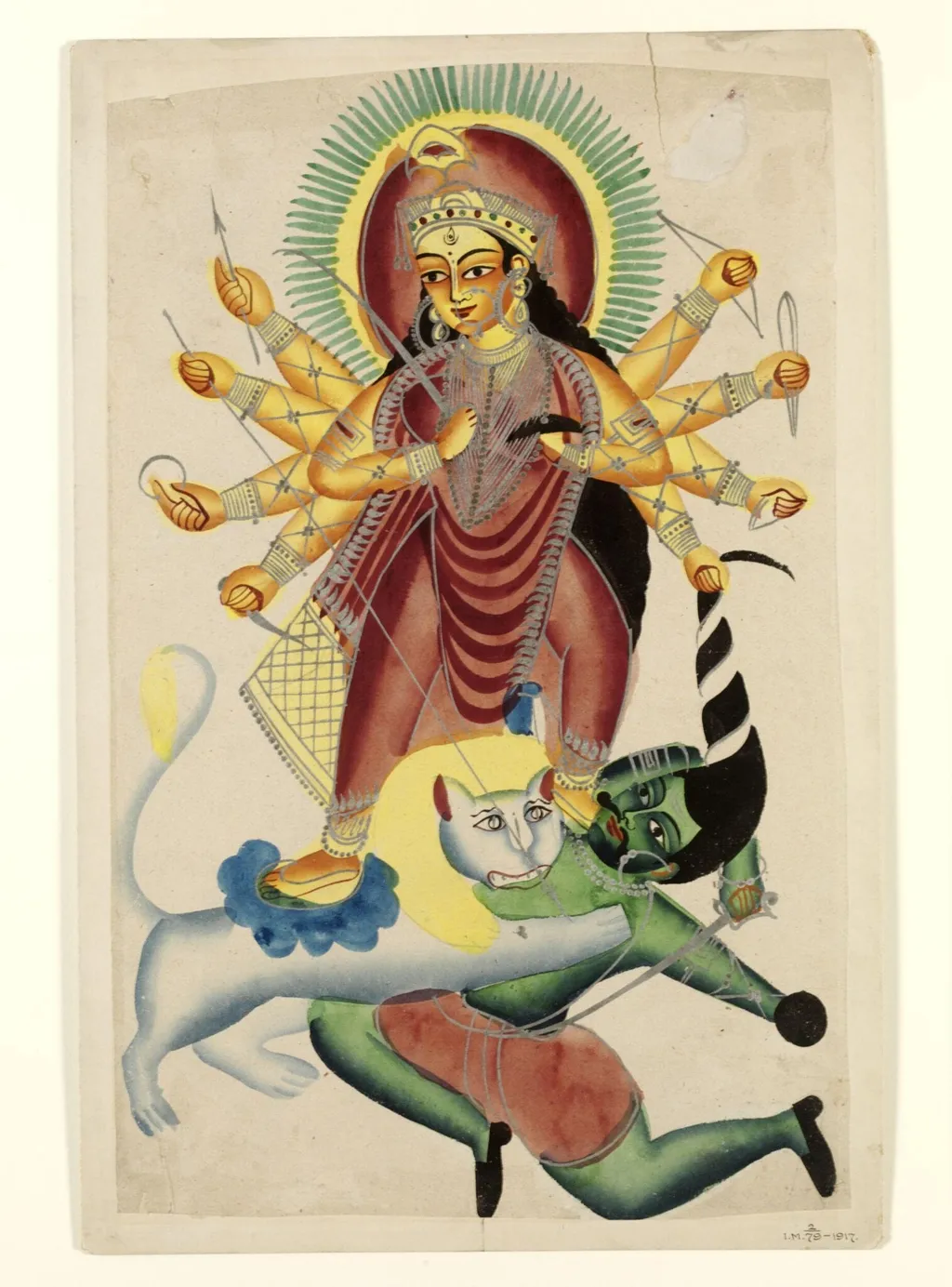
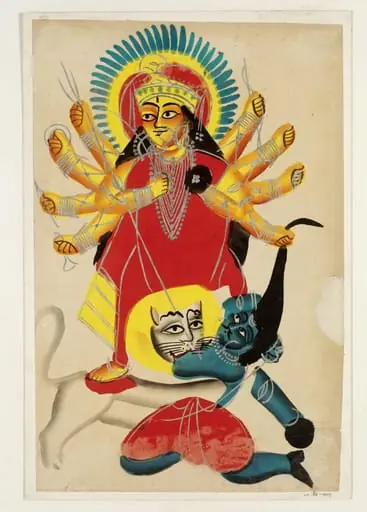
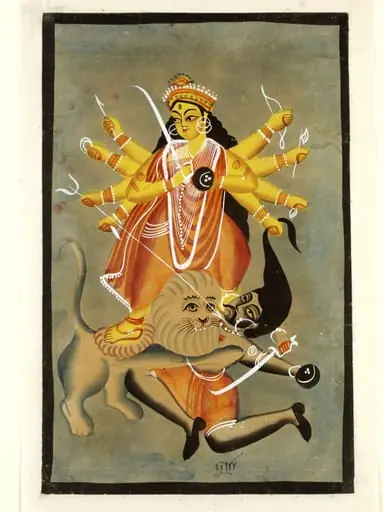
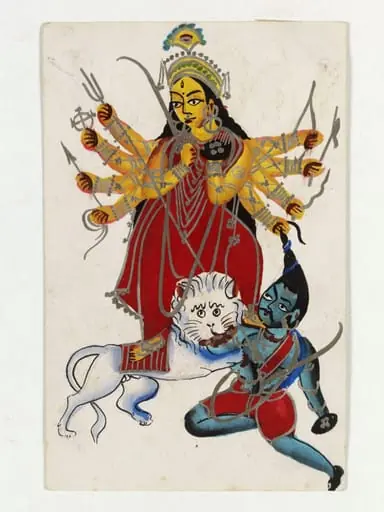
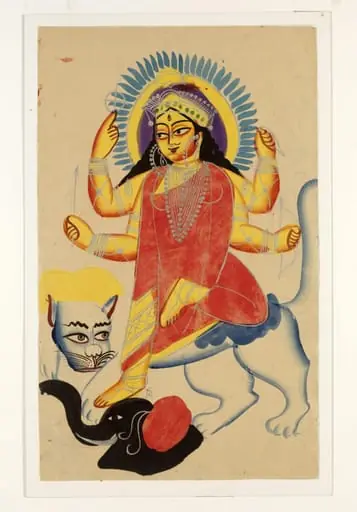
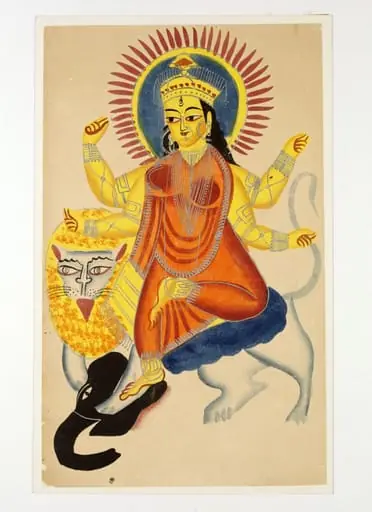
Durga and Mahishasura is a paint painting by the Impressionist artist Unknown. It dates from 1855 and is held in the collection of the Victoria and Albert Museum. This 1855 painting depicts the Hindu goddess Durga defeating the buffalo demon Mahishasura.
About this work
Overview
This 1855 painting depicts the Hindu goddess Durga defeating the buffalo demon Mahishasura. Executed in opaque watercolour with tin alloy on paper, it belongs to a collection assembled by J. Lockwood Kipling between 1865 and 1893. The album, containing works sourced from bazaars and fairs across Upper India and Bengal, was later donated to a museum by his son, Rudyard Kipling, in 1917.
Subject & Meaning
The lion at her side, a traditional emblem of her authority, attacks the demon, reinforcing the triumph of dharma over adharma.
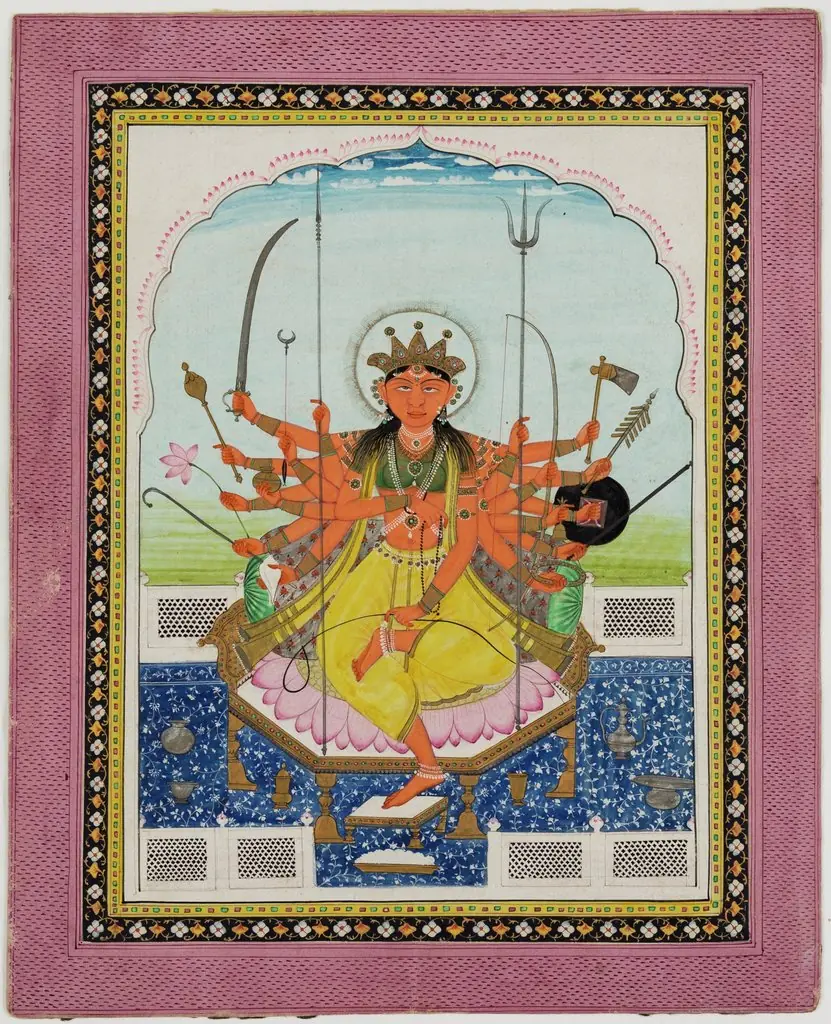
The scene illustrates a pivotal moment from Hindu mythology: Durga, the warrior goddess, vanquishing Mahishasura, a shape-shifting demon who had usurped divine order. Her eight arms brandish weapons gifted by gods, symbolizing collective cosmic power. The lion at her side, a traditional emblem of her authority, attacks the demon, reinforcing the triumph of dharma over adharma. Her serene expression contrasts with the demon’s agony, emphasizing divine composure amid violence.
Technique & Style
The painting employs opaque watercolour and tin alloy to achieve luminous, flat planes of color, typical of regional Indian miniature traditions. Bold outlines and vivid hues define the figures, while the background’s muted brown provides contrast. The composition is hierarchical and symbolic rather than naturalistic; depth is suggested through layering, not chiaroscuro. The style reflects indigenous pictorial conventions, not Western Impressionism.
History & Provenance
Created in the mid-19th century, the painting was acquired by J. Lockwood Kipling during his time in India, where he collected vernacular artworks from local markets. He compiled these into a personal album, documenting regional visual culture. After his death, his son Rudyard Kipling donated the entire collection to a museum in 1917, preserving a rare archive of popular Indian art from the colonial era.
Context
This work emerged during a period when Indian artists adapted traditional iconography for commercial and devotional markets. Paintings of Durga slaying Mahishasura were especially popular during Durga Puja festivals in Bengal. The use of tin alloy suggests a local technique to enhance pigment durability and sheen, reflecting artisanal innovation within regional workshops rather than elite court traditions.
Legacy
The painting survives as part of a significant colonial-era collection that documented indigenous art forms before systematic museum acquisition practices emerged. Its inclusion in the Kipling album highlights early efforts to preserve vernacular visual culture. Today, it serves as a reference for understanding 19th-century Indian artistic production and the transmission of religious imagery beyond temple walls.
Artist & collection

 Domestic Scene
 Giacomo and Cardinal Marco, investing Andrea, Abbot of San Zeno, with his Benefice
 The Nymph of Fontainebleau
 Portrait of a Woman
 Madonna and Child with Saints in the Enclosed Garden
 Venus and Minerva
 Family Group of Four on Sofa
 Wall painting from Room H of the Villa of P. Fannius Synistor at Boscoreale