Artwork
End elevation of the cenotaph of Akbar. Sikandra.
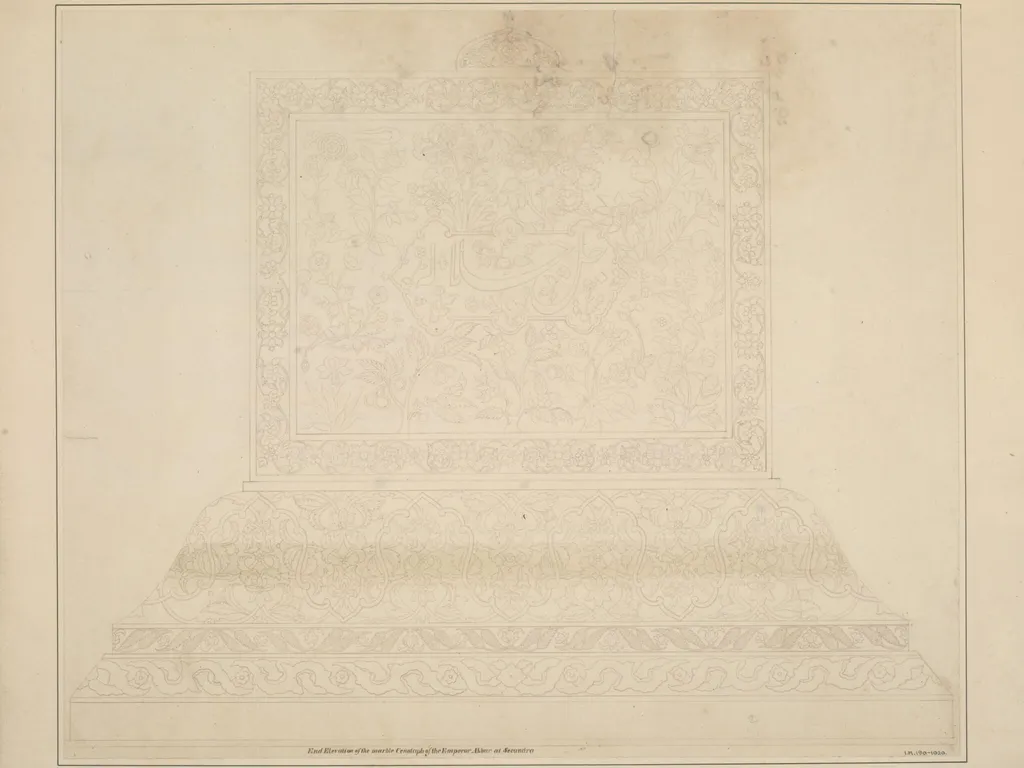
End elevation of the cenotaph of Akbar. Sikandra. is a drawing by the Romanticist artist Unknown. It dates from 1819 and is held in the collection of the Victoria and Albert Museum.
About this work
Overview
This architectural drawing captures the rear elevation of Akbar’s cenotaph at Sikandra, one of fifteen illustrations commissioned in the early 19th century.
This architectural drawing captures the rear elevation of Akbar’s cenotaph at Sikandra, one of fifteen illustrations commissioned in the early 19th century. Produced by artists based in Calcutta, originally from Delhi, the work was created under the patronage of Colonel Pownell Phipps between 1816 and 1822. It belongs to a systematic visual record of Mughal monuments in Agra, reflecting colonial-era efforts to document India’s architectural heritage with precision and clarity.
Subject & Meaning
The drawing presents the back face of Akbar’s marble tomb, a structure meant to honor the Mughal emperor’s legacy. Though the cenotaph itself is ornate, the sketch emphasizes structural form over decoration, focusing on symmetry and proportion. The label identifies it as an elevation, indicating its function as a technical record rather than an artistic interpretation. It serves as a measured representation of a monument central to Mughal funerary tradition.
Technique & Style
Executed in fine, light ink lines, the drawing resembles an architectural blueprint. The artist rendered the marble surface with restrained detail, highlighting the geometric base and the vine-like border with delicate precision. Curved elements beneath the main platform are suggested rather than fully modeled, maintaining clarity. The absence of shading or color underscores its documentary purpose, prioritizing accuracy over aesthetic embellishment.
History & Provenance
The drawing was produced by Delhi-trained artists working in Calcutta during the British East India Company’s expansion. Commissioned by Colonel Pownell Phipps, it became part of a portfolio later donated by his son, Colonel R.W. Phipps. The collection entered institutional holdings as a valuable record of Mughal architecture at a time when many structures were deteriorating or being altered under colonial administration.
Context
Created during a period of heightened British interest in Indian antiquities, this drawing reflects early 19th-century antiquarian practices. Similar records were made of Agra’s forts, mosques, and tombs, often for administrative or scholarly use. The focus on elevation views—rather than panoramic scenes—reveals a preference for structural documentation, aligning with surveying traditions emerging in colonial India.
Legacy
As part of a larger set of architectural studies, this drawing contributes to the historical archive of Mughal monuments before extensive 19th-century restorations. Its methodical approach influenced later documentation efforts by institutions like the Archaeological Survey of India. Today, it remains a key reference for scholars studying the original form of Akbar’s tomb and the evolution of colonial visual scholarship.
Artist & collection

 Domestic Scene
 Giacomo and Cardinal Marco, investing Andrea, Abbot of San Zeno, with his Benefice
 The Nymph of Fontainebleau
 Portrait of a Woman
 Madonna and Child with Saints in the Enclosed Garden
 Venus and Minerva
 Family Group of Four on Sofa
 Wall painting from Room H of the Villa of P. Fannius Synistor at Boscoreale
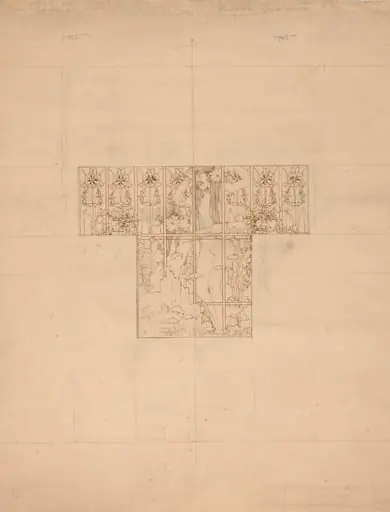 Nude and Fish with Flowers (Study for etched bathroom window)
![Sheet of Studies [recto and verso], by John Flaxman](https://artifactworldgallery.com/img/john-flaxman--sheet-of-studies-recto-and-verso--f6a63f702efb4c37-w320.webp) Sheet of Studies [recto and verso]
Sheet of Studies [recto and verso]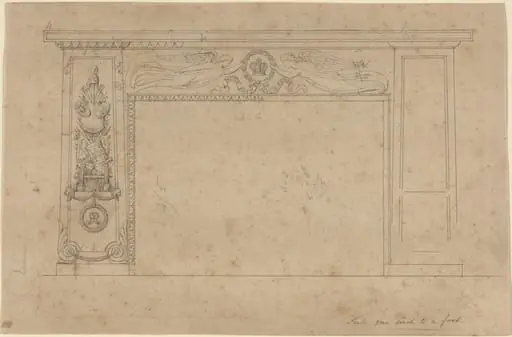 Design for the Chimney Piece in the Throne Room, Buckingham Palace
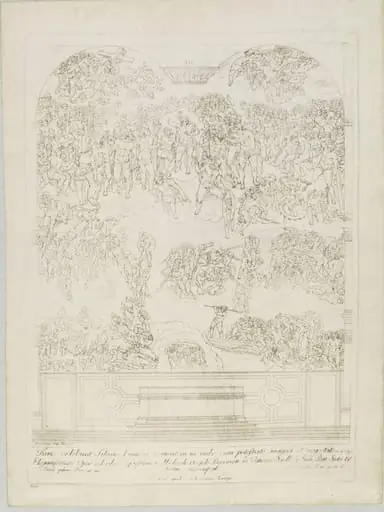 Last Judgment
 Untitled
 Untitled
 Structure with Figures in Asian Dress (Illustration for “The Casket”?)
 Untitled
![Study of an Interior [verso], by Walter Shirlaw](https://artifactworldgallery.com/img/walter-shirlaw--study-of-an-interior-verso--ae90136ae4907dbf-w320.webp) Study of an Interior [verso]
Study of an Interior [verso] Souhaits (Aspirations)
 Border from a Farhang-i Jahangiri Manuscript
 Design for Monument or Metalwork