Artwork
Design for the Chimney Piece in the Throne Room, Buckingham Palace
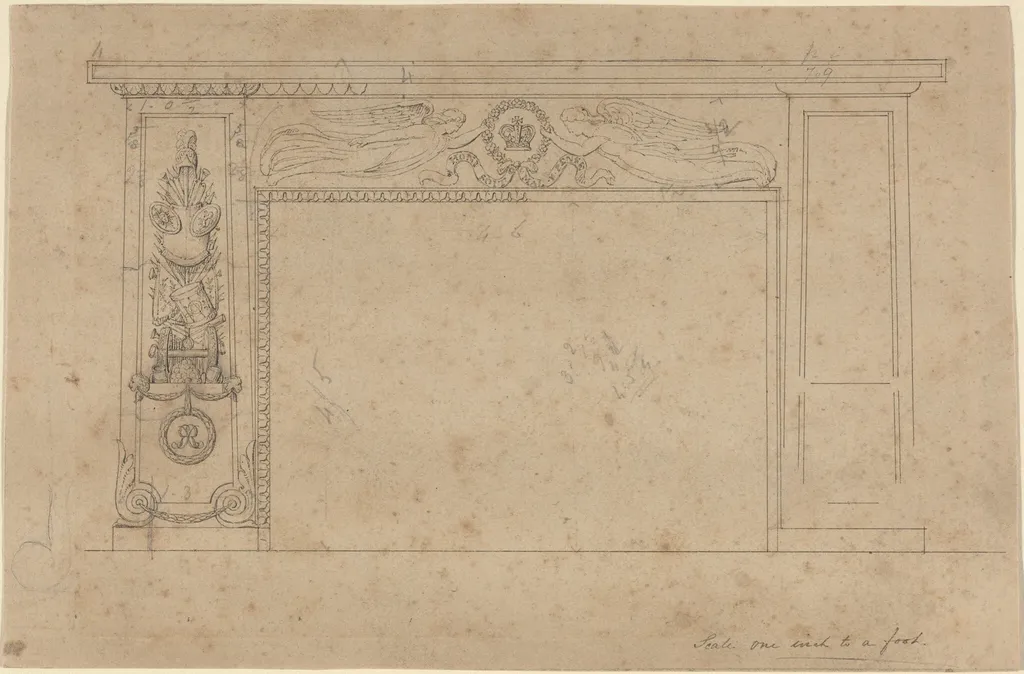
Design for the Chimney Piece in the Throne Room, Buckingham Palace is an ink drawing by the Romanticist artist John Flaxman. It dates from 1823 and is held in the collection of the National Gallery of Art.
About this work
Overview
John Flaxman’s 1823 drawing presents a detailed plan for a chimney piece intended for the throne room of Buckingham Palace. Executed in pen and black ink on light paper, the design outlines an elaborate fireplace surrounded by classical architectural elements, with dimensions noted as a scale of one inch to one foot, indicating a substantially larger finished work.
Subject & Meaning
The composition features tall, fluted columns capped by ornamental swirls and a crown, framing the central hearth. Above the fireplace, two winged lions guard a shield bearing a lion, reinforcing the regal and ceremonial character appropriate for a royal audience chamber.
Technique & Style
Flaxman employs his characteristic linear precision, using fine ink lines to convey depth and ornamentation without shading. The drawing reflects his neoclassical vocabulary, honed during his early modeling for Wedgwood and later illustrated work in Rome, emphasizing clear contours and classical motifs.
History & Provenance
Created during Flaxman’s mature period as a leading English artist, the sketch was produced for the redesign of Buckingham Palace’s throne room. The work remains a testament to his involvement in architectural projects beyond sculpture, illustrating his role in shaping official British interiors in the early nineteenth century.
Context
At the time, neoclassicism dominated British decorative arts, and Flaxman’s designs were sought after for their adherence to classical order and symbolism. The inclusion of heraldic elements such as crowns and lions aligns with contemporary expectations for royal spaces, linking architecture to monarchical identity.
Artist & collection
Artist
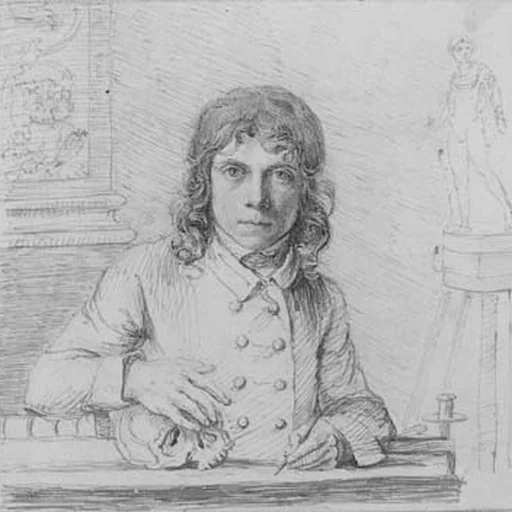
John Flaxman (6 July 1755 – 7 December 1826) was an English sculptor and draughtsman who was a leading figure in British and European Neoclassicism.

 Structure with Figures in Asian Dress (Illustration for “The Casket”?)
 Designs for Monuments
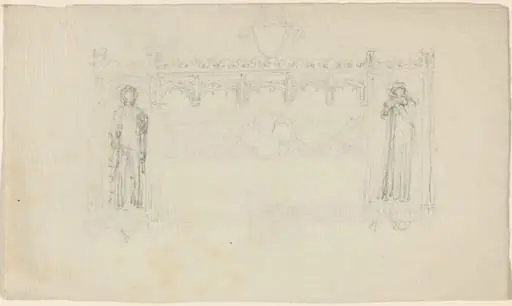 Design for the Simcoe Monument, Exeter Cathedral
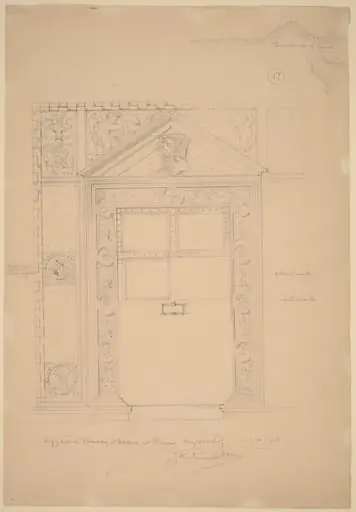 Byzantine Doorway with Duomo, Rimini
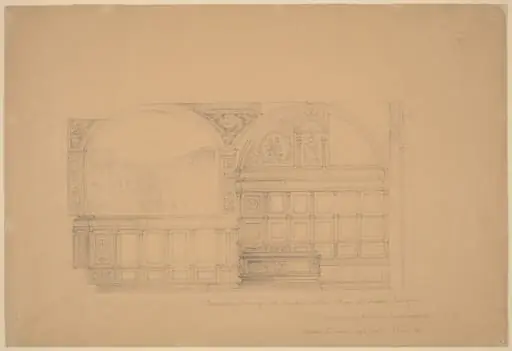 Perugino's Udienza del Cambio in the Collegio del Cambio, Perugia
 Untitled
 Studies for a Monument
 Studies of Fountain Decorations
 Drawing attributed to Pugin
 Two Architectural Studies