Artwork
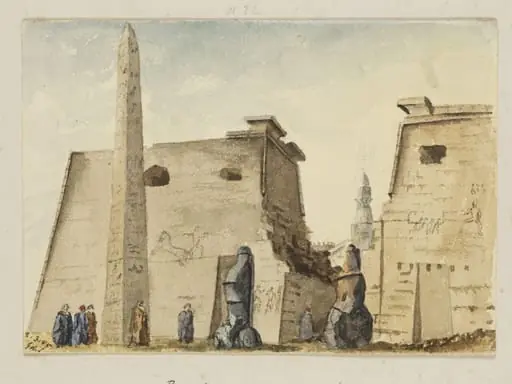
Entry of Palace of Luxor, formerly Thebes
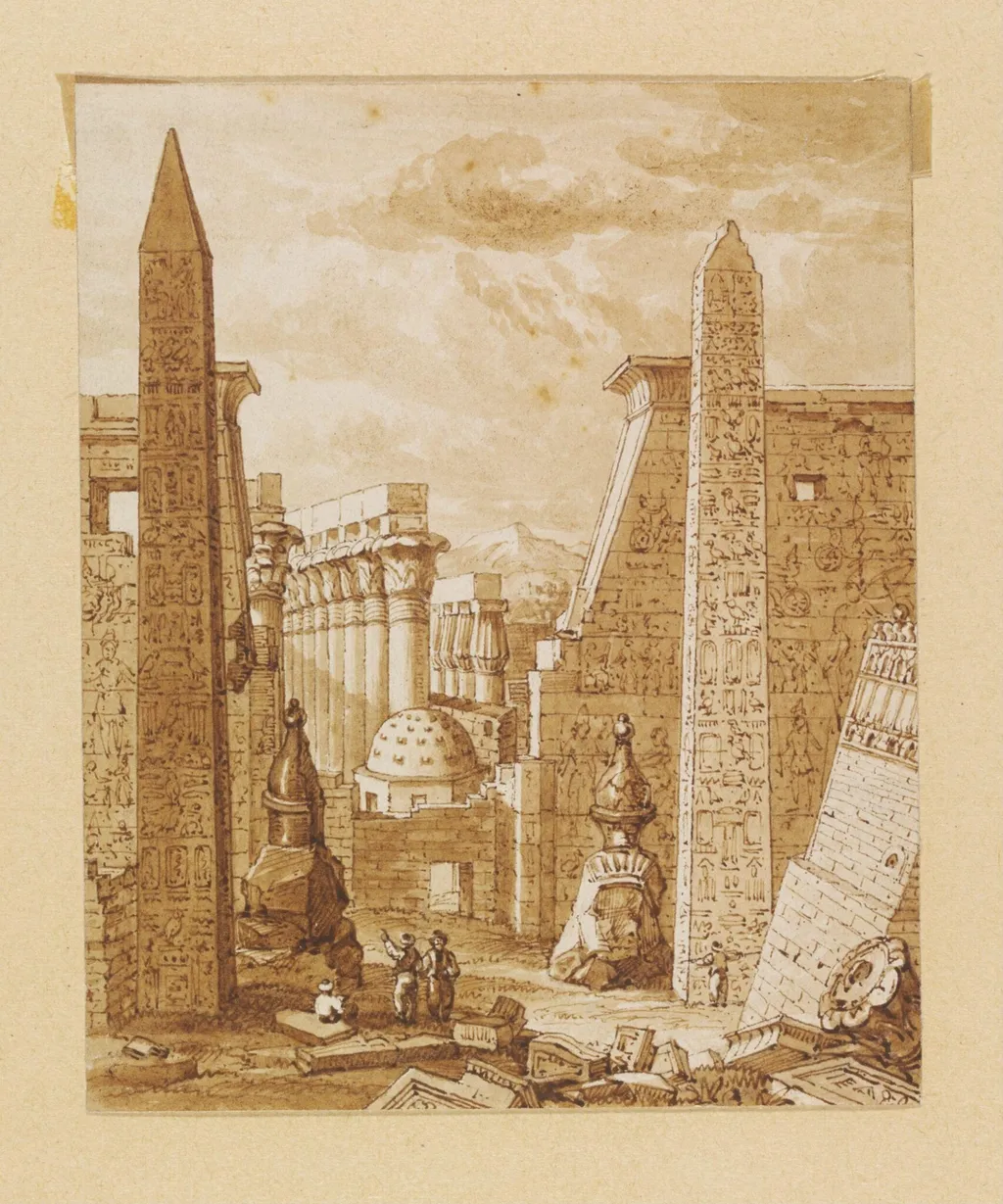
Entry of Palace of Luxor, formerly Thebes is a drawing by the Romanticist artist Unknown. It dates from 1830 and is held in the collection of the Victoria and Albert Museum.
About this work
Overview
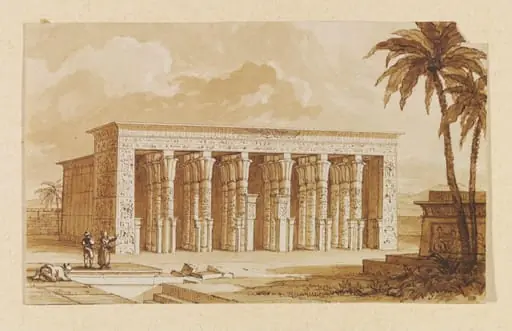
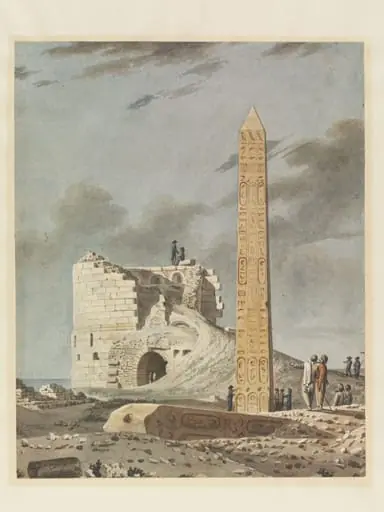
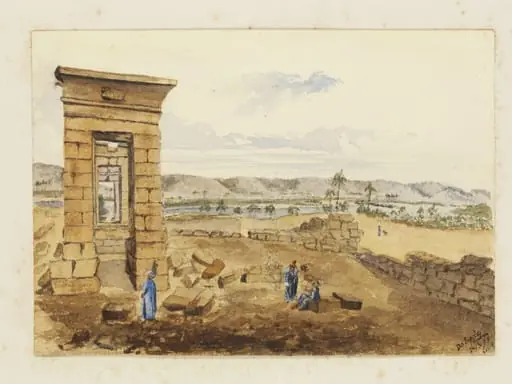
This drawing is one of seven preparatory sketches created for the title page of Revd Michael Russell’s 1831 book, *View of Ancient and Modern Egypt*.
This drawing is one of seven preparatory sketches created for the title page of Revd Michael Russell’s 1831 book, *View of Ancient and Modern Egypt*. It reproduces an engraving from the *Description de l'Égypte*, specifically Volume III, Plate 3. Though once attributed to Joseph Schranz, the work is now understood as a copy made from published sources rather than an original field study. Its purpose was illustrative, supporting a scholarly text on Egypt’s historical landscape.
Subject & Meaning
The scene portrays the entrance to the ancient Temple of Luxor, once part of Thebes, with two towering obelisks flanking a ruined pylon. Broken columns, scattered stone blocks, and a small domed structure suggest decay and abandonment. Figures scattered across the foreground—some kneeling, others standing—imply pilgrimage or study, reinforcing the site’s enduring cultural resonance. The drawing emphasizes ruin as a vessel of memory, not grandeur.
Technique & Style
Executed in fine linear draftsmanship, the drawing meticulously renders the hieroglyphic carvings on the obelisks and the weathered textures of stone. The composition is orderly, with vertical elements dominating to convey monumentality. Distant mountains and a muted sky provide scale without distraction. The artist prioritized architectural detail over atmospheric effect, reflecting a documentary intent rather than romantic interpretation.
History & Provenance
The drawing originated as part of a series commissioned for Russell’s 1831 publication, drawing directly from the *Description de l'Égypte*, the French state-sponsored survey of Egypt after Napoleon’s campaign. The engravings it references were credited to Branston. The work entered the Victoria and Albert Museum’s collection as part of its broader holdings in 19th-century topographical drawings, though its exact provenance before acquisition remains undocumented.
Context
In the early 1830s, European interest in ancient Egypt surged following the publication of the *Description de l'Égypte*. Scholars and publishers sought to disseminate its findings through accessible illustrations. Russell’s book, supported by these sketches, catered to a growing audience of antiquarians and clergy interested in biblical and classical antiquity. This drawing reflects the era’s trend of reinterpreting archaeological sources through print culture.
Legacy
Though not an original fieldwork drawing, this piece exemplifies how 19th-century publications relied on mediated visual sources to shape public understanding of ancient sites. Its presence in the Victoria and Albert Museum underscores its role in the transmission of Egyptological imagery. It remains a quiet testament to the mechanics of knowledge production in an age before photography, where drawing served as both record and reinterpretation.
Artist & collection

 Domestic Scene
 Giacomo and Cardinal Marco, investing Andrea, Abbot of San Zeno, with his Benefice
 The Nymph of Fontainebleau
 Portrait of a Woman
 Madonna and Child with Saints in the Enclosed Garden
 Venus and Minerva
 Family Group of Four on Sofa
 Wall painting from Room H of the Villa of P. Fannius Synistor at Boscoreale