Artwork
Farfurie mare, de formă aplatizată, modelată la roata olarului și angobată cu humă albă pe fața interioară. Decorul este realizat prin pictare cu pensula și cu cornul și constă în motive florale și vegetale stilizate (un buchet de flori cu boboci, de culoare albastru și galben și frunze de culoare verde, desenate cu contur fin, de culoare maro, buchet ce este înscris într-un cerc de culoare albastră) și motive geometrice (linii sub formă de cerc, linie ondulată, ce decorează buza farfuriei). Cromatica: alb, albastru, verde, galben. Fața ornamentată a farfuriei este acoperită cu un strat de smalț transparent.
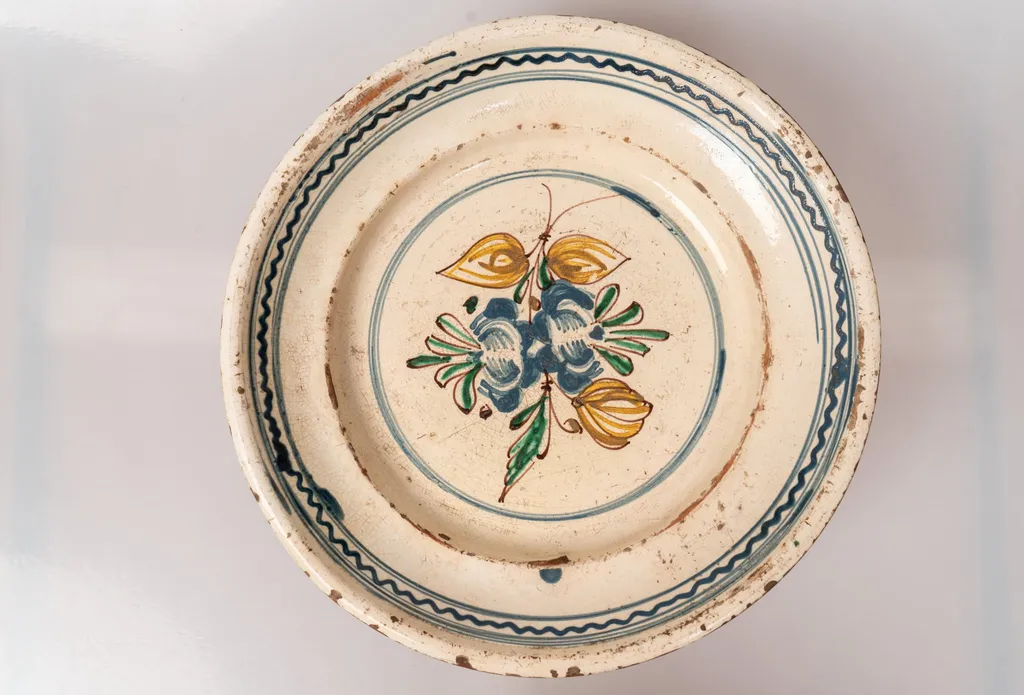
Farfurie mare, de formă aplatizată, modelată la roata olarului și angobată cu humă albă pe fața interioară. Decorul este realizat prin pictare cu pensula și cu cornul și constă în motive florale și vegetale stilizate (un buchet de flori cu boboci, de culoare albastru și galben și frunze de culoare verde, desenate cu contur fin, de culoare maro, buchet ce este înscris într-un cerc de culoare albastră) și motive geometrice (linii sub formă de cerc, linie ondulată, ce decorează buza farfuriei). Cromatica: alb, albastru, verde, galben. Fața ornamentată a farfuriei este acoperită cu un strat de smalț transparent. is a print by Unknown. It dates from 1850 and is held in the collection of the Ethnographical Museum of Transylvania. This is a flattened, wheel-thrown ceramic dish with a simple rounded rim.
About this work
Overview
The form is utilitarian yet carefully adorned, reflecting a balance between function and aesthetic refinement typical of its cultural context.
This is a flattened, wheel-thrown ceramic dish with a simple rounded rim. Its interior surface is coated with a white slip, providing a luminous ground for painted decoration. A transparent glaze covers the entire ornate face, preserving the pigments and enhancing their vibrancy. The form is utilitarian yet carefully adorned, reflecting a balance between function and aesthetic refinement typical of its cultural context.
Subject & Meaning
The central motif is a stylized floral bouquet composed of blue and yellow blossoms with green foliage, enclosed within a circular band. The arrangement suggests natural abundance, possibly symbolizing fertility or seasonal cycles. Surrounding the central design are geometric patterns—wavy lines and dotted borders—that frame the imagery without overwhelming it. These elements together convey a quiet harmony between organic forms and structured ornamentation.
Technique & Style
Decoration was applied using both brush and horn tools, allowing for fine linear control and varied texture. Floral outlines are rendered in thin brown strokes, while fills use solid areas of blue, yellow, and green. The precision of the lines contrasts with the fluidity of the wavy rim pattern, indicating deliberate handcrafting. The use of slip and transparent glaze demonstrates an understanding of ceramic chemistry to achieve durable, vivid coloration.
History & Provenance
The dish originates from a tradition of ceramic production in Eastern Europe, likely dating to the late medieval or early modern period. Similar vessels have been found in regional archaeological contexts, suggesting local workshops produced such items for domestic use. Its preservation indicates it was valued, possibly used in ceremonial or seasonal settings rather than everyday tasks.
Context
This piece reflects a broader regional practice of decorating ceramics with stylized botanical and geometric motifs, common in rural and artisanal communities. The color palette—white, blue, green, and yellow—aligns with locally available pigments and aesthetic preferences. Unlike more elaborate courtly wares, this dish emphasizes simplicity and clarity, pointing to a vernacular artistic language rooted in everyday life.
Legacy
The dish stands as an example of pre-industrial ceramic artistry, where decoration served both decorative and symbolic functions. Its survival offers insight into the visual culture of non-elite communities. Contemporary ceramicists studying traditional techniques often reference such pieces for their restrained elegance and technical discipline, preserving their influence in craft education.
Artist & collection
Museum
Ethnographical Museum of Transylvania
Continue through works from the same source collection.
 Domestic Scene
 Giacomo and Cardinal Marco, investing Andrea, Abbot of San Zeno, with his Benefice
 The Nymph of Fontainebleau
 Portrait of a Woman
 Madonna and Child with Saints in the Enclosed Garden
 Venus and Minerva
 Family Group of Four on Sofa
 Wall painting from Room H of the Villa of P. Fannius Synistor at Boscoreale
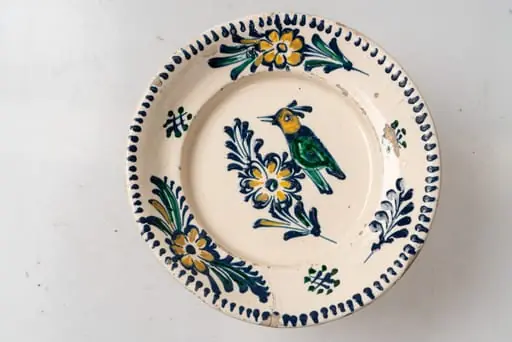 Farfurie de formă aplatizată, cu buza răsfrântă și foarte ușor concavă spre interior. Piesa este modelată din lut la roata olarului și angobată cu humă albă pe fața interioară. Decorul este realizat prin pictare cu pensula și cu cornul și se compune din motive avimorfe (o pasăre stând pe o crenguță cu frunze și cu o floare, pictate în registrul central de pe fundul farfuriei), trei motive vegetale (frunze și frunze cu flori, pe buza farfuriei) și motive geometrice (linii hașurate, puncte, pe buza farfuriei). Muchia buzei este decorată cu un șir de linii mici paralele, de culoare albastră. Cromatica: alb, albastru, verde, galben. Fața ornamentată a farfuriei este acoperită cu un strat de smalț transparent.
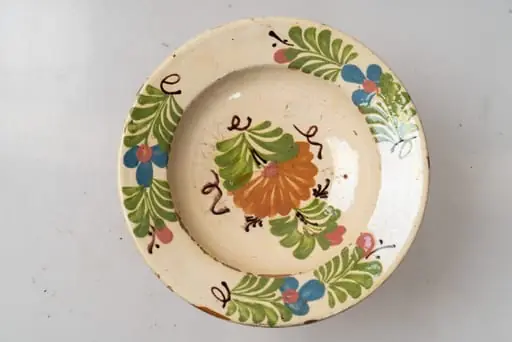 Farfurie adâncă, cu buza lată, răsfrântă; piesa este modelată din lut la roata olarului și este angobată cu humă albă pe fața interioară. Decorul este realizat prin pictare cu pensula și cu cornul și constă în motive florale și fitomorfe (o floare cu frunze și un boboc, pe centrul farfuriei și trei grupuri de flori cu frunze, pe buza farfuriei). Cromatica: alb, albastru, verde, siena naturală, roz-bej, maro. Fața ornamentată a farfuriei este acoperită cu un strat de smalț transparent.
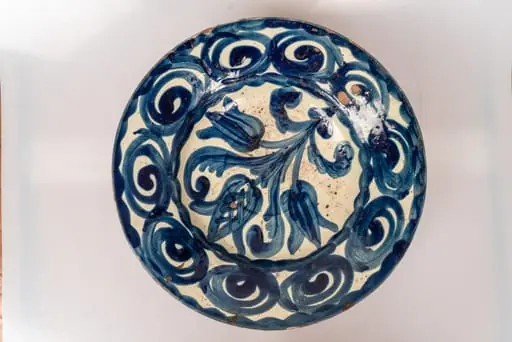 Farfurie mare, adâncă, cu buza răsfrântă; piesa este modelată la roata olarului și angobată pe fața interioară cu humă albă. Decorul monocromatic, este realizat prin pictare cu pensula, cu linii groase, și se compune din motive florale stilizate (trei flori de lalele cu frunze, dispuse central, pe fundul farfuriei) și motivul spiralei, ce acoperă întreaga suprafață a buzei, într-un șir continuu. Bordura interioară a farfuriei și muchia buzei sunt marcate de câte o linie vălurită. Pe fața ornamentată farfuria este acoperită cu un strat de smalț transparent. Cromatica: alb, albastru.
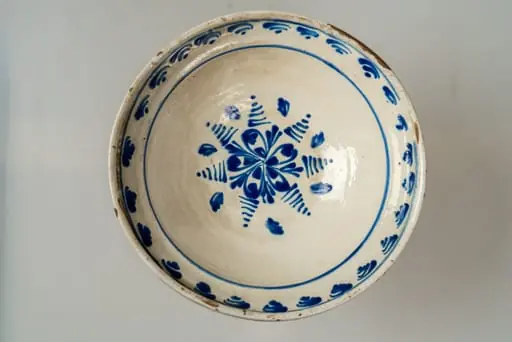 Farfurie adâncă, de tip castron, modelată la roata olarului și angobată cu humă albă pe fața interioară. Decorul este realizat prin pictare cu cornul și cu pensula, cu pigment albastru pe bază de oxid de cobalt, și este format din motive decorative florale (o floare cu 5 petale, dispusă central, pe fundul farfuriei, completată de 7 grupuri de câte 6 linii paralele, descrescătoare, dispuse în formă de stea) și geometrice (grupuri de câte trei linii paralele, concave și descrescătoare ca mărime, dispuse într-un șir continuu pe buza farfuriei, încadrate de două linii sub formă de cerc). Fața decorată a farfuriei este acoperită cu un strat de smalț transparent. Cromatica: alb, albastru.
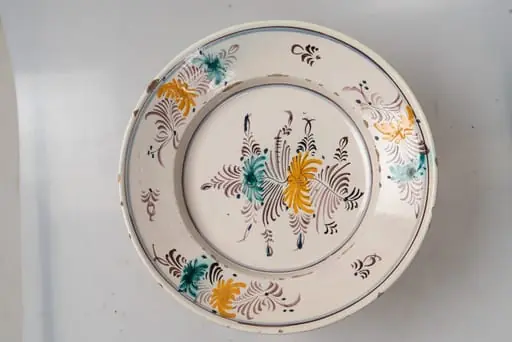 Farfurie mare, de formă aplatizată, cu buza răsfrântă. Decorul, dispus pe un fond alb-lăptos, fin realizat prin pictare cu pensula, este format din motive florale și vegetale stilizate, dispuse într-un registru central, pe fundul farfuriei (format din două flori, una galbenă și cealaltă verde-turcoaz, cu petale alungite, împreună cu frunze și elemente vegetale de culoare maro-brun, cu accente albastre) și pe buza farfuriei, unde regăsim trei grupuri de motive formate din același tip de flori ca cele din registrul central, dar de dimensiuni mai mici, grupuri separate de câte un mic motiv vegetal de culoare maro. Cromatica: alb, verde-turcoaz, maro-brun, albastru, galben-ocru.
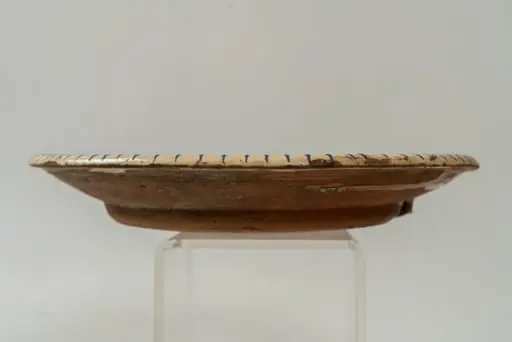 Farfurie de formă aplatizată, modelată la roata olarului, angobată cu humă albă pe fața interioară a acesteia. Decorul este realizat prin pictare cu pensula și cu cornul și constă în motive decorative vegetale stilizate (floare cu frunze - dispuse central, pe fundul farfuriei) și motive geometrice (grupuri de linii paralele, descrescătoare ca mărime - motivul brăduțului - și un șir de linii paralele pe toată lungimea muchiei buzei). Cromatica decorului: alb, albastru. Farfuria este smălțuită pe interior, cu smalț transparent.
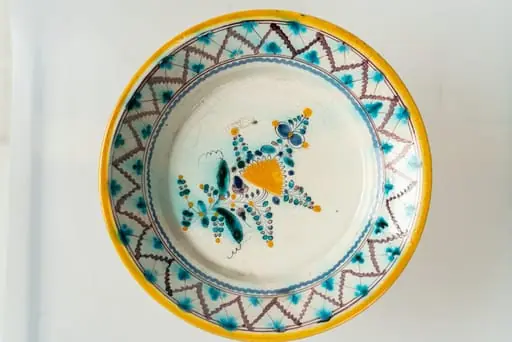 Farfurie mare, de formă aplatizată, cu marginea lată, răsfrântă, și cu muchia buzei ușor concavă spre exterior. Decorul, dispus pe un fond alb, prin pictare, este format din motive florale fin stilizate (flori și frunze), dispuse central, pe fundul farfuriei, și motive geometrice pe buza acesteia. Cromatica decorului: alb, verde-turcoaz, brun, galben-ocru, albastru.