Artwork
Fishing eagle
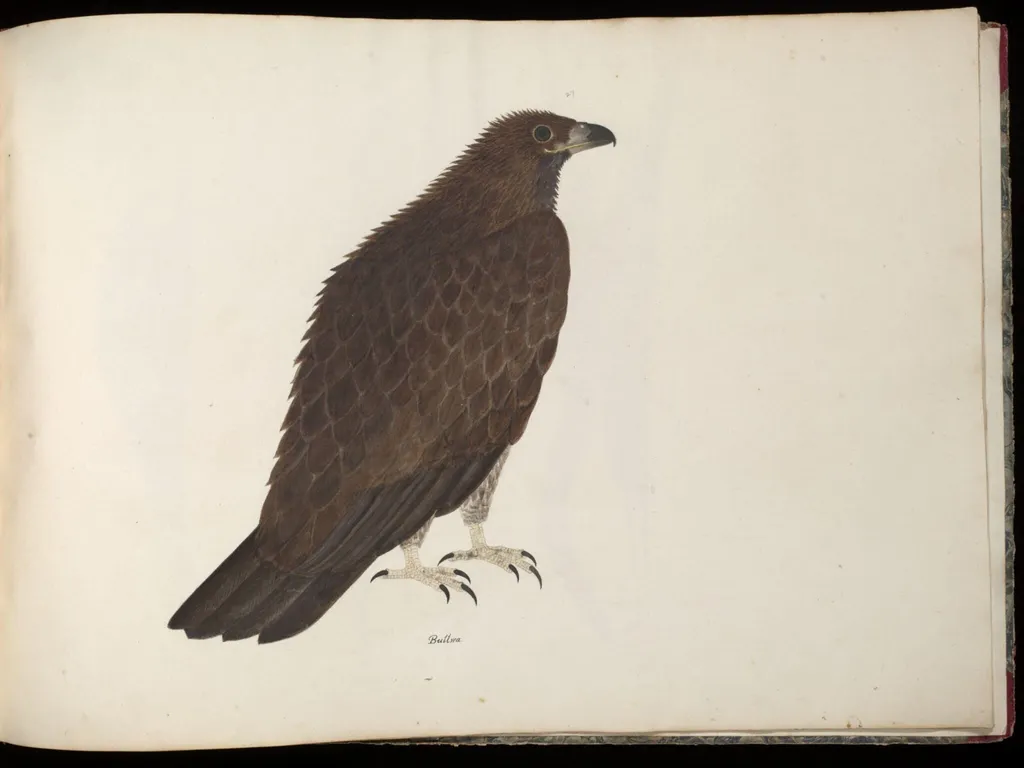
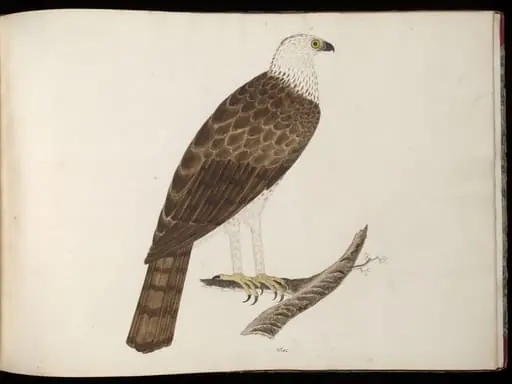
Fishing eagle is a paint painting by the Romanticist artist Unknown. It dates from 1826 and is held in the collection of the Victoria and Albert Museum.
About this work
Overview
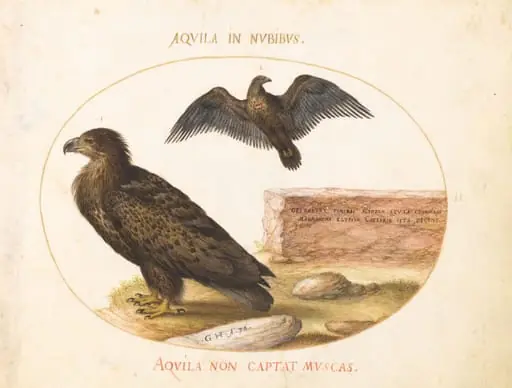
The work is a single illustration of a fishing eagle, executed in 1826 and incorporated into a set of twelve folios bound together with marbled covers. The folio presents the bird in a poised stance, its plumage rendered in nuanced browns and its eyes a vivid yellow, offering a detailed naturalistic portrait within a compact, book‑format presentation.
Subject & Meaning
The image captures a large raptor, likely a fishing eagle, with its head turned back over its shoulder, talons extended as if ready to seize prey. The bird’s ruffled feathers and intense gaze convey both the power of the predator and the observational interest of early nineteenth‑century naturalists in documenting wildlife behavior.
Technique & Style
Rendered with careful attention to texture, the artist employed fine brushwork to differentiate the lighter under‑feathers from the darker back plumage, and to delineate the curved talons. The realistic treatment aligns with the Romantic era’s fascination with the sublime in nature, emphasizing precise detail while evoking the creature’s dramatic presence.
History & Provenance
The folio forms part of a collection assembled under the patronage of Lord Amherst, who governed British India from 1823 to 1828. Amherst and his relatives, known for their enthusiasm for natural history, commissioned or acquired the series, reflecting their engagement with scientific illustration during the period.
Context
Produced during a time when European explorers and administrators were gathering specimens and visual records from colonial territories, the painting exemplifies the intersection of artistic skill and scientific inquiry. Such illustrated folios served both as decorative objects and as reference material for scholars interested in the fauna of the Indian subcontinent.
Artist & collection

 Domestic Scene
 Giacomo and Cardinal Marco, investing Andrea, Abbot of San Zeno, with his Benefice
 The Nymph of Fontainebleau
 Portrait of a Woman
 Madonna and Child with Saints in the Enclosed Garden
 Venus and Minerva
 Family Group of Four on Sofa
 Wall painting from Room H of the Villa of P. Fannius Synistor at Boscoreale