Artwork
Winter Hawk
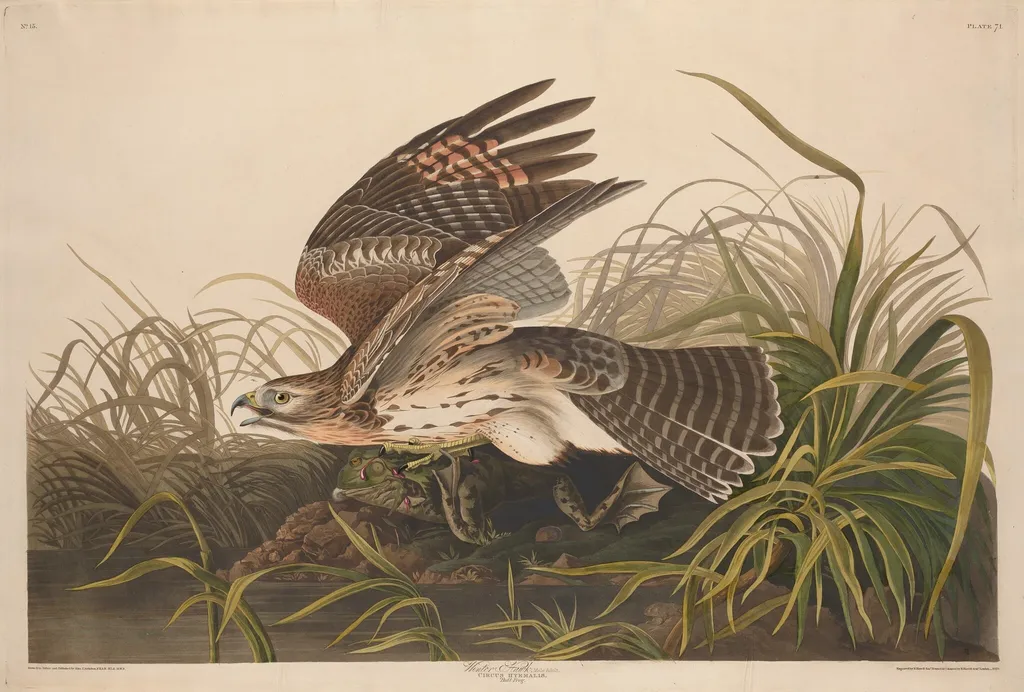
Winter Hawk is an ink print by the Romanticist artist Robert Havell Jr.. It dates from 1829 and is held in the collection of the National Gallery of Art.
About this work
Overview
His technique combined precise line work with soft tonal gradations, reflecting the period’s demand for detailed naturalistic imagery in printed form.
Robert Havell Jr. produced *Winter Hawk* in 1829 as a hand-colored engraving and aquatint on Whatman wove paper. A member of a multi-generational English artistic family from Reading, Berkshire, Havell specialized in reproductive prints, often collaborating on natural history projects. His technique combined precise line work with soft tonal gradations, reflecting the period’s demand for detailed naturalistic imagery in printed form.
Subject & Meaning
The print portrays a red-tailed hawk perched on a branch, wings outstretched, clutching prey in its talons. The scene captures a moment of predatory stillness, set against a damp, reed-choked landscape. No symbolic interpretation is documented, but the composition emphasizes the bird’s physical presence and environmental context, aligning with early 19th-century scientific illustration’s focus on observed natural behavior rather than allegory.
Technique & Style
Havell employed aquatint to achieve subtle gradations of tone in the feathers and background, while fine engraving lines defined texture in the bird’s plumage and surrounding vegetation. Hand-coloring added realistic hues to the brown, white, and black feather patterns. The use of Whatman paper, known for its smooth, absorbent surface, allowed for precise ink hold and delicate washes, enhancing the lifelike rendering of the scene.
History & Provenance
Created during Havell’s collaboration on John James Audubon’s *Birds of America*, *Winter Hawk* emerged from a network of British printmakers refining natural history imagery. Though not part of the main folio, it shares the same technical standards and observational rigor. Its provenance traces to Havell’s workshop in London, where he produced numerous prints for scientific and commercial audiences between 1820 and 1840.
Context
In the 1820s, printed natural history images were vital for disseminating scientific knowledge before photography. Artists like Havell bridged art and science, translating field observations into accessible formats. The emphasis on texture, lighting, and ecological detail reflected broader Enlightenment ideals of empirical observation, with aquatint offering a middle ground between the precision of engraving and the atmospheric depth of watercolor.
Legacy
Havell’s work contributed to the standardization of ornithological illustration in print. While overshadowed by Audubon’s larger projects, his technical skill influenced later printmakers in natural history publishing. *Winter Hawk* exemplifies the quiet, meticulous tradition of British printmaking that prioritized accuracy over spectacle, leaving a quiet but enduring mark on the visual documentation of wildlife.
Artist & collection

Artist
The Havell family of Reading, Berkshire, England, included a number of notable engravers, etchers and painters, as well as writers, publishers, educators, and musicians.