Artwork
White-Headed Eagle
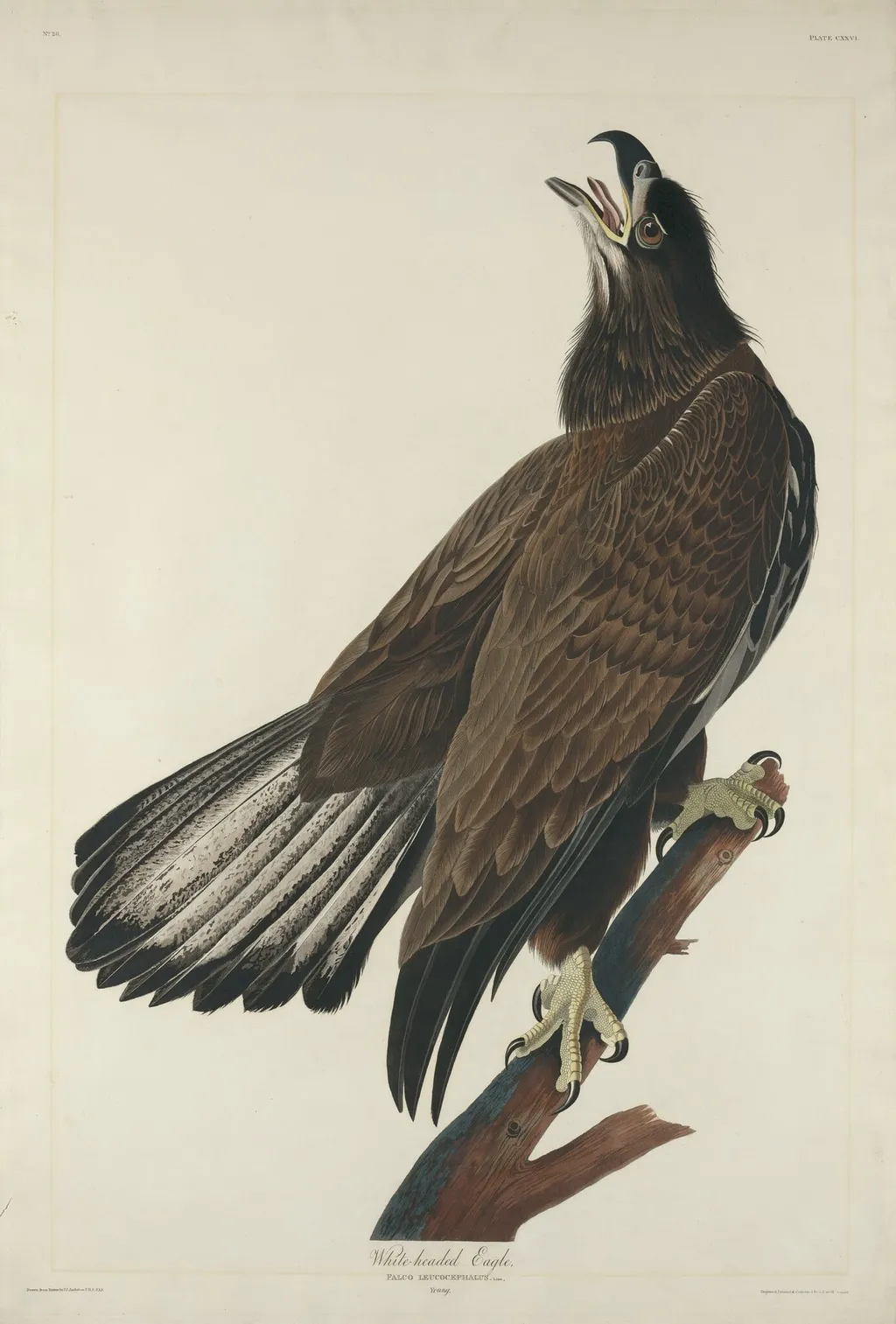
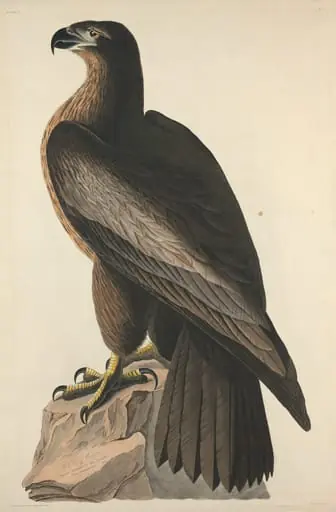
White-Headed Eagle is an ink print by the Romanticist artist Robert Havell Jr.. It dates from 1832 and is held in the collection of the National Gallery of Art.
About this work
Overview
The work belongs to a broader 19th-century tradition of natural history illustration, where scientific accuracy and visual detail were prioritized.
Created in 1832 by Robert Havell Jr., this hand-colored engraving and aquatint depicts a bald eagle on Whatman wove paper. The work belongs to a broader 19th-century tradition of natural history illustration, where scientific accuracy and visual detail were prioritized. Havell’s technique reflects the family’s established expertise in printmaking, particularly in aquatint, a method allowing subtle tonal gradations. The piece is one of many produced during a period when natural science was increasingly documented through printed imagery.
Subject & Meaning
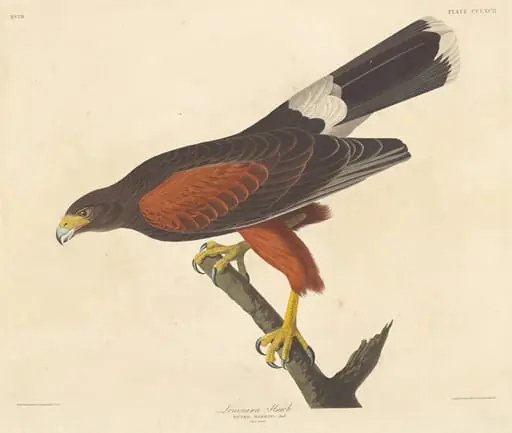
The eagle is rendered with precise anatomical detail, its white head and tail contrasting against dark brown body feathers. Perched on a bare branch, it grips tightly with its talons, wings slightly spread as if mid-motion. The plain background focuses attention on the bird’s form, emphasizing its physical presence over symbolic context. The inclusion of its common and scientific names underscores the work’s intent as a zoological record rather than a mythic or national emblem.
Technique & Style
Havell employed engraving for fine linear definition and aquatint for soft tonal transitions, particularly in the feather textures. Each feather was individually rendered with meticulous line work, capturing the layered structure of plumage. Hand-coloring was applied with care to match observed natural hues, avoiding exaggeration. The use of Whatman paper, known for its smooth, absorbent surface, allowed for crisp ink registration and delicate washes, enhancing the realism of the depiction.
History & Provenance
Robert Havell Jr. was part of a multi-generational family of English printmakers based in Reading, Berkshire, whose workshop produced numerous natural history illustrations. His father, Robert Havell the Elder, and uncle Luke Havell were also engravers and painters. This work emerged from their commercial and scientific collaborations, often linked to publications documenting flora and fauna. The piece was likely produced for a scientific or educational audience, reflecting the family’s role in disseminating naturalist knowledge through print.
Context
In the early 19th century, detailed natural history prints were in demand among collectors, scientists, and institutions. European artists frequently illustrated American wildlife for audiences abroad, often based on specimens or sketches sent from the New World. Havell’s work aligns with this transatlantic exchange, contributing to a visual archive that shaped European perceptions of North American fauna, even as it remained grounded in empirical observation.
Legacy
The Havell family’s prints, including this eagle, remain valued for their technical precision and historical significance in natural history illustration. Though not widely exhibited today, they serve as important artifacts of pre-photographic documentation. Their influence endures in the methodology of scientific art, where clarity and fidelity to nature remain central. This work exemplifies how printmaking bridged art and science in an era before mass imaging technologies.
Artist & collection

Artist
The Havell family of Reading, Berkshire, England, included a number of notable engravers, etchers and painters, as well as writers, publishers, educators, and musicians.