Artwork
Gathering Osmanthus
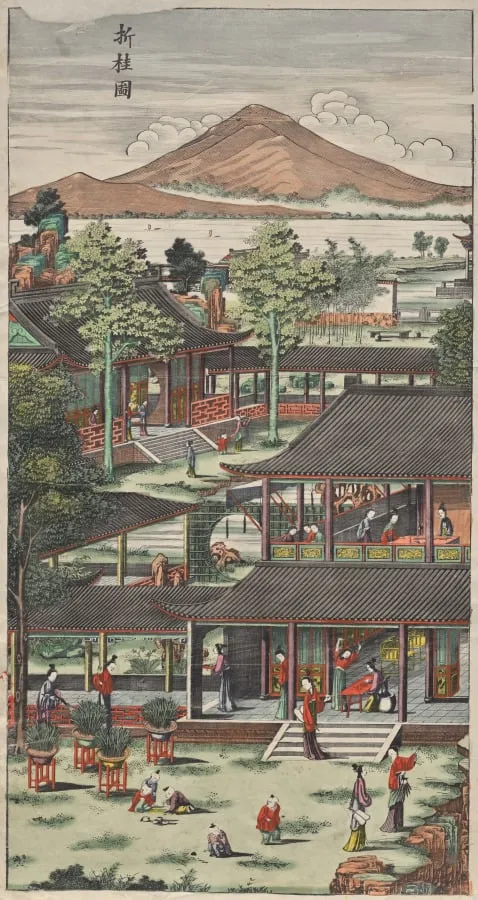
Gathering Osmanthus is a print by the Baroque artist Unknown. It dates from 1766 and is held in the collection of the Cleveland Museum of Art.
About this work
This painting was made as a cheap, mass-produced print—like a poster—during China’s Qianlong reign.
You see two women in long robes standing under a tree full of tiny white flowers.
This painting was made as a cheap, mass-produced print—like a poster—during China’s Qianlong reign. Most art from this time was for the rich, but prints like this hung in ordinary homes. The tree is osmanthus, a flower that smells sweet and symbolizes good luck.
To see more art from this time, look up *qing dynasty (1644–1911)*.
Overview
Gathering Osmanthus is a print created during China's Qianlong reign, a period of flourishing print culture in Jiangnan cities. It represents a departure from exclusive, handmade art, catering to a broader audience.
Subject & Meaning
The print depicts two women in traditional robes standing beneath an osmanthus tree, laden with small white flowers. Osmanthus, known for its fragrance, is a symbol of good fortune.
Technique & Style
Produced as a mass-market single-sheet print, Gathering Osmanthus reflects the commercialization of color printing. Its accessibility and affordability made it a common decorative item in ordinary homes.
Context
This print is part of a larger trend in 17th-century Jiangnan cities, where printing evolved to meet urban visual culture demands, shifting from exclusive illustrated books to widely available wall hangings.
Artist & collection

 Domestic Scene
 Giacomo and Cardinal Marco, investing Andrea, Abbot of San Zeno, with his Benefice
 The Nymph of Fontainebleau
 Portrait of a Woman
 Madonna and Child with Saints in the Enclosed Garden
 Venus and Minerva
 Family Group of Four on Sofa
 Wall painting from Room H of the Villa of P. Fannius Synistor at Boscoreale