Artwork
God of Fire
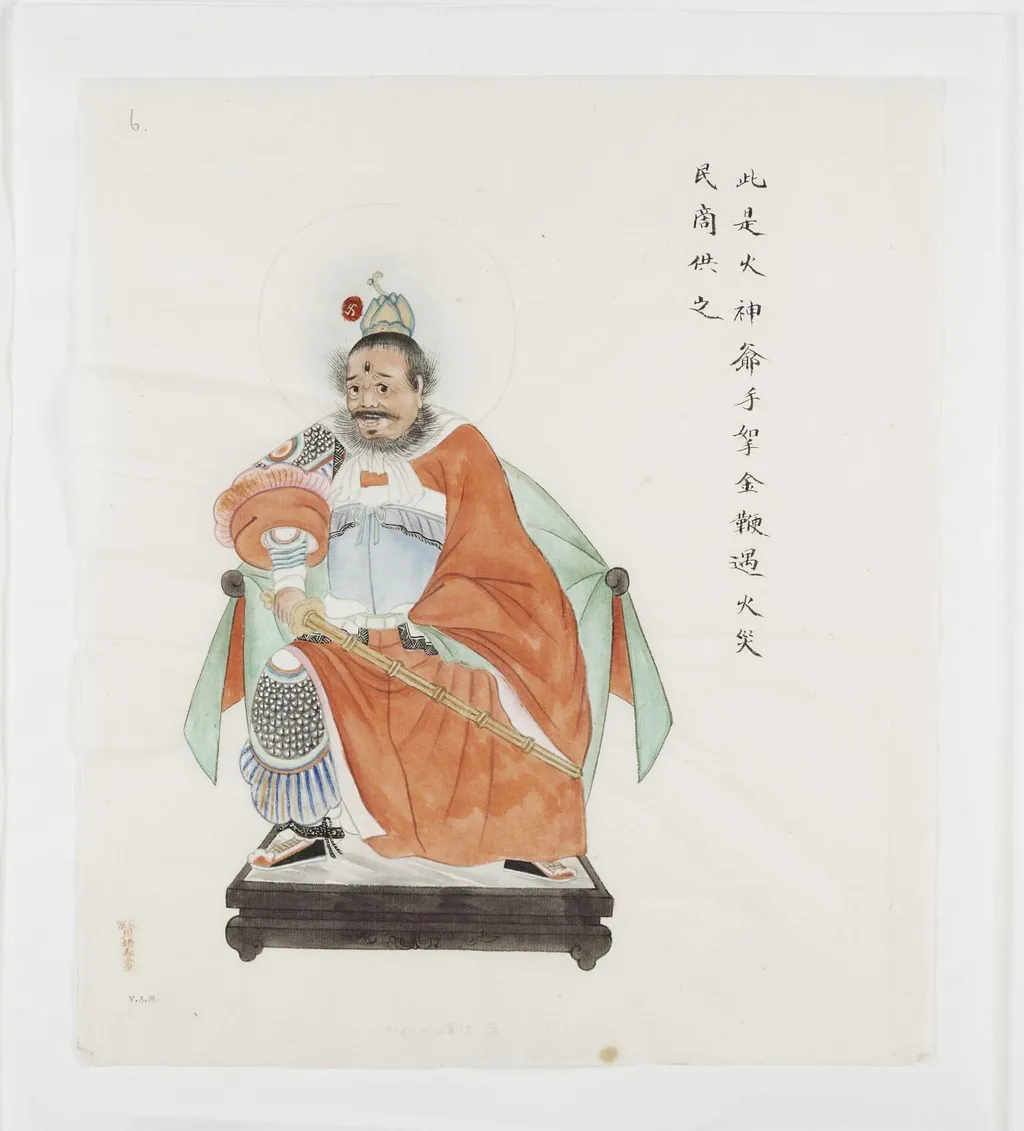
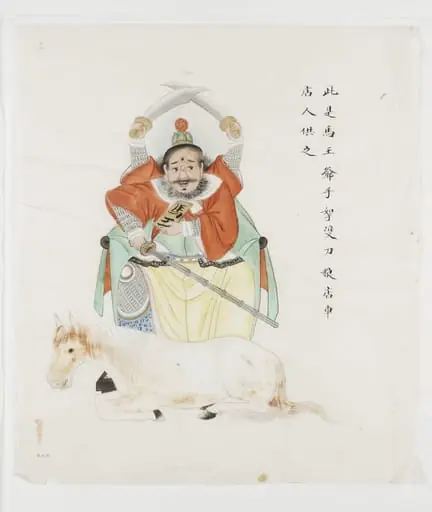
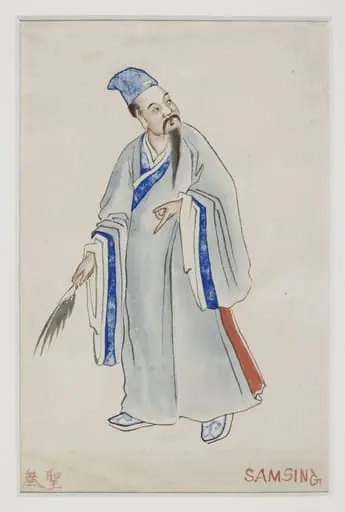
God of Fire is a paint painting by Unknown. It dates from 1900 and is held in the collection of the Victoria and Albert Museum. This rectangular painting portrays a seated figure identified as a household deity, rendered in ink and color on paper.
About this work
Overview
The subject wears ceremonial attire, including an orange-red robe and a pale blue chest plate, with additional decorative elements at the shoulder and knee.
This rectangular painting portrays a seated figure identified as a household deity, rendered in ink and color on paper. The subject wears ceremonial attire, including an orange-red robe and a pale blue chest plate, with additional decorative elements at the shoulder and knee. A vertical inscription flanks the right edge, while a red seal mark occupies the lower left corner, confirming its origin within a larger series of works.
Subject & Meaning
The figure represents Zhurong, the Chinese god of fire, depicted in a formal seated posture. Traditional garments, including a layered robe and chest plate, signify divine or official status. The bamboo tube held in one hand may symbolize a ritual implement or tool associated with the deity’s domain, while the downward gaze suggests contemplation or authority. The plain background emphasizes the figure’s symbolic presence.
Technique & Style
Executed in a precise, linear style characteristic of classical Chinese painting, the work employs fine brushwork to delineate intricate details in the robes and accessories. Color is applied in flat, even washes, with muted tones contrasting against the vivid orange-red of the outer garment. The composition balances symmetry with subtle asymmetrical elements, such as the placement of the inscription and seal.
History & Provenance
The painting forms part of a series of 155 works acquired by the Victoria and Albert Museum in 1910. It was purchased from Mrs. Amherst-Law, a collector of East Asian art, and cataloged under the accession number E.3177-1910. The red seal mark suggests an earlier private or workshop origin, though specific details of its creation remain undocumented.
Context
Such depictions of household deities were common in traditional Chinese religious and domestic practices, serving as protective icons. The attire and attributes align with Ming or Qing dynasty conventions for representing divine figures, reflecting both Confucian and Daoist influences. The work’s inclusion in a larger series indicates it may have been part of a ritual set or instructional collection.
Legacy
Preserved as part of a museum collection, the painting offers insight into the visual culture of Chinese folk religion and official iconography. Its accession in the early 20th century reflects Western institutional interest in non-European artistic traditions during that period. The work remains a reference for scholars studying the representation of deities in Chinese art.
Artist & collection

 Domestic Scene
 Giacomo and Cardinal Marco, investing Andrea, Abbot of San Zeno, with his Benefice
 The Nymph of Fontainebleau
 Portrait of a Woman
 Madonna and Child with Saints in the Enclosed Garden
 Venus and Minerva
 Family Group of Four on Sofa
 Wall painting from Room H of the Villa of P. Fannius Synistor at Boscoreale