Artwork
Gold Figure of Ranganata
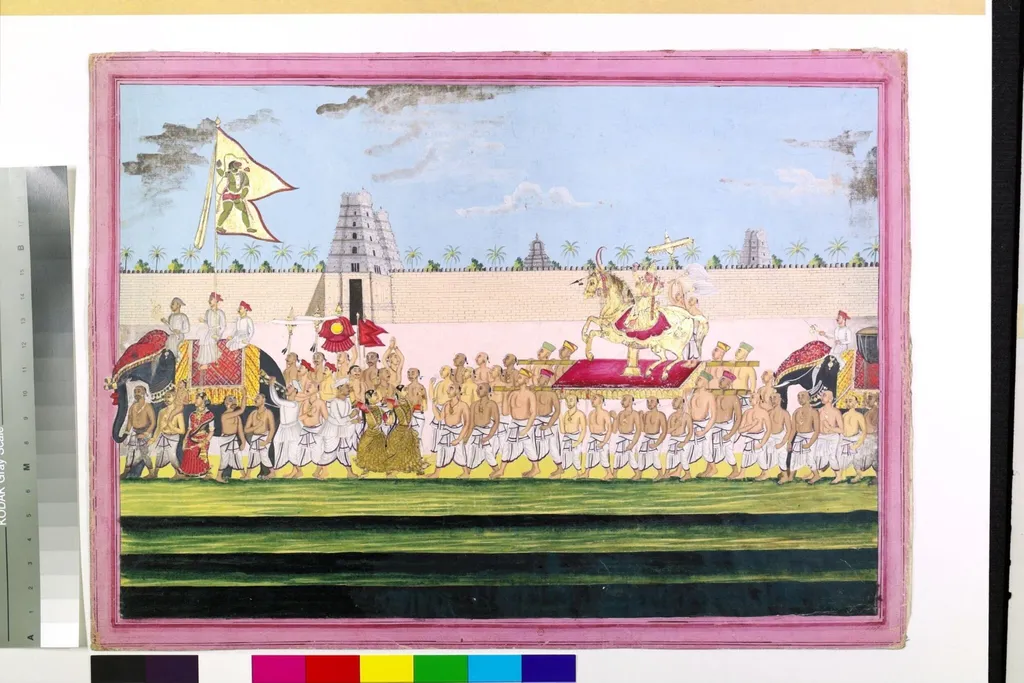
Gold Figure of Ranganata is a paint painting by the Romanticist artist Unknown. It dates from 1800 and is held in the collection of the Victoria and Albert Museum. The work depicts the Vaiyali festival at the Ranganata temple in Srirangam, a prominent Vaishnavite shrine near Tiruchirappalli.
About this work
This painting shows a temple festival in India around 1800. A silver idol sits on a horse in a bright procession. The temple’s tall gateways rise behind in gold and red.
The artist painted the Vaiyali festival at Ranganata temple. This was a major event for devotees. It shows how faith and art merged in daily life.
Look up the Victoria and Albert Museum next.
Overview
The work depicts the Vaiyali festival at the Ranganata temple in Srirangam, a prominent Vaishnavite shrine near Tiruchirappalli. A silver deity is shown mounted on a horse, carried in a palanquin procession, with the temple’s towering gopura and enclosing walls rising behind the crowd.
Subject & Meaning
The scene records a key ritual in which male devotees transport a portable silver image of the god during the annual celebration. The procession underscores the communal devotion and the ritual’s role in affirming the temple’s status as a major religious center in southern India.
Technique & Style
Executed in a naturalistic manner, the painting combines detailed observation of architecture and costume with a clear, linear perspective. The artist’s handling of light on the gilded gateways and the metallic sheen of the idol reflects early‑19th‑century European training applied to an Indian subject.
History & Provenance
Commissioned by members of the English East India Company or other European residents in India, the work belongs to a body of early 1800s paintings made for colonial patrons. Such pieces are valued for documenting Indian ceremonial life just before the introduction of photography.
Context
During the period of expanding British influence, European expatriates often sought visual records of local customs. This painting serves both as a visual account of a specific religious festival and as evidence of cross‑cultural encounters between colonial observers and Indian traditions.
Artist & collection

 Domestic Scene
 Giacomo and Cardinal Marco, investing Andrea, Abbot of San Zeno, with his Benefice
 The Nymph of Fontainebleau
 Portrait of a Woman
 Madonna and Child with Saints in the Enclosed Garden
 Venus and Minerva
 Family Group of Four on Sofa
 Wall painting from Room H of the Villa of P. Fannius Synistor at Boscoreale