Artwork
Group of Arabs near Alexandria - 1801 - taken on the Spot
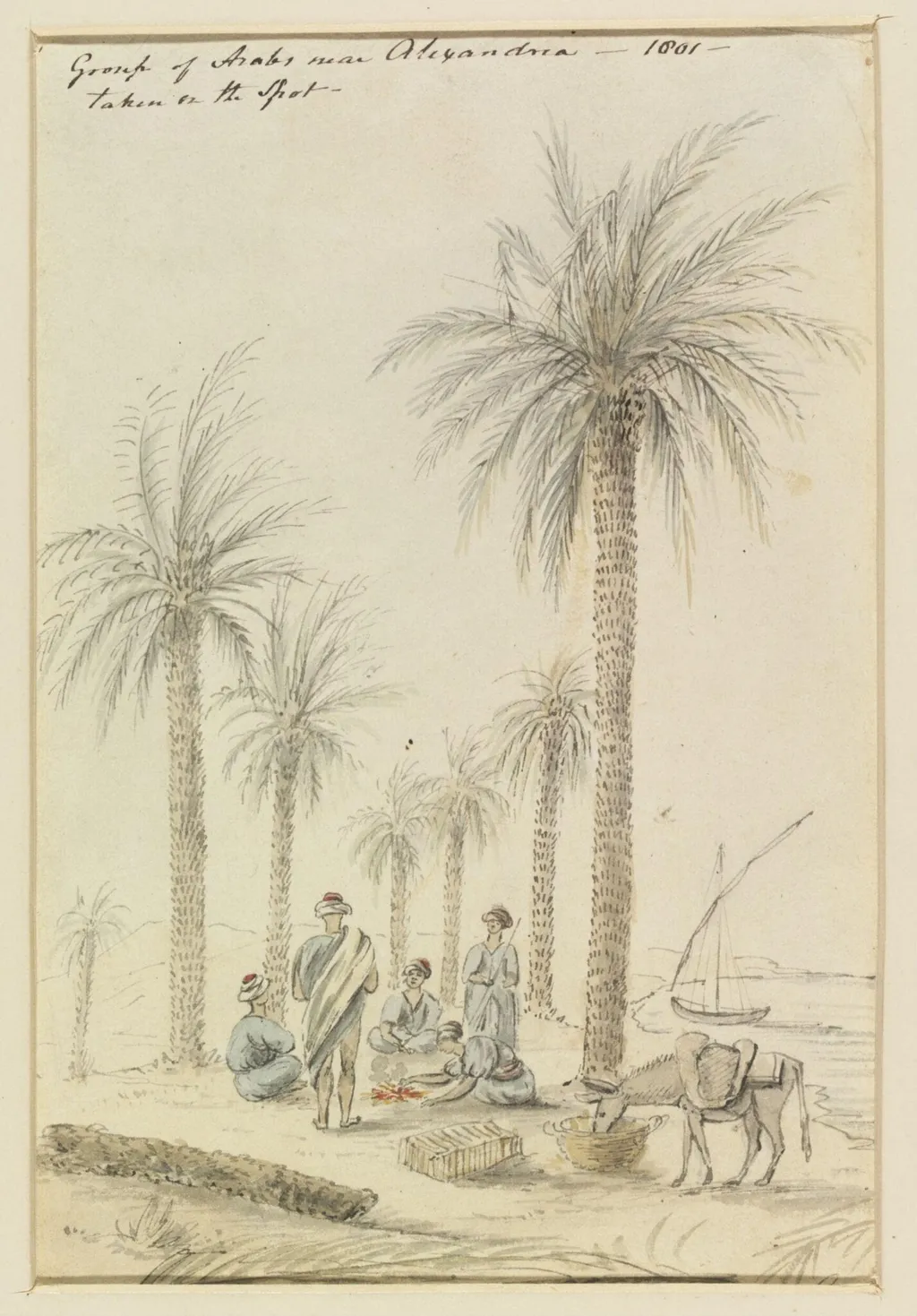
Group of Arabs near Alexandria - 1801 - taken on the Spot is a watercolor work on paper by the Romanticist artist Unknown. It dates from 1801 and is held in the collection of the Victoria and Albert Museum. This watercolour, dated 1801, captures a quiet moment near Alexandria during the British military campaign in Egypt.
About this work
The artist wrote the title on the paper: *"Group of Arabs near Alexandria – 1801 – taken on the Spot.
This sketch shows five people sitting or standing under tall palm trees by the water. One man leans on a stick, another squats near a small fire, and two women sit with a child. A donkey stands nearby, and a boat floats in the background.
The artist wrote the title on the paper: *"Group of Arabs near Alexandria – 1801 – taken on the Spot."* The loose, quick lines suggest they drew this outside, not in a studio.
Next, check out the Victoria and Albert Museum to see more works like this.
Overview
This watercolour, dated 1801, captures a quiet moment near Alexandria during the British military campaign in Egypt. Executed on-site, it reflects the observational practice of soldiers documenting their surroundings. The artist, likely an officer, inscribed the scene with a precise title, emphasizing its direct observation. The medium’s immediacy and informal brushwork suggest it was made outdoors, not in a controlled studio environment.
Subject & Meaning
The scene portrays five individuals—men, women, and a child—gathered beneath palm trees beside water. One man leans on a staff, another tends a small fire, while two women sit nearby with a child. A donkey and a distant boat complete the setting. The composition avoids dramatic narrative, instead offering a candid glimpse of daily life, possibly reflecting the artist’s interest in local customs rather than military action.
Technique & Style
Rendered in loose, fluid watercolour, the work employs quick, spontaneous strokes that convey movement and atmosphere. The artist avoided detailed rendering, favoring suggestive lines and washes to define forms. The lack of rigid structure and the open composition align with on-location sketching practices, where speed and observation took precedence over finish. The paper’s modest scale reinforces its function as a personal record.
History & Provenance
Created during the British expedition to Egypt in 1801, the watercolour is tied to military personnel stationed near Alexandria. While the artist’s identity remains unconfirmed, it may be linked to one of the officers documented in campaign records. Its survival suggests it was preserved as a personal memento, possibly later acquired by a collector or institution interested in early 19th-century travel documentation.
Context
This work emerged amid a surge of British interest in Egypt following Napoleon’s campaign and the subsequent British military presence. Officers often sketched local life, architecture, and landscapes as part of cultural documentation. Such images contributed to European perceptions of the region, offering alternatives to exoticized portrayals by relying on direct, if limited, observation.
Legacy
As a firsthand record from a military campaign, the watercolour contributes to the archive of early colonial-era visual ethnography. Though not widely exhibited, it exemplifies the role of amateur artists in shaping Western understanding of the Middle East. Its unpolished quality lends authenticity, distinguishing it from later, more stylized depictions of the region.
Artist & collection

 Domestic Scene
 Giacomo and Cardinal Marco, investing Andrea, Abbot of San Zeno, with his Benefice
 The Nymph of Fontainebleau
 Portrait of a Woman
 Madonna and Child with Saints in the Enclosed Garden
 Venus and Minerva
 Family Group of Four on Sofa
 Wall painting from Room H of the Villa of P. Fannius Synistor at Boscoreale
 Aswan; looking south up the Nile
 View of the Sea Castle (Sidon)
 Palm trees at Karnak, Thebes
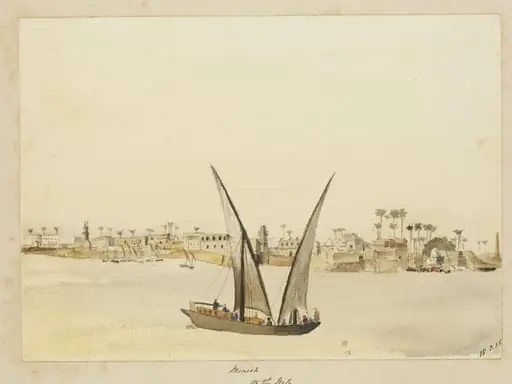 `Minieh On the Nile'
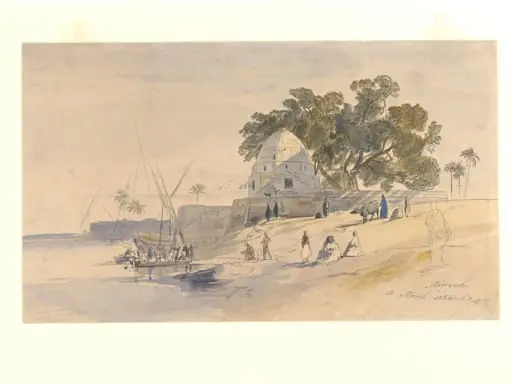 Minyeh, Egypt
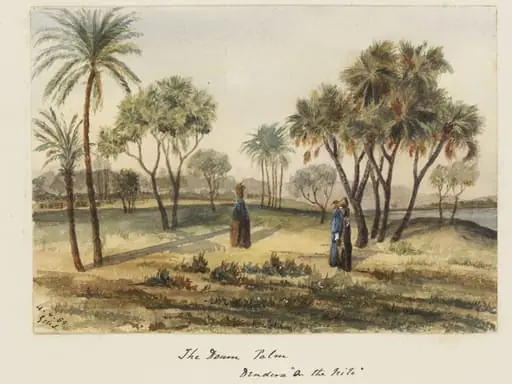 `The Doum Palm Dendera "On the Nile"
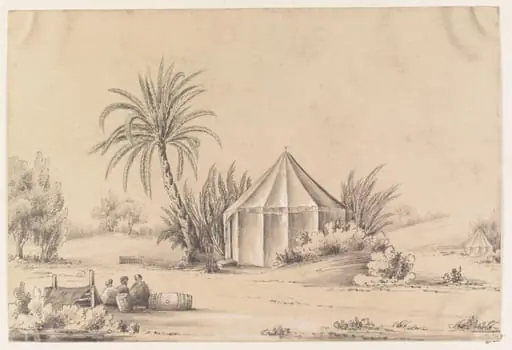 A Scene in the Desert Wady Gharendl
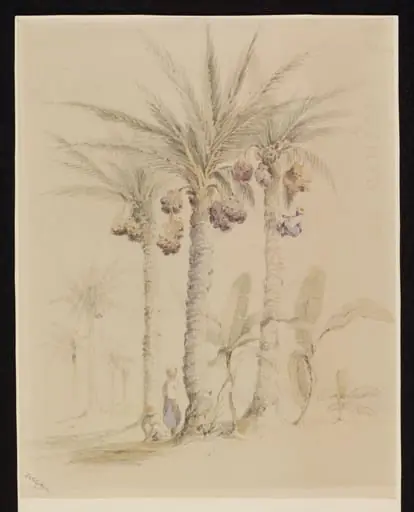 Date Gatherers
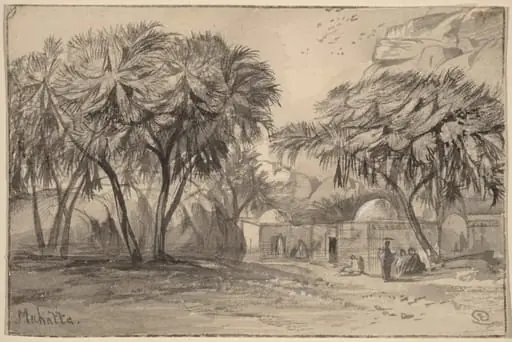 Mahatta
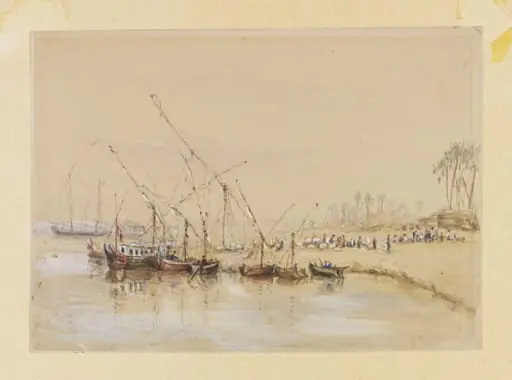 A Scene on the Nile: with dahabiyyahs and bales of cotton being loaded into feluccas
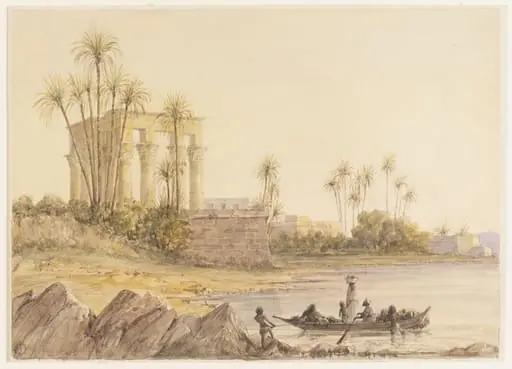 Landing Place. Philoe
 Date grove near Alexandria