Artwork
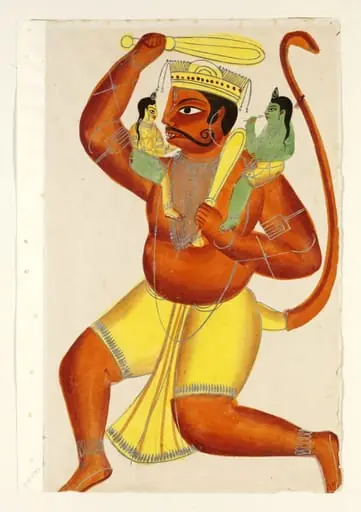
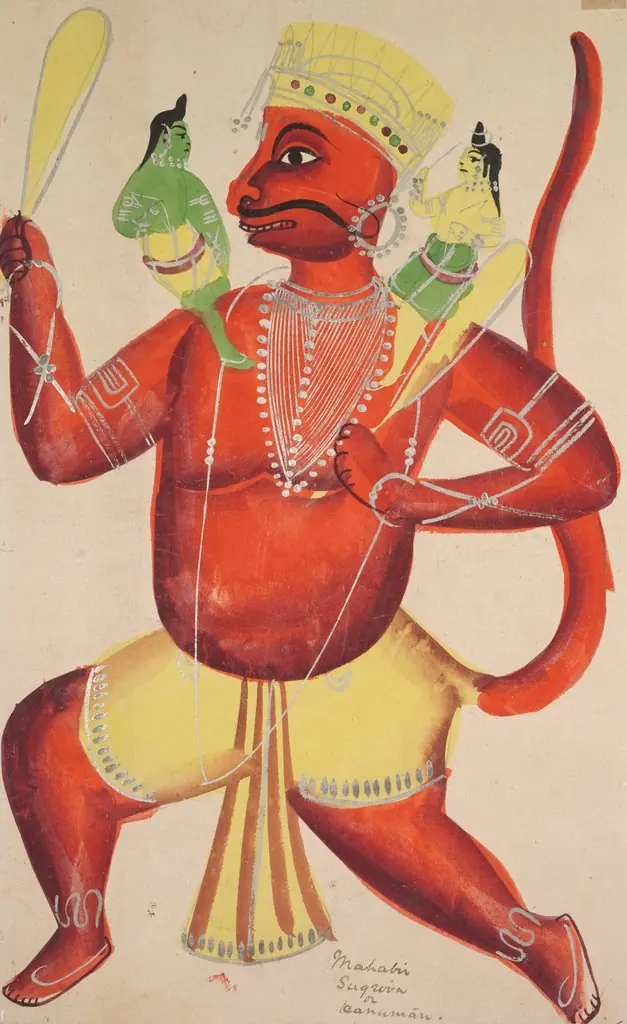
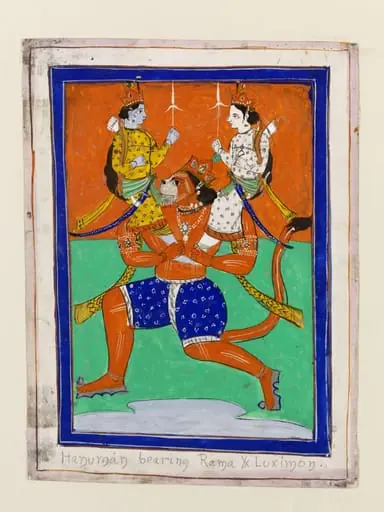
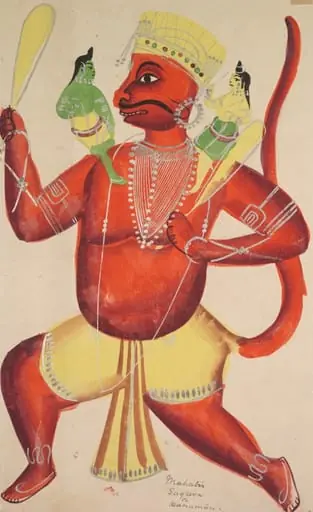
Hanuman carrying Rama and Lakshmana
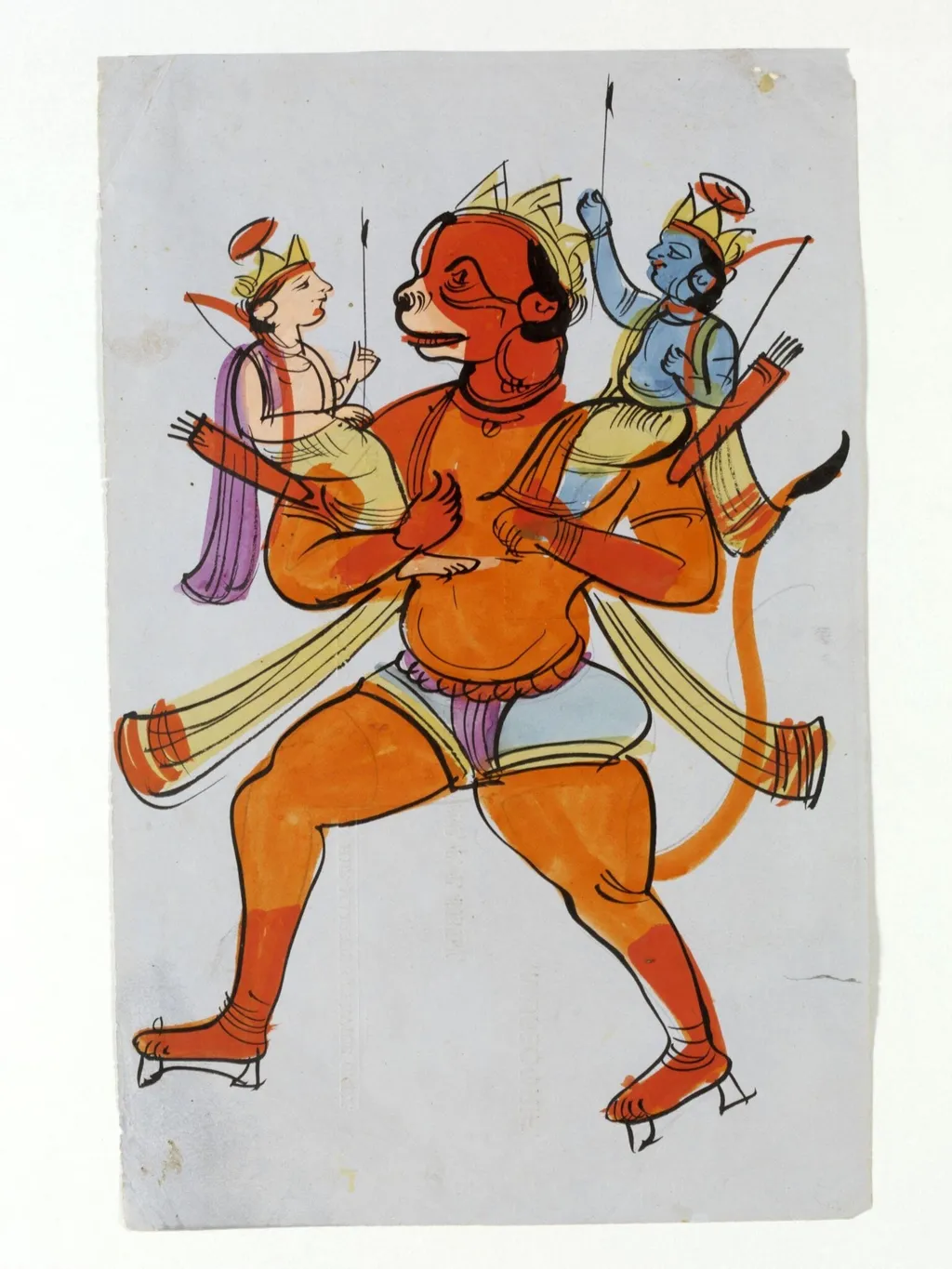
Hanuman carrying Rama and Lakshmana is a paint painting by the Indian Miniature artist Unknown. It dates from 1850 and is held in the collection of the Victoria and Albert Museum. This opaque watercolour on paper, dated around 1850, depicts Hanuman bearing Rama and Lakshmana.
About this work
Overview
This opaque watercolour on paper, dated around 1850, depicts Hanuman bearing Rama and Lakshmana. Created in the context of North Indian devotional art, it belongs to a larger collection assembled by J. Lockwood Kipling between 1865 and 1893. The album, comprising nearly two hundred works gathered from regional markets, was later presented to the museum by his son Rudyard Kipling in 1917.
Subject & Meaning
The scene illustrates a moment from the Ramayana in which Hanuman, the devoted monkey god, carries the exiled princes Rama and Lakshmana across the sky.
The scene illustrates a moment from the Ramayana in which Hanuman, the devoted monkey god, carries the exiled princes Rama and Lakshmana across the sky. His monumental form symbolizes divine strength and loyalty, while the smaller figures represent human dependence on divine aid. The composition emphasizes spiritual hierarchy through scale, not physical realism, reinforcing Hanuman’s role as a protector and servant of dharma.
Technique & Style
The painting employs flat, unmodulated hues and lacks perspective or shading, typical of popular devotional art from Upper India and Bengal. Figures are outlined with clarity, and details like Hanuman’s crown and ears are stylized for symbolic recognition. The bold, simplified forms reflect an aesthetic rooted in folk traditions, prioritizing narrative legibility and devotional impact over naturalistic representation.
History & Provenance
The work was collected by J. Lockwood Kipling during his time in British India, where he gathered artworks from bazaars and fairs. His album, which included lithographs and paintings, served as a record of regional visual culture. In 1917, his son Rudyard Kipling donated the entire collection to a public museum, preserving these works as ethnographic and artistic artifacts rather than mere religious objects.
Context
Produced during a period of growing colonial interest in Indian visual traditions, this painting emerged from a vibrant ecosystem of itinerant artists supplying devotional imagery to local audiences. Its style aligns with other works from the Punjab and Bengal regions, where narrative scenes from epics were rendered in accessible, vivid forms for temple and home use, often outside elite courtly traditions.
Legacy
As part of the Kipling album, the painting entered institutional collections at a time when Indian art was being cataloged and preserved by colonial administrators. Its survival offers insight into the circulation of popular religious imagery and the ways in which vernacular art was collected, valued, and later recontextualized within Western museum frameworks.
Artist & collection

 Domestic Scene
 Giacomo and Cardinal Marco, investing Andrea, Abbot of San Zeno, with his Benefice
 The Nymph of Fontainebleau
 Portrait of a Woman
 Madonna and Child with Saints in the Enclosed Garden
 Venus and Minerva
 Family Group of Four on Sofa
 Wall painting from Room H of the Villa of P. Fannius Synistor at Boscoreale