Artwork
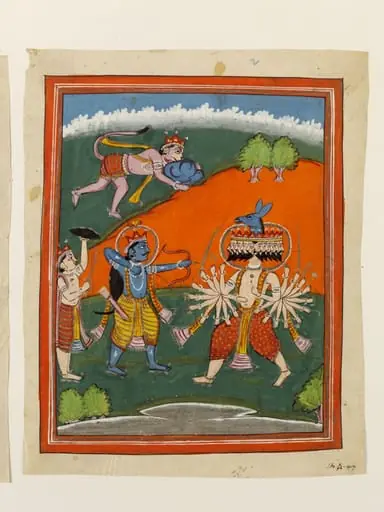
Hanuman, Rama and Laksmana
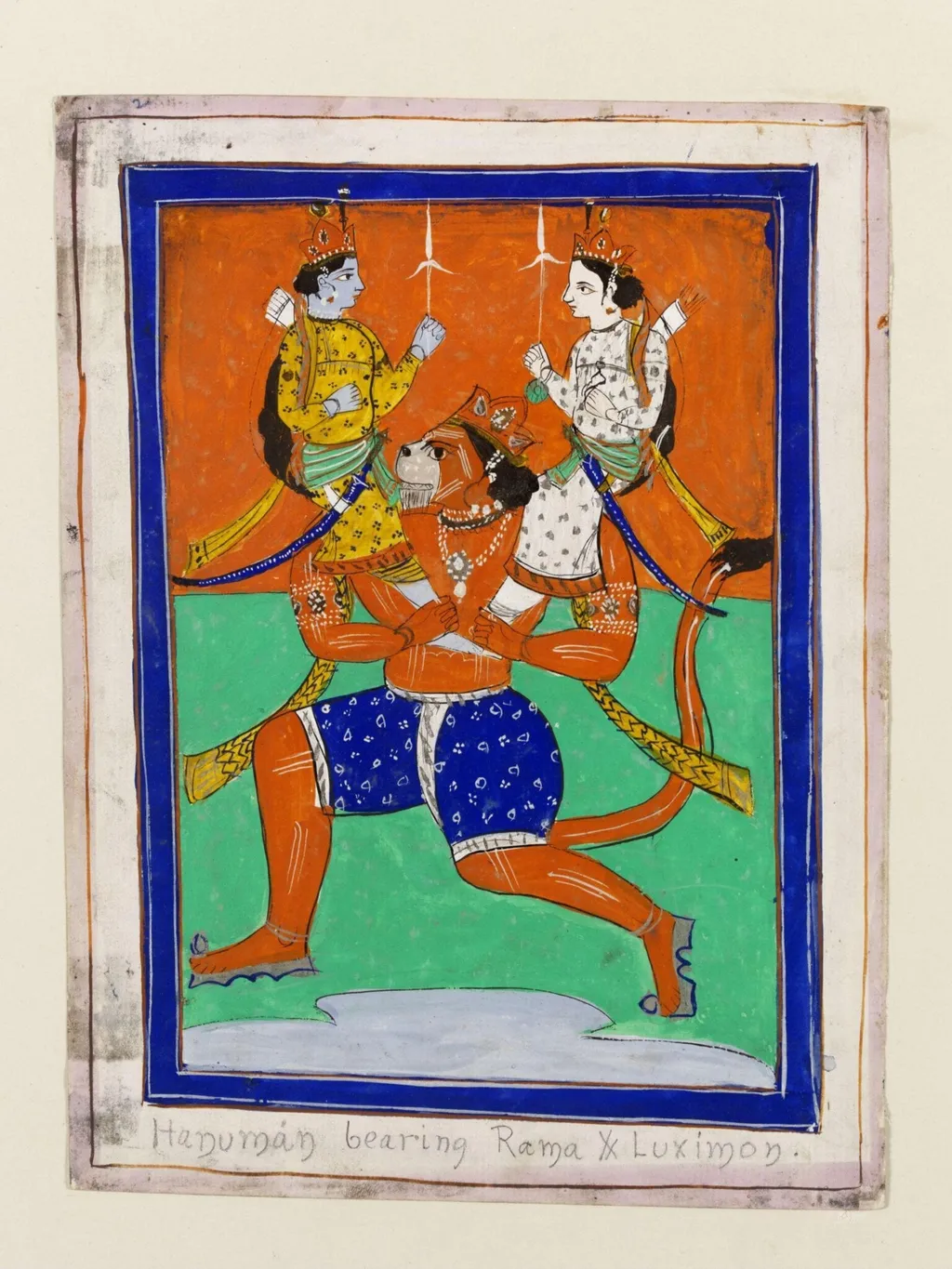
Hanuman, Rama and Laksmana is a paint painting by Unknown. It dates from 1850 and is held in the collection of the Victoria and Albert Museum.
About this work
Overview
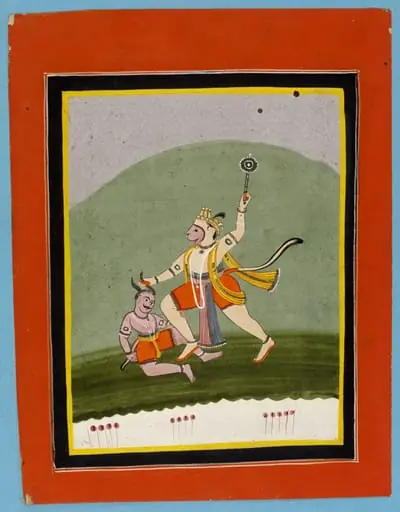
This opaque watercolor on paper, dated around 1850, portrays a scene from the Ramayana in which Hanuman, the divine monkey, carries Rama and Lakshmana.
This opaque watercolor on paper, dated around 1850, portrays a scene from the Ramayana in which Hanuman, the divine monkey, carries Rama and Lakshmana. Created in the context of North Indian popular art traditions, it was later included in an album compiled by J. Lockwood Kipling between 1865 and 1893. The album, containing nearly two hundred works gathered from regional markets, was donated to the museum by his son Rudyard Kipling in 1917.
Subject & Meaning
The painting illustrates Hanuman’s devotion and strength as he bears the two princes, Rama and Lakshmana, across a landscape. Their presence signifies divine protection and the triumph of dharma. Hanuman, depicted with blue skin and a red-hued upper body, embodies loyalty and service. The inscription at the base confirms the narrative, grounding the image in a widely recognized episode from the Ramayana, where divine aid enables the heroes’ journey.
Technique & Style
The work employs opaque watercolor on paper, a common medium in regional Indian painting traditions. Bold, flat areas of color—green and orange backgrounds, dark blue borders—create visual rhythm without perspective. Figures are stylized, with exaggerated proportions emphasizing Hanuman’s power and the princes’ elevated status. The composition is tightly organized, balancing movement and stillness within a confined frame typical of bazaar-derived art.
History & Provenance
The painting was collected by J. Lockwood Kipling during his time in British India, where he assembled a diverse album of vernacular artworks from fairs and markets in Upper India and Bengal. His son, Rudyard Kipling, donated the entire collection to the museum in 1917. This act preserved a snapshot of popular visual culture from mid-19th-century India, offering insight into how religious narratives were visually transmitted beyond elite courtly circles.
Context
Produced during a period of growing colonial interest in Indian folk art, this painting reflects the vibrant, non-courtly traditions of regional illustrators. Unlike Mughal or Rajput miniatures, such works were made for public consumption, often sold as devotional or narrative images. The inclusion of Hindi or regional script alongside imagery suggests an audience familiar with the Ramayana’s stories, reinforcing the role of art in communal religious life.
Legacy
The painting survives as part of a larger archive that documents the intersection of indigenous art and colonial collecting practices. Its preservation in a major museum underscores the value placed on vernacular traditions, even when they diverged from formal artistic canons. It continues to serve as a reference for understanding how mythological narratives were visually adapted for everyday audiences across northern India.
Artist & collection

 Domestic Scene
 Giacomo and Cardinal Marco, investing Andrea, Abbot of San Zeno, with his Benefice
 The Nymph of Fontainebleau
 Portrait of a Woman
 Madonna and Child with Saints in the Enclosed Garden
 Venus and Minerva
 Family Group of Four on Sofa
 Wall painting from Room H of the Villa of P. Fannius Synistor at Boscoreale