Artwork
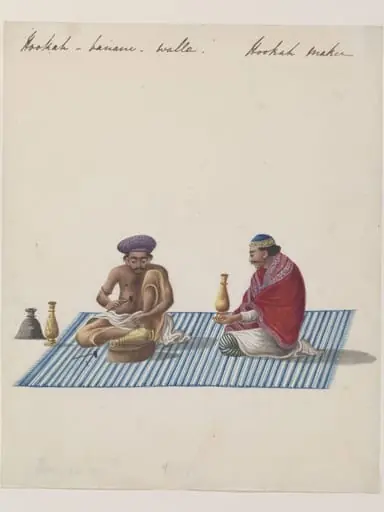
Hookah Maker
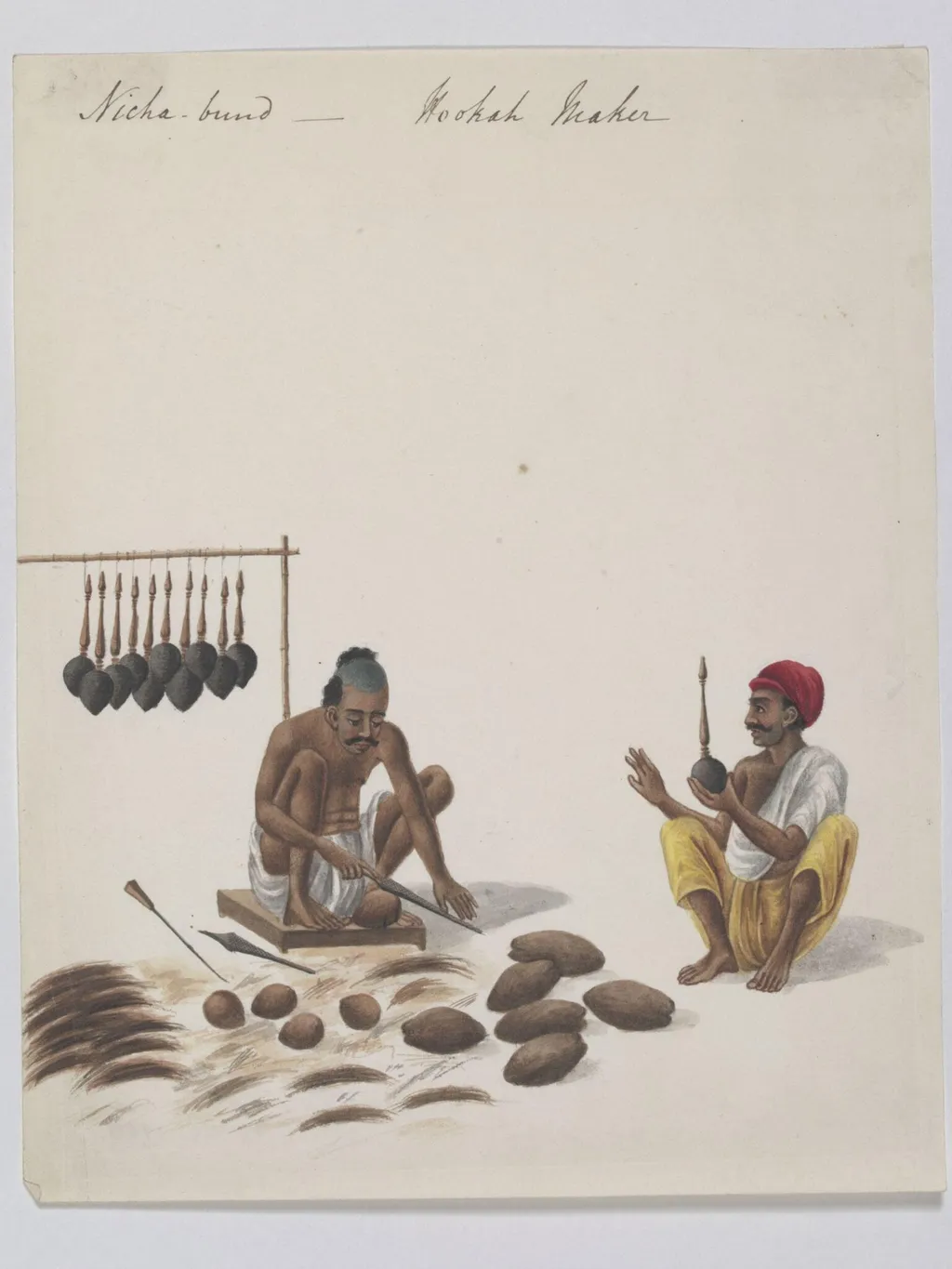
Hookah Maker is a paint painting by the Patna School of Painting artist Unknown. It dates from 1826 and is held in the collection of the Victoria and Albert Museum.
About this work
Overview
The work is a small-scale oil painting produced in Patna during the late eighteenth‑century, part of a series of thirty‑five images that document everyday occupations for the British East India Company. It portrays a single artisan at work, surrounded by the implements of his trade, and is executed in the flat, narrative style typical of Company art.
Subject & Meaning
At the centre sits a craftsman seated on the ground, shaping the stems—referred to as “snakes”—that fit into huqqas, traditional water‑pipes made from coconut shells. A second figure holds a completed huqqa, while finished pipes hang on a rack behind them, indicating both the production process and the finished commodity.
Technique & Style
Rendered in muted earth tones, the painting employs a modest chiaroscuro to suggest volume and spatial recession, though the overall effect remains largely two‑dimensional. The composition is straightforward, with the primary figure occupying the foreground and ancillary objects arranged to guide the viewer’s eye across the workshop scene.
History & Provenance
Commissioned by employees of the East India Company, the piece was intended as a visual record of local trades that supplied British personnel in India. The series remained in company archives before entering the museum’s collection in the early twentieth century, where it has been catalogued as an example of cross‑cultural visual documentation.
Context
Company paintings emerged as a pragmatic genre, blending Indian artistic conventions with European demands for ethnographic detail. This particular image reflects the economic importance of huqqa production in northern India, where coconut shells were repurposed for smoking implements that were popular among both native and colonial users.
Artist & collection

 Domestic Scene
 Giacomo and Cardinal Marco, investing Andrea, Abbot of San Zeno, with his Benefice
 The Nymph of Fontainebleau
 Portrait of a Woman
 Madonna and Child with Saints in the Enclosed Garden
 Venus and Minerva
 Family Group of Four on Sofa
 Wall painting from Room H of the Villa of P. Fannius Synistor at Boscoreale