Artwork
Icoa. D
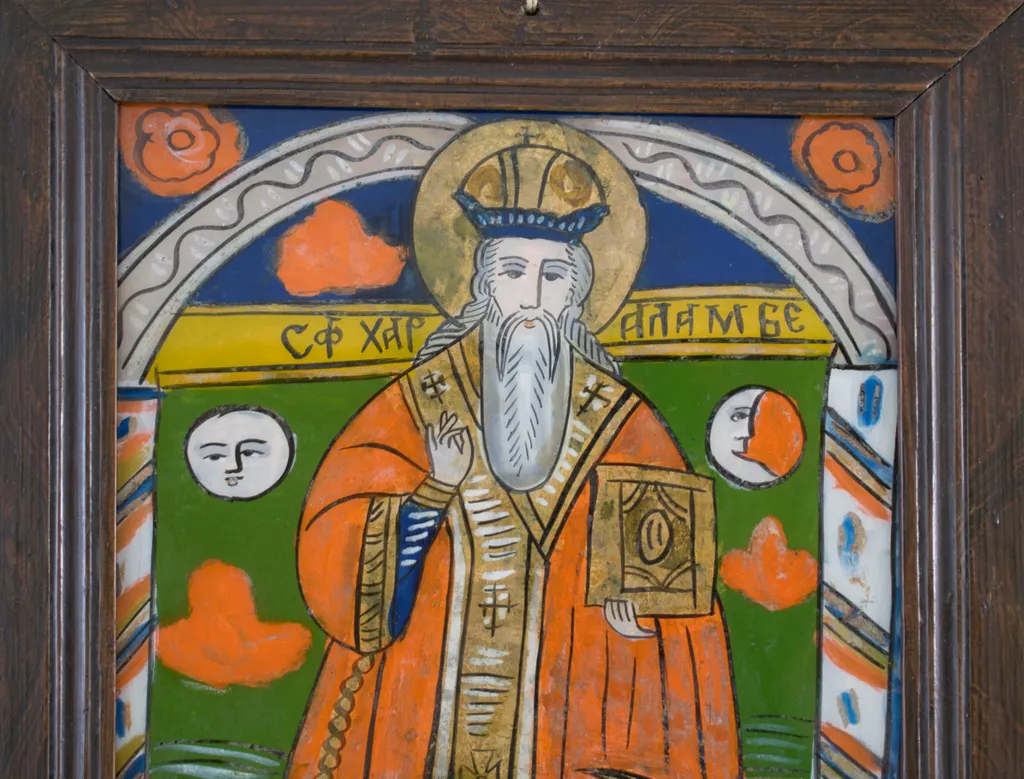
Icoa. D is a drawing by Unknown. It dates from 1850 and is held in the collection of the "Dimitrie Gusti" National Village Museum. This image depicts a solemn, robed figure with a luminous face and long white beard, crowned and holding a small golden book.
About this work
Overview
This image depicts a solemn, robed figure with a luminous face and long white beard, crowned and holding a small golden book.
This image depicts a solemn, robed figure with a luminous face and long white beard, crowned and holding a small golden book. The background is composed of flat, vivid hues—green, orange, and blue—arranged in simplified forms resembling clouds and a faint secondary face at the robe’s edge. The figure’s hands are gently raised, suggesting a gesture of blessing or instruction. The overall aesthetic is stylized, with bold outlines and minimal modeling, evoking folk or devotional traditions.
Subject & Meaning
The figure, likely a divine or sacred personage, is identified by the crown and book, symbols of authority and wisdom. The glowing face and raised hands imply spiritual presence or transmission of knowledge. The obscured face within the robe may represent hidden divinity or duality. The archaic script above the head suggests a liturgical or sacred inscription, reinforcing the figure’s role as a conduit of sacred text or divine law.
Technique & Style
The image employs flat, unmodulated color and strong outlines, avoiding shading or perspective to emphasize symbolic clarity over naturalism. Forms are reduced to essential shapes, with no use of cross-hatching or tonal gradation. This deliberate simplification aligns with folk or iconographic traditions, where visual immediacy and spiritual resonance take precedence over realistic depiction.
History & Provenance
The work’s origins are undocumented, but its visual language resembles medieval icons, illuminated manuscripts, or regional religious art from cultures that prioritize symbolic representation. The absence of known artist or date suggests it may have been created for private devotion or communal ritual, possibly outside mainstream artistic centers, preserving an oral or localized visual tradition.
Context
This image likely emerged in a setting where religious imagery served as a tool for teaching or meditation, not aesthetic display. Its bold colors and simplified forms reflect a visual culture that valued clarity and spiritual presence over technical refinement. Similar motifs appear in folk art traditions across Eurasia, where sacred figures are rendered with symbolic rather than anatomical accuracy.
Legacy
Though unattributed and undocumented in formal art histories, the image contributes to a broader continuum of devotional art that prioritizes spiritual communication over realism. Its stylistic choices resonate with modern interest in non-Western and vernacular traditions, offering insight into how communities visualize the sacred without reliance on academic techniques.
Artist & collection
Museum
"Dimitrie Gusti" National Village Museum
Continue through works from the same source collection.
 Domestic Scene
 Giacomo and Cardinal Marco, investing Andrea, Abbot of San Zeno, with his Benefice
 The Nymph of Fontainebleau
 Portrait of a Woman
 Madonna and Child with Saints in the Enclosed Garden
 Venus and Minerva
 Family Group of Four on Sofa
 Wall painting from Room H of the Villa of P. Fannius Synistor at Boscoreale
 Icoa exf
 Icoafolc
 Sf. Nicolae
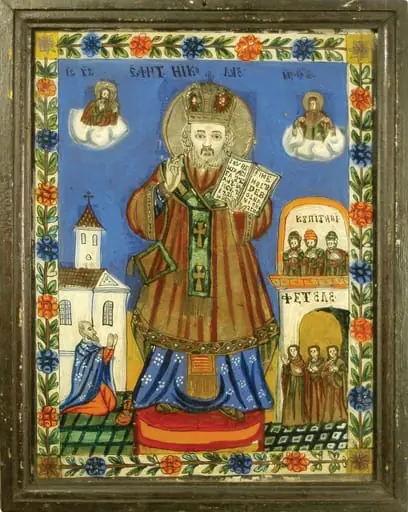 Sf. Nicolae
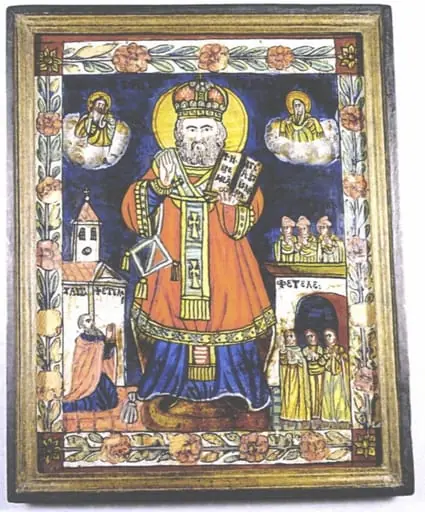 Sfântul Ncolae
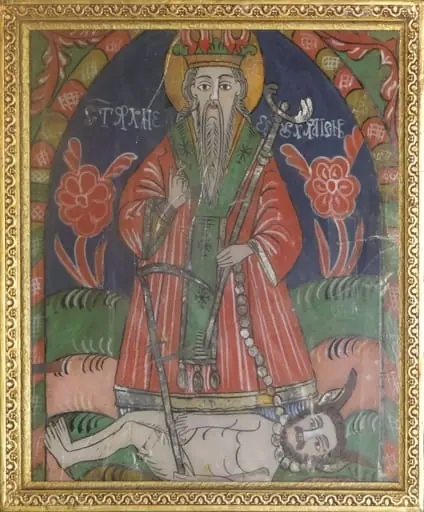 Sf. Haralambie
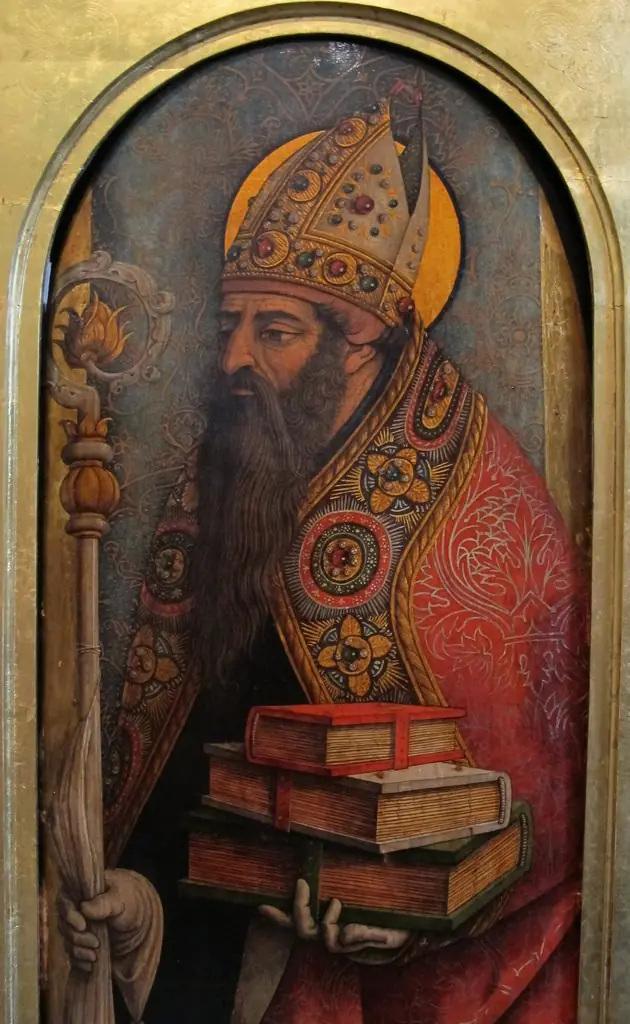 St. Augustine
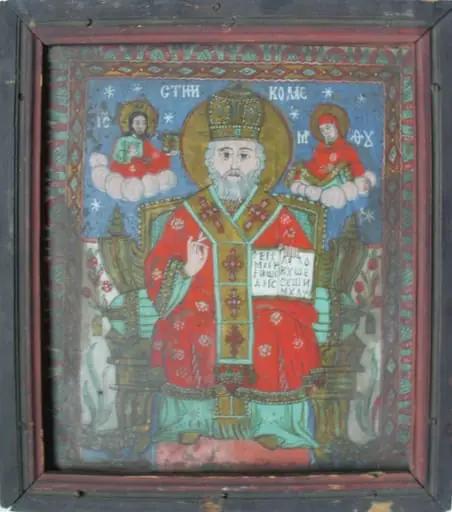
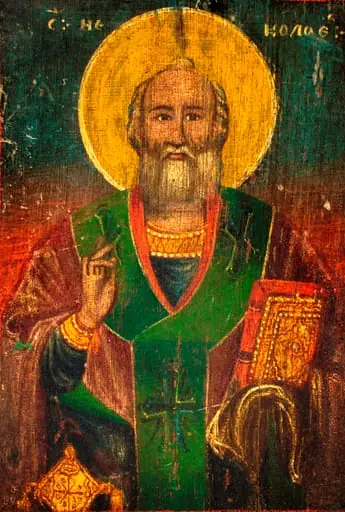 Icoana îl reprezintă pe sfântul Nicolae 3/4, frontal, în ipostaza de mare ierarh, binecuvântînd cu mâna dreaptă, în stânga ținînd Cartea Sfântă. Sfântul este redat cu capul descoperit, barba de lungime medie, fruntea înaltă, ochii căprui. În jurul capului aureolă de culoare deschisă, gălbuie, aplicată peste un strat de bronz auriu, mărginită cu o linie albă. Înveșmântat cu sacos roșu cărămiziu, cu intradosul verde, epitrahil verde, cu o linie subțire pe margine și cruci negre conturate cu alb și raze negre. Stihar bleumarin cu mânecuțe aurii decorate cu perle albe și motiv geometric, la fel galonul de la gât. Mâna cu care ține cartea este acoperită de omofor, în semn de smerenie. De mâna cu care binecuvintează atârnă bedernița de culoare galben aurie, cu franjuri și motive geometrice. Coperta cărții legate în piele bogat decorată. Chenar din linii ondulate de culoare galbenă, dispuse longitudinal, mărginit la interior de o linie subțire roșie și una închisă la exterior. Proporțiile în general respectate, capul este ușor mai mic în comparație cu corpul masiv, ceea ce creează un efect de depărtare, accentuat și de fondul luminat roșiatic în partea de jos, albastru în cea de sus. Maniera picturală, indică un pictor școlit, influențat de pictura academistă. Icoana prezintă un strat de murdărie și mici crăpături.
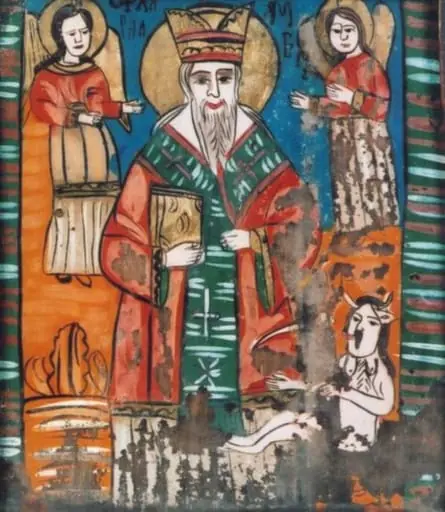 Sfântul Haralambie