Artwork
Icoana îi reprezintă pe cei doisprezece Apostoli cu Sfinții Apostoli Petru și Pavel, Petru cu cheile Împărăției Cerești în mână și pe Pavel cu sabia Cuvântului în mână. Sfinții Apostoli au mantiile roșii vermillon, înspre trandafiriu, și veșmintele în combinație de crem-rozaliu și ocru-orange, cu liniuțe albe-roșii. Toți cei 12 Apostoli țin chivotul Bisericii creștin-ortodoxe și sobornicești cu mânilie dimpreună. În registrul superior, dintr-o mandorlă este Dumnezeu-Tatăl Binecuvântând. Fondul icoanei este cerul albastru regal-cobalt. În registrul îndepărtat elementul de arhitectură reprezintă simbolic Biserica ortodoxă-creștină apostolică, pe care o poartă, ca pe un chivot, Sfinții Apostoli Petru și Pavel, propovăduind-o. Biserica, cheile și crucea sunt simboluri puternice. Compoziția este rezistentă și cromatica armonioasă: roșu vermillon-trandafiriu, albastru regal, cobalt și ceruleum, galben chihlimbar, ocru, brun, gri, alb zinc, negru, auriu. Inscripția din româno-chirilică se traduce Petru și Pavel. Icoana este din Țara Oltului, Șcheii Brașovului.
Icoana îi reprezintă pe cei doisprezece Apostoli cu Sfinții Apostoli Petru și Pavel, Petru cu cheile Împărăției Cerești în mână și pe Pavel cu sabia Cuvântului în mână. Sfinții Apostoli au mantiile roșii vermillon, înspre trandafiriu, și veșmintele în combinație de crem-rozaliu și ocru-orange, cu liniuțe albe-roșii. Toți cei 12 Apostoli țin chivotul Bisericii creștin-ortodoxe și sobornicești cu mânilie dimpreună. În registrul superior, dintr-o mandorlă este Dumnezeu-Tatăl Binecuvântând. Fondul icoanei este cerul albastru regal-cobalt. În registrul îndepărtat elementul de arhitectură reprezintă simbolic Biserica ortodoxă-creștină apostolică, pe care o poartă, ca pe un chivot, Sfinții Apostoli Petru și Pavel, propovăduind-o. Biserica, cheile și crucea sunt simboluri puternice. Compoziția este rezistentă și cromatica armonioasă: roșu vermillon-trandafiriu, albastru regal, cobalt și ceruleum, galben chihlimbar, ocru, brun, gri, alb zinc, negru, auriu. Inscripția din româno-chirilică se traduce Petru și Pavel. Icoana este din Țara Oltului, Șcheii Brașovului. is a drawing by Unknown. It dates from 1850 and is held in the collection of the ASTRA National Museum Complex.
About this work
Overview
This icon depicts the Twelve Apostles collectively bearing the symbolic chest of the Orthodox Church, with Saints Peter and Paul prominently featured.
This icon depicts the Twelve Apostles collectively bearing the symbolic chest of the Orthodox Church, with Saints Peter and Paul prominently featured. Peter holds the keys to the Kingdom of Heaven, while Paul bears the sword of the Word. Above them, God the Father blesses from a mandorla within a royal cobalt blue sky. The composition is structured in horizontal registers, with architectural elements in the background representing the apostolic Church. The work originates from Șcheii Brașovului in Țara Oltului.
Subject & Meaning
The icon conveys the apostolic foundation of the Orthodox Church through symbolic action: all twelve apostles carry the church as a sacred chest, affirming their collective role in preserving doctrine. Peter and Paul, as leaders of the early Christian community, are distinguished by their attributes—keys and sword—signifying spiritual authority and divine truth. The architectural form behind them evokes the enduring structure of the Church, while the blessing hand of God above affirms divine sanction of their mission.
Technique & Style
The icon employs traditional Byzantine conventions with a restrained yet rich palette: vermilion and rose-red mantles, cream-pink and ochre-orange garments, and accents of gold, cobalt, and zinc white. Lines are crisp, forms are stylized, and color relationships are carefully balanced to create visual harmony without naturalism. The use of gold and deep blues reflects liturgical symbolism, while the flat, layered composition emphasizes spiritual presence over spatial depth.
History & Provenance
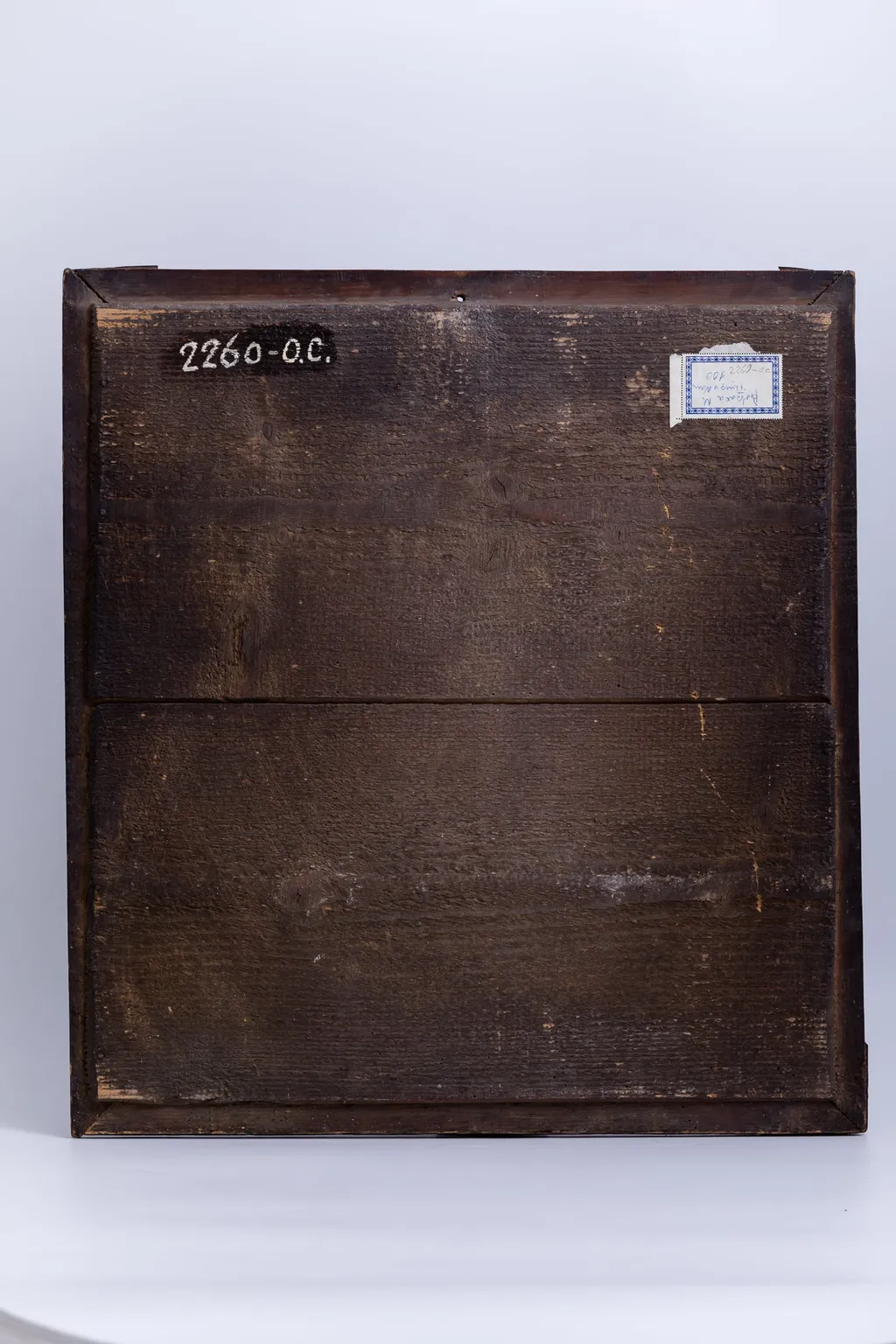
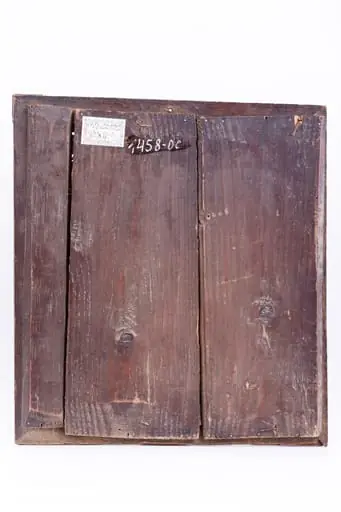
The icon was painted on the reverse of a dark wooden panel, now visibly worn from handling and age. Faint traces of paint and surface scratches suggest prolonged use in a devotional context. Two small labels on the upper right—handwritten ink and a museum tag—indicate later institutional handling. Its origin in Șcheii Brașovului places it within the religious art traditions of Țara Oltului, likely dating to the late medieval or early modern period.
Context
Produced in a region with strong Orthodox Christian traditions, the icon reflects liturgical and theological norms of Eastern Christianity. The emphasis on apostolic succession, the use of Cyrillic inscriptions, and the symbolic architecture align with broader Balkan and Romanian iconographic practices. Such images served both as objects of veneration and as didactic tools, reinforcing doctrinal unity among the faithful through visual language accessible to the illiterate.
Legacy
This icon remains a tangible link to regional religious expression in Transylvania, preserving stylistic and symbolic conventions that endured for centuries. Its survival, despite physical wear and later museum curation, underscores the resilience of Orthodox devotional culture. The persistence of its iconography—keys, sword, mandorla, and chest—demonstrates the continuity of theological imagery across generations in Romanian ecclesiastical art.
Artist & collection

 Domestic Scene
 Giacomo and Cardinal Marco, investing Andrea, Abbot of San Zeno, with his Benefice
 The Nymph of Fontainebleau
 Portrait of a Woman
 Madonna and Child with Saints in the Enclosed Garden
 Venus and Minerva
 Family Group of Four on Sofa
 Wall painting from Room H of the Villa of P. Fannius Synistor at Boscoreale
 Icoana reprezintă Învierea Domnului Iisus Hristos. Mântuitorul Iisus Hristos, ieșind din mormânt, Înviind, Binecuvântând zdrobește ușile iadului. Mântuitorul este înfășurat cu o țesătură verde kaki-gri în mijlocul coapselor și a mijlocului și cu mantia roșie vermillon pe umeri. În dreapta mormântului gri, deschis, sunt doi ostași romani, uimiți. Icoana de Nicula are o cromatică armonioasă: galben-solar, roșu vermillon, alb, albastru cobalt, verde brad-pădure, negru, gri cenușiu. Fondul icoanei este cerul albastru cobalt-ceruleum, în registrul superior și un câmp galben-ocru, cu brun-maro cu pete crem, în registrul inferior, realizându-se, astfel sugestiv, intrarea și ieșirea din pământul morții și a păcatului. Întreaga compoziție iconografică este încadrată de un chenar decorativ geometrizant roșu vermillon și de unul fitomorf, format dintr-o ghirlandă cu două flori-narcise cu frunze unduitoare. Cromatica este armonioasă: roșu vermillon, galben chihlimbar, albastru cobalt-ceruleum, brun, maro, bej, verde smarald, kaki, negru, gri, alb. Inscripția în româno-chirilică se traduce IC XC Iisus Hristos. Icoana este din Nordul Transilvaniei, Nicula.
 Icoana îi reprezintă pe cei doi Apostoli Sfinții Petru și Pavel, dimpreună cu Soborul de Sfinți Apostoli. Petru cu cheile Împărăției Cerești în mână și pe Pavel cu sabia Cuvântului în mână, susținând împreună chivotul unei biserici, simbolul Bisericii sobornicești și apostolești. Au mantiile roșii și veșmintele în combinație de roșu vermillon, albastru cobalt dungat cu alb și galben solar. Fondul icoanei este cerul albastru ceruleum cu elemente astrale - stele albe și roșii. În grup strâns, în spatele Sfinților Petru și Pavel sunt încă 7 sfinți apostoli și ucenici și un înger cu aripile galbene de lumină. Toți susțin împreună chivotul unei biserici mari. Deasupra Sfinților Apostoli este Dumnezeu-Tatăl care îi veghează, din Cerurile deschise, trimițându-i în toată lumea să propovăduiască Sfânta Evanghelie, numindu-i pescari de oameni. Dumnezeu-Tatăl este prezent prin Ochiul Dumnezeiesc înscris în semnul triunghiului echilateral al Sfintei Treimi, care privește din Cerurile deschise, prin mandorla de nouri albi-albaștri. Chipurile sunt foarte expresive, cu trăsături fine. Compoziția este rezistentă și cromatica foarte armonioasă: roșu vermillon, verde spanac-avocado, galben solar ocru, albastru ceruleum, cobalt, bleu-ciel, brun, gri, alb, negru, auriu. Icoana este de Țara Oltului. Inscripția din româno-chirilică se traduce Petru Pavel.
 Icoana este împărțită în 6 ferestre, de prăznicar, pe trei registre, două câte două: Sfinții Mari Ierarhi Spiridon Tămăduitor de boli, Vasile cel Mare, Grigorie de Dumnezeu Cuvântătorul, Ioan Gură-de-Aur, Nicolae făcător de minuni. Sfinții sunt încadrați de coloane și arcade de bolți de biserică. Au veșminte arhierești cu sacos, felon, mithră, aureolă și epitrahil-patrafir. Țin în mâna dreaptă Sfânta Scriptură închisă și Binecuvântează cu mâna stângă. Cromatica este armonioasă și vie, puternică, specifică Țării Oltului; roșu vermillon, albastru regal, bleu-ciel, verde spanac-avocado, galben-ocru, brun, bej, cafeniu, negru, alb, auriu. Inscripția din româno-chirilică se traduce Sf Spiridon Sf Vasile Sf Grigorie Sf Ioan Sf Nicolae. Icoana este de Șcheii Brașovului, Țara Oltului.
 Icoana îi reprezintă împreună pe Sfântul Mare Ierarh Nicolae, Sfântul Ioan Botezătorul și Sfântul Mare Mucenic Teodor Tiron. Veșmintele Sfântului Nicolae sunt sacos gri și roșu vermillon, cu patrafir-epitrahil auriu cu verde, două bedernițe verzi, de o parte și de alta a veșmântului. În mijloc, este Sfântul Ioan Botezătorul și Înaintemergătorul Domnului Iisus Hristos îmbrăcat cu un himation alb-gri-negru, din păr de cămilă, și o mantie roșie, purtând crucea biruinței. Alături este Sfântul Mare Mucenic Teodor Tiron, îmbrăcat cu haine de oștean-militar, tunică și vestă de zale aurie, cu mantie roșie cu interiorul galben, de lumină. În mâna dreaptă are spada credinței. Fondul icoanei este albastru cobalt, în registrul superior și roz, în registrul inferior. Pe latura inferioară, icoana este încadrată de elemente florale - trei ruje mari, trandafiri roșii, cu frunze verzi. Inscripția din româno-chirilică se traduce Sf Nicolae Sf Ioan Botezătorul Sf Teodor Tiron. Icoana este de Țara Oltului.
 Icoana îl reprezintă pe Mântuitorul Iisus Hristos, copil fiind, având în mânuțe globul pământesc cu o cruce deasupra, asemenea unui chivot sfințit, galben cu verde. Copilașul este înfășurat cu o țesătură roșie vermillon-roz și negru. În interiorul icoanei este un composit de albastru ceruleum și galben chihlimbar luminos. Întreaga tematică iconografică este încadrată de un chenar decorativ fitomorf, format dintr-o ghirlandă de trandafiri, 3 ruje roșii, cu motivul zăluței albe în interior, pe latura inferioară a icoanei și un boboc de măceș în spatele Copilașului Iisus. Inscripția din româno-chirilică se traduce Cristos. Icoana este de Nicula, având o cromatică luminoasă: roșu vermillon, roz, albastru bleu-ciel și ceruleum, galben chihlimbar, verde brad, alb, negru. Icoana este din Nordul Transilvaniei, Nicula.
 Icoana reprezintă Sfânta Treime. Dumnezeu-Tatăl și Fiul Iisus Hristos susțin globul pământesc dimpreună, Binecuvântând lumea, și având Crucea în spatele Pământului. Dumnezeu-Tatăl și Dumnezeu-Fiul sunt înveșmântați în roșu vermillon și verde-văratic-kaki, cu liniuțe fine albe. Deasupra, în registrul superior, dintr-un mănunchi de raze luminoase, printr-o mandorlă de nouri albi, rotunzi, se pogoară Sfântul Duh, sub forma porumbelului alb. Astfel este prezentă întreaga Sfântă Treime. Între Dumnezeu-Tatăl și Fiul este un spațiu luminos de galben, cu Crucea aurie. Fondul icoanei este cerul albastru ultramarin-indigo înconjurat de lumina galbenă de chihlimbar și lumina albă, ca de zăpadă. Întreaga tematică iconografică este încadrată de un chenar decorativ geometrizant brun-acajou, cu linia albă șerpuită, simbolul infinitului. Inscripția din româno-chirilică se traduce S Treime. Cromatica este luminoasă și armonioasă: roșu vermillon, albastru ultramarin-indigo, galben chihlimbar, verde văratic-kaki, brun, acajou, alb, negru. Icoana este din Nordul Transilvaniei, Nicula.
 Icoana îi reprezintă alături, față în față, ca într-o oglindă, pe Pruncul Iisus Hristos și Pruncul Ioan, cel care avea să fie Sfântul Ioan Botezătorul și Înaintemergătorul Domnului nostru Iisus Hristos. Cei doi copilași erau veri, cu o diferență de șase luni între ei. Pruncul Iisus Hristos are în mânuțe globul pământesc cu o cruce deasupra, asemenea unui chivot sfințit, iar Pruncul Ioan are în brațe un mieluț, arătând către Mântuitorul Iisus Hristos: „Iată mielul!”. Sunt înfășurați amândoi cu câte o țesătură roșie-cărămizie-roz, culoarea pătimirii și a jertfei. În interiorul icoanei este un composit de albastru ultramarin bleu-marin și galben luminos. Întreaga tematică iconografică este încadrată de un chenar decorativ fitomorf, format dintr-o ghirlandă de trandafiri, 5 duble și 4 ruje roșii, bobocei de trandafirași, În centru icoanei, între cei doi copilași este un fruct de măceș. Icoana este de Nicula, având o cromatică luminoasă: roșu vermillon-cărămiziu-roz, albastru ultramarin și bleumarin, bleu ciel și ceruleum, galben chihlimbar, verde brad, alb, negru. Inscripția din româno-chirilică se traduce: Ioan IC XC Iisus Hristos. Icoana este din Nordul Transilvaniei, Nicula.