Artwork
Icoana reprezintă Pogorârea Duhului Sfânt, Cincizecimea sau Rusaliile, una dintre cele mai vechi sărbători, considerată în tradiția creștină ziua întemeierii Bisericii. Este prăznuită la 50 de zile după Învierea Domnului Iisus Hristos. A avut loc convertirea a 3000 de oameni. Este numită Duminica cea Mare. Duhul Sfânt S-a Pogorât asupra Apostolilor, sub forma limbilor de foc. Maica Domnului este prezentă la Pogorârea Duhului Sfânt, în mijlocul Apostolilor. În cadrul icoanei, Maica Domnului este înveșmântată în sacos alb, cu dungi albastre verticale și felon, maforion roșu-vermillon. În stânga și în dreapta Maicii Domnului sunt doi dintre cei 12 Apostoli ai Mântuitorului Iisus Hristos, înveșmântați în sacos alb cu dungi albastre și mantii roșii. În registrul îndepărtat în dreapta și în stânga sunt doi îngeri înveșmântați cu lumină galbenă. În registrul superior este un soare roșu vermillon-orange, cu raze verzi, reprezentând Cerurile deschizându-se. Sfântul Duh este reprezentat ca un porumbel alb pogorându-Se, întâlnit de asemenea și la Botezul Domnului Iisus Hristos. Fondul icoanei este cerul albastru-vernil-gri, încadrat de un chenar decorativ fitomorf, format din ghirlande trandafirii roșii, cu frunze verzi și galbene. Trandafiri - ruje pentru că este Praznicul Rusaliilor, verzi pentru că este Sfântul Duh, galbene pentru că este reamintirea Învierii Domnului Iisus Hristos. Cromatica este armonioasă: albastru-vernil-gri, verde brad, galben-chihlimbar, ocru, roșu vermillon, alb, negru. Inscripția din româno-chirilică se traduce Rusaliile. Icoana reprezintă o tematică iconografică mai rară, dar esențială. Icoana este din Nicula.
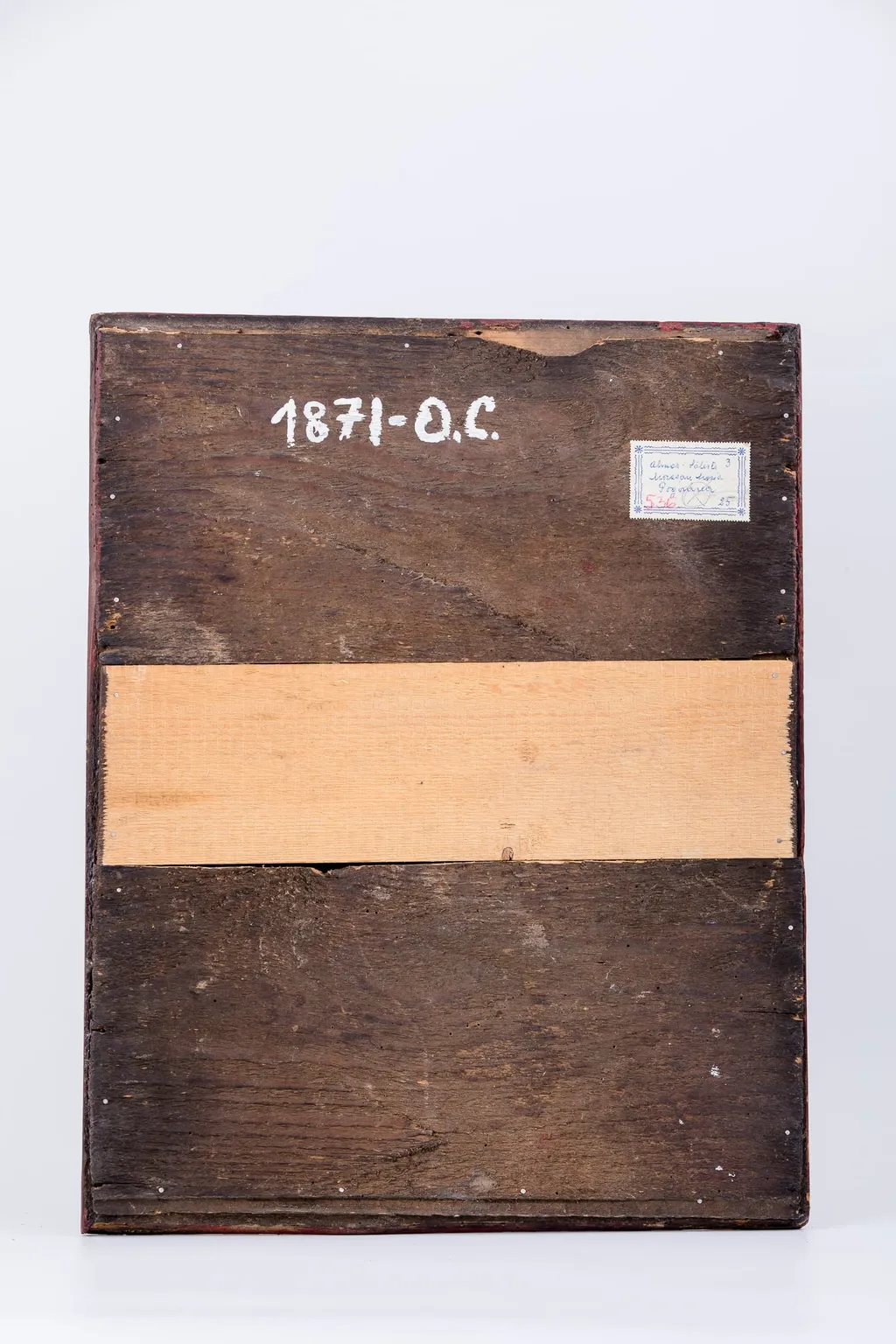
Icoana reprezintă Pogorârea Duhului Sfânt, Cincizecimea sau Rusaliile, una dintre cele mai vechi sărbători, considerată în tradiția creștină ziua întemeierii Bisericii. Este prăznuită la 50 de zile după Învierea Domnului Iisus Hristos. A avut loc convertirea a 3000 de oameni. Este numită Duminica cea Mare. Duhul Sfânt S-a Pogorât asupra Apostolilor, sub forma limbilor de foc. Maica Domnului este prezentă la Pogorârea Duhului Sfânt, în mijlocul Apostolilor. În cadrul icoanei, Maica Domnului este înveșmântată în sacos alb, cu dungi albastre verticale și felon, maforion roșu-vermillon. În stânga și în dreapta Maicii Domnului sunt doi dintre cei 12 Apostoli ai Mântuitorului Iisus Hristos, înveșmântați în sacos alb cu dungi albastre și mantii roșii. În registrul îndepărtat în dreapta și în stânga sunt doi îngeri înveșmântați cu lumină galbenă. În registrul superior este un soare roșu vermillon-orange, cu raze verzi, reprezentând Cerurile deschizându-se. Sfântul Duh este reprezentat ca un porumbel alb pogorându-Se, întâlnit de asemenea și la Botezul Domnului Iisus Hristos. Fondul icoanei este cerul albastru-vernil-gri, încadrat de un chenar decorativ fitomorf, format din ghirlande trandafirii roșii, cu frunze verzi și galbene. Trandafiri - ruje pentru că este Praznicul Rusaliilor, verzi pentru că este Sfântul Duh, galbene pentru că este reamintirea Învierii Domnului Iisus Hristos. Cromatica este armonioasă: albastru-vernil-gri, verde brad, galben-chihlimbar, ocru, roșu vermillon, alb, negru. Inscripția din româno-chirilică se traduce Rusaliile. Icoana reprezintă o tematică iconografică mai rară, dar esențială. Icoana este din Nicula. is a drawing by Unknown. It dates from 1850 and is held in the collection of the ASTRA National Museum Complex. This wooden panel once bore an icon depicting the Descent of the Holy Spirit, known in Romanian tradition as Rusaliile.
About this work
The tag and date hint it might have been part of something important, but the front is missing.
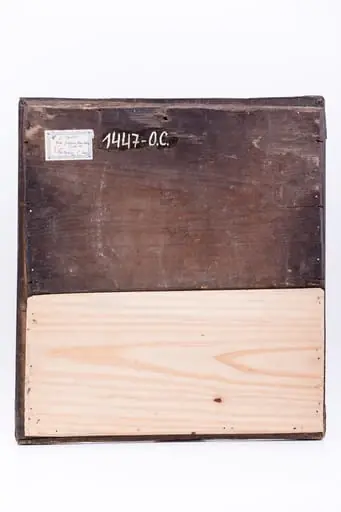
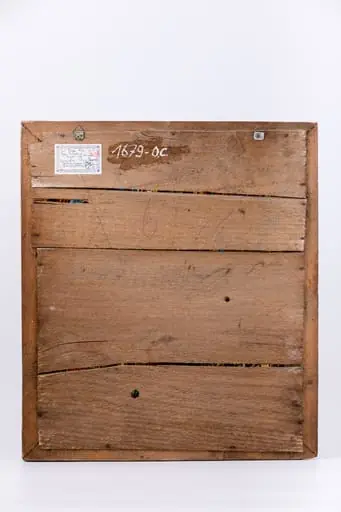
This is the back of a wooden panel. The wood is dark, worn, and split in places. There’s a faded white label with "1871–O.C." written on it, and a small paper tag stuck near the top right corner.
The panel looks old, with patches of lighter wood showing through the dark finish. The tag and date hint it might have been part of something important, but the front is missing.
If you’re curious about old religious objects like this, look up cult object.
Overview
This wooden panel once bore an icon depicting the Descent of the Holy Spirit, known in Romanian tradition as Rusaliile. The reverse side shows signs of age: dark, split wood, worn finish, and faint remnants of a label reading '1871–O.C.' A small paper tag near the top right suggests it was once cataloged or venerated. The front image, now lost, was likely a liturgical object from the Nicula monastery, tied to Pentecost observances in Romanian Orthodox practice.
Subject & Meaning
The icon illustrated the Pentecost event, when the Holy Spirit descended upon the Apostles as tongues of fire, marking the founding of the Christian Church. The Virgin Mary, centrally placed among the Apostles, symbolized her role as the Church’s spiritual mother. A white dove, echoing Christ’s baptism, descended from a radiant red sun above, representing heaven opening. The scene affirmed divine presence at the birth of the Church, witnessed by angels and sanctified by ritual color symbolism.
Technique & Style
The icon followed traditional Byzantine conventions with hierarchical composition and symbolic color coding. The Virgin wore a white tunic with blue vertical stripes and a vermilion maphorion; Apostles were clad in white and red mantles. Angels glowed in golden light, while the heavens opened with vermilion-orange rays against a blue-gray sky. Decorative floral borders featured red roses, green leaves, and yellow accents, each hue tied to Pentecostal themes. Pigments included ochre, verdigris, and charcoal, applied with restrained brushwork typical of regional icon workshops.
History & Provenance
The panel originated in the Nicula monastery, a center of Orthodox devotion in Transylvania. The inscription 'Rusaliile' in Romanian Cyrillic confirms its liturgical use during Pentecost. The 1871 date on the reverse suggests it was recorded or restored in the late 19th century, possibly during a period of renewed interest in traditional religious artifacts. Its survival as a back panel implies the front was removed, perhaps for reuse, damage, or transfer to another object.
Context
Pentecost, or Rusaliile, was among the oldest Christian feasts, celebrated fifty days after Easter. In Romanian tradition, it was called 'Great Sunday' and marked by communal rituals, processions, and icon veneration. Icons of this theme, though less common than those of Christ or the Virgin, held theological weight as representations of the Church’s divine foundation. The Nicula monastery, known for its iconography, produced such works for local parishes and pilgrims seeking spiritual connection.
Legacy
Though the front image is lost, the surviving panel remains a material witness to devotional practices in 19th-century Romanian Orthodoxy. Its physical state—worn, split, labeled—reflects centuries of use and reverence. The persistence of its iconographic program, even in fragmentary form, underscores the endurance of Byzantine visual theology in rural religious life. Today, such fragments are studied as cultural artifacts, preserving the quiet continuity of faith expressed through material objects.
Artist & collection

 Domestic Scene
 Giacomo and Cardinal Marco, investing Andrea, Abbot of San Zeno, with his Benefice
 The Nymph of Fontainebleau
 Portrait of a Woman
 Madonna and Child with Saints in the Enclosed Garden
 Venus and Minerva
 Family Group of Four on Sofa
 Wall painting from Room H of the Villa of P. Fannius Synistor at Boscoreale
 Icoana este rară prin tematica iconografică abordată, având o compoziție simetrică, echilibrată și armonioasă cromatic, structural și teologic. Central este Dumnezeu pe tron arhieresc Mare Judecător și Învățător. Este îmbrăcat cu sacos albastru cobalt-regal cu dungi albe, cu felon și omofor roșu vermillon, cu epitrahil-patrafir vernil-absint, cu trei cruci negre și o floare de lalea cu trei petale lunguiețe albe. Cu mâna dreaptă ține Sfânta Scriptură deschisă pe genunchi și cu mâna stângă Binecuvântează. Tronul arhieresc este bogat ornamentat cu elemente decorative geometrizante bronzii, albe și negre, având aripile de arhitectură umplute cu un caroiaj aparte. Mântuitorul Iisus Hristos are picioarele așezate pe o pernă roșie. În partea dreaptă a Lui Dumnezeu este Sfântul Ioan Botezătorul și Înaintemergătorul Domnului Iisus Hristos. Sfântul Ioan este îmbrăcat în sarică albastră de păr de cămilă și omofor-mantie verde kaki. În stânga Mântuitorului Iisus Hristos este Maica Domnului, în sacos albastru cobalt și mantie cu maforiom roșu vermillon, cu interiorul vernil-absint. În registrul mai îndepărtat sunt situați Sfinții Arhangheli Mihail și Gavriil, mai-marii oștilor cerești și încă doi sfinți arhangheli, din soborul îngerilor păzitori. În registrul superior este Dumnezeu-Tatăl, în veșmânt roșu, trimițând din Cerurile deschise, printr-o mandorlă de nouri albi, pe Sfântul Duh, sub forma porumbelului alb. Fondul icoanei este cerul albastru cobalt, încadrată icoana fiind de un chenar decorativ bronziu, lat, cu elemente florale stilizate mari roșii - 9 ruje. Inscripția din româno-chirilică este IC XC MP Iisus Hristos Maica Domnului. Cromatica este vie, luminoasă și armonioasă: roșu vermillon, verde absint, vernil, kaki, albastru cobalt, brun, bej, negru, alb. Icoana este din Țara Făgărașului.
 Icoana cu tematica iconografică Botezul Domnului Iisus Hristos este realizată pe trei registre: în registrul central, Domnul Iisus Hristos primește Botezul, în râul Iordanului, din partea Sfântului Mare Prooroc și Înaintemergător Ioan Botezătorul, care se află în stânga Mântuitorului. Mântuitorul este înfășurat cu o pânză de culoare roșie vermillon împrejurul șoldurilor și a coapselor, și are mâinile împreunate pe piept, în semn de supunere, ascultare, smerenie, de bună-voie venind la Botez. În dreapta Lui, este un înger evlavios, cu aripile galbene-aurii de lumină, care Îl așteaptă pe mandorlă de nouri albi-albaștri bleu-ciel, cu un ștergar transparent gata să înveșmânteze Trupul Domnului. Sfântul Ioan Botezătorul este îmbrăcat cu o mantie roșie și un himation alb-albastru sau o haină din păr. Cerurile de culoare albastru sunt deschise și din mijlocul unei mandorle de nouri alb-albaștri se pogoară porumbelul, simbolul Sfântului Duh, pe creștetul Mântuitorului. Cromatica este specifică Țării Oltului: roșu vermillon, albastru cobalt-ceruleum, galben chihlimbar și solar, verde-văratic, brun, crem, rozaliu, alb, negru. Cerul albastru-cobalt și văzduhul verde-văratic sunt bogat ornamentate cu elemente florale - ruje roșii, cu frunze albastre. Întreaga icoană este încadrată pe laterale de chenar decorativ geometrizant bronziu, cu ruje roșii și frunze albastre. Inscripția din româno-chirilică se traduce Botezul Lui IC XC Iisus Hristos. Icoana este de Țara Oltului.
 Maica Domnului Împărăteasă a Cerurilor, pe tron așezată, ține Pruncul Iisus Hristos, în brațe. Maica Domnului este îmbrăcată cu mantie cu maforion brun, cu interiorul căptușit cu verde închis. Poartă aureolă și coroniță roșie de împărăteasă. Pruncul Iisus Hristos este îmbrăcat cu gri și verde închis, are aureolă și binecuvântează cu mâna dreaptă. În registrul superior sunt ocrotitori și păzitori Sfinții Arhangheli Mihail și Gavriil, sprijinindu-se cu mâinile de cele două turnulețe - elemente decorativ geometrizante din structura arhitecturală a bogatului tron arhieresc al Maicii Domnului Împărăteasă. În registrul superior sunt Sfântul Mare Evanghelist Luca, cel care a pictat-o pentru prima dată pe Maica Domnului cu Pruncul Iisus Hristos. Sfântul Evanghelist Luca apare împreună cu simbolul reprezentativ - vițelul - Parabola Întoarcerii Fiului risipitor. În cealaltă parte este Sfântul Evanghelist Ioan, cu vulturul, asemenea căruia se înalță în zbor Cuvântul Dumnezeiesc, fiind Teologul Iubirii. Cromatica este armonioasă, caldă și luminoasă: roșu vermillon, verde spanac-avocado, ocru, brun, gri, alb, negru. Inscripția din româno-chirilică se traduce Maica Domnului MP Iisus Hristos IC XC. Icoana este încadrată de un chenar decorativ geometrizant, pe laterale, ca două panglici late, cu ghirlande de flori mari, de culoare verde-gri. Icoana este datată 1866. Icoana este a lui Savu Moga, din Arpașu de Sus, Țara Făgărașului.
 Icoana îi reprezintă pe cei doi Apostoli Sfinții Petru și Pavel, dimpreună cu Soborul de Sfinți Apostoli. Petru cu cheile Împărăției Cerești în mână și pe Pavel cu sabia Cuvântului în mână, susținând împreună chivotul unei biserici, simbolul Bisericii sobornicești și apostolești. Au mantiile roșii și veșmintele în combinație de roșu vermillon, albastru cobalt dungat cu alb și galben solar. Fondul icoanei este cerul albastru ceruleum cu elemente astrale - stele albe și roșii. În grup strâns, în spatele Sfinților Petru și Pavel sunt încă 7 sfinți apostoli și ucenici și un înger cu aripile galbene de lumină. Toți susțin împreună chivotul unei biserici mari. Deasupra Sfinților Apostoli este Dumnezeu-Tatăl care îi veghează, din Cerurile deschise, trimițându-i în toată lumea să propovăduiască Sfânta Evanghelie, numindu-i pescari de oameni. Dumnezeu-Tatăl este prezent prin Ochiul Dumnezeiesc înscris în semnul triunghiului echilateral al Sfintei Treimi, care privește din Cerurile deschise, prin mandorla de nouri albi-albaștri. Chipurile sunt foarte expresive, cu trăsături fine. Compoziția este rezistentă și cromatica foarte armonioasă: roșu vermillon, verde spanac-avocado, galben solar ocru, albastru ceruleum, cobalt, bleu-ciel, brun, gri, alb, negru, auriu. Icoana este de Țara Oltului. Inscripția din româno-chirilică se traduce Petru Pavel.
 Icoana este mai rară, prin tematica iconografică abordată. Este un prăznicar cu 6 sfinți ierarhi, mucenici, arhidiaconi. Sunt împărțiți în două registre, a câte trei grupuri, înscrise între coloane, pe sub arcade de Biserică. În registrul superior sunt cei trei Ierarhi Vasile cel Mare, Grigorie de Dumnezeu-Cuvântătorul și Ioan Gură-de-Aur. Cei Trei Sfinți Ierarhi Vasile cel Mare, Grigorie de Dumnezeu Cuvântătorul și Ioan Gură-de-Aur slujesc și săvârșesc Sfânta Liturghie împreună. Sunt înveșmântați în veșminte liturgice: sacos albastru ceruleum și roz putred-stacojiu, cu linii albe, felon roșu vermillon-orange, epitrahil ocru-galben și verde-lime cu câte trei-patru cruci negre. Sfinții ierarhi Binecuvântează cu mâna dreaptă și țin în mâna stângă Sfânta Evanghelie închisă. În registrul al doilea, cel inferior, sunt Sfântul Mare Mucenic Dimitrie Izvorâtor de Mir, Sfântul Mare Ierarh Nicolae făcător de minuni și Sfântul Mare Arhidiacon Ștefan. Se remarcă sacosul de zale gri-argintii ale Sfântului Dimitrie, care ține în mâna dreaptă o cădelniță, iar Sfântul Ștefan Binecuvântează cu crucea, pe care o ține în mâna dreaptă. Fondul întregii icoane este cerul albastru cobalt-ceruleum, împodobit cu stele albe și roșii, elemente astrale. Cromatica este luminoasă și armonioasă: verde văratic, verde lime, alb, orange, roșu vermillon, roz-stacojiu, galben-ocru, galben chihlimbar, bej, crem, albastru cobalt și ceruleum, negru. Este o icoană specifică picturii de Țara Oltului, cu un desen fin cu conturul negru și cromatica pastelată. Inscripția din româno-chirilică se traduce Sf Vasile Sf Grigorie Sf Ioan Sf Dimitrie Sf Nicolae Sf Ștefan.