Artwork
Icoana îi reprezintă pe cei doi Apostoli Sfinții Petru și Pavel, dimpreună cu Soborul de Sfinți Apostoli. Petru cu cheile Împărăției Cerești în mână și pe Pavel cu sabia Cuvântului în mână, susținând împreună chivotul unei biserici, simbolul Bisericii sobornicești și apostolești. Au mantiile roșii și veșmintele în combinație de roșu vermillon, albastru cobalt dungat cu alb și galben solar. Fondul icoanei este cerul albastru ceruleum cu elemente astrale - stele albe și roșii. În grup strâns, în spatele Sfinților Petru și Pavel sunt încă 7 sfinți apostoli și ucenici și un înger cu aripile galbene de lumină. Toți susțin împreună chivotul unei biserici mari. Deasupra Sfinților Apostoli este Dumnezeu-Tatăl care îi veghează, din Cerurile deschise, trimițându-i în toată lumea să propovăduiască Sfânta Evanghelie, numindu-i pescari de oameni. Dumnezeu-Tatăl este prezent prin Ochiul Dumnezeiesc înscris în semnul triunghiului echilateral al Sfintei Treimi, care privește din Cerurile deschise, prin mandorla de nouri albi-albaștri. Chipurile sunt foarte expresive, cu trăsături fine. Compoziția este rezistentă și cromatica foarte armonioasă: roșu vermillon, verde spanac-avocado, galben solar ocru, albastru ceruleum, cobalt, bleu-ciel, brun, gri, alb, negru, auriu. Icoana este de Țara Oltului. Inscripția din româno-chirilică se traduce Petru Pavel.
Icoana îi reprezintă pe cei doi Apostoli Sfinții Petru și Pavel, dimpreună cu Soborul de Sfinți Apostoli. Petru cu cheile Împărăției Cerești în mână și pe Pavel cu sabia Cuvântului în mână, susținând împreună chivotul unei biserici, simbolul Bisericii sobornicești și apostolești. Au mantiile roșii și veșmintele în combinație de roșu vermillon, albastru cobalt dungat cu alb și galben solar. Fondul icoanei este cerul albastru ceruleum cu elemente astrale - stele albe și roșii. În grup strâns, în spatele Sfinților Petru și Pavel sunt încă 7 sfinți apostoli și ucenici și un înger cu aripile galbene de lumină. Toți susțin împreună chivotul unei biserici mari. Deasupra Sfinților Apostoli este Dumnezeu-Tatăl care îi veghează, din Cerurile deschise, trimițându-i în toată lumea să propovăduiască Sfânta Evanghelie, numindu-i pescari de oameni. Dumnezeu-Tatăl este prezent prin Ochiul Dumnezeiesc înscris în semnul triunghiului echilateral al Sfintei Treimi, care privește din Cerurile deschise, prin mandorla de nouri albi-albaștri. Chipurile sunt foarte expresive, cu trăsături fine. Compoziția este rezistentă și cromatica foarte armonioasă: roșu vermillon, verde spanac-avocado, galben solar ocru, albastru ceruleum, cobalt, bleu-ciel, brun, gri, alb, negru, auriu. Icoana este de Țara Oltului. Inscripția din româno-chirilică se traduce Petru Pavel. is a drawing by Unknown. It dates from 1850 and is held in the collection of the ASTRA National Museum Complex. This icon depicts the Twelve Apostles, led by Saints Peter and Paul, jointly supporting a model church symbolizing the universal Church.
About this work
If you're interested in learning more about this painting, you might want to look up the Museum of Ethnography, where it is currently held.
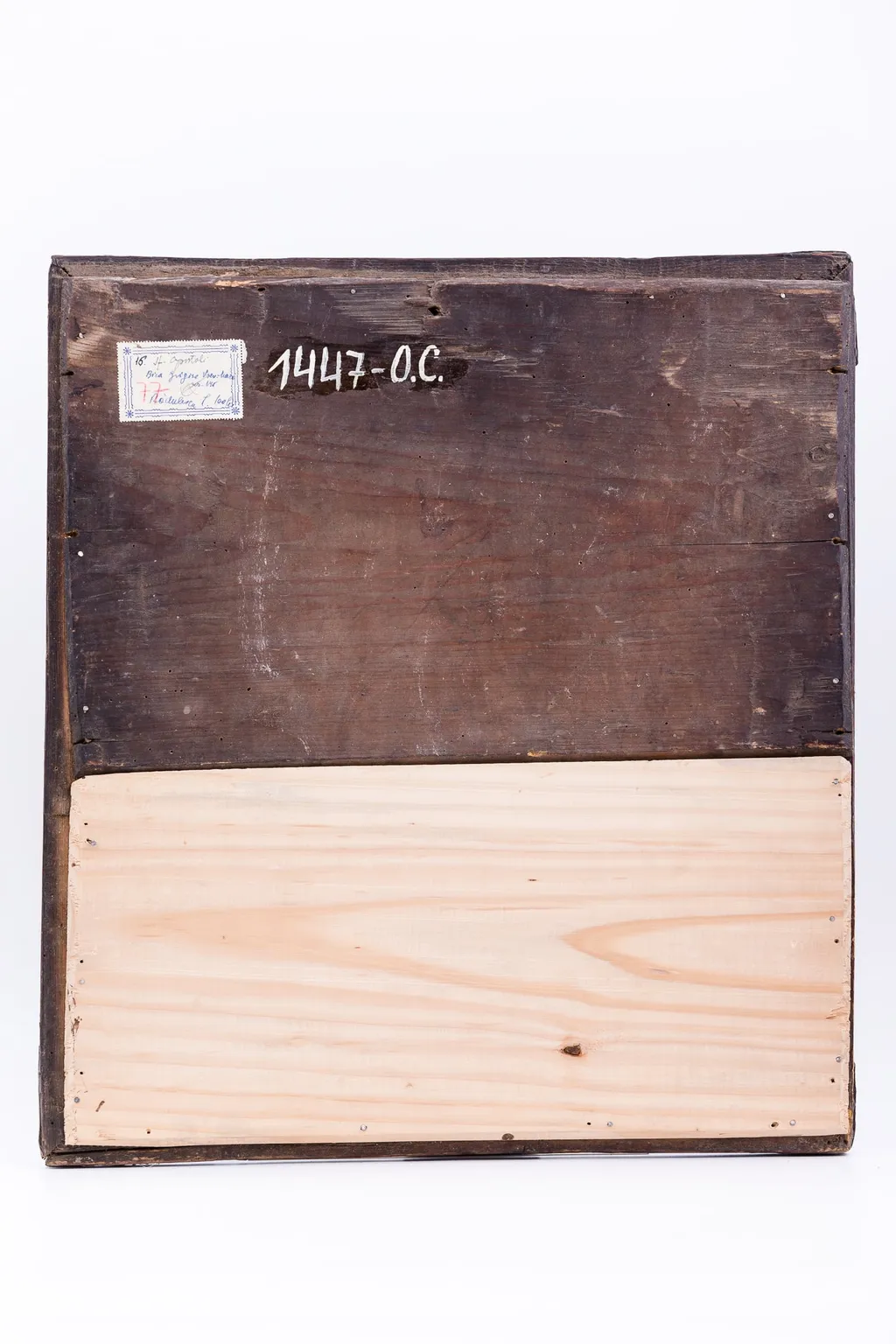
The image shows the back of a painting, which is made of wood. The top half is dark brown, while the bottom half is light brown. There is a white sticker on the top left corner with some writing on it, but it's not clear what it says. In the top center, there is a handwritten number "1447-O.C." in white.
The painting appears to be quite old, with visible signs of wear and tear on the wood. The dark brown color of the top half suggests that it may have been exposed to the elements at some point.
If you're interested in learning more about this painting, you might want to look up the Museum of Ethnography, where it is currently held.
Overview
This icon depicts the Twelve Apostles, led by Saints Peter and Paul, jointly supporting a model church symbolizing the universal Church. Above them, the Eye of God within a triangular mandorla signifies divine oversight. The composition includes seven additional apostles and a radiant angel, all arranged in a tight, unified group beneath the heavenly realm. The background features a celestial blue field with white and red stars, reinforcing the sacred setting.
Subject & Meaning
Saint Peter holds the keys to the Kingdom of Heaven, while Saint Paul bears the sword of the Word, emblematic of their respective roles as foundational figures of the Church. Together with the other apostles and an angel, they uphold the church model, representing the apostolic succession and the collective mission to spread the Gospel. The presence of God the Father as the divine Eye underscores their divine commission as 'fishers of men,' affirming the Church’s heavenly mandate.
Technique & Style
The icon employs a rich, harmonious palette including vermilion, cobalt blue, solar yellow, and gold leaf, applied with precision to convey spiritual luminosity. Facial features are delicately rendered, expressing solemnity and individuality. The figures are tightly grouped, creating a stable, symmetrical composition. The use of contrasting tones—deep browns, ochres, and whites—enhances depth, while the celestial background suggests transcendence through subtle star motifs.
History & Provenance
The icon originates from the region of Olt in Romania and is executed on wooden panel, typical of Eastern Orthodox devotional art. The reverse shows signs of age: darkened upper sections suggest exposure to moisture or smoke, while a faint white label and handwritten inscription '1447-O.C.' indicate early cataloging. Its current location is the Museum of Ethnography, where it is preserved as a representative artifact of Romanian religious material culture.
Context
Created within the tradition of Romanian iconography, this work reflects the theological emphasis on apostolic authority and ecclesial unity prevalent in Orthodox communities during the late medieval period. The inclusion of the Trinity symbol and celestial imagery aligns with liturgical themes of divine mission and heavenly governance. Such icons were often displayed in church sanctuaries or private chapels to reinforce doctrinal teachings through visual means.
Legacy
As a preserved example of 15th-century Wallachian icon painting, this work contributes to the understanding of regional artistic practices and religious symbolism in Eastern Europe. Its survival, despite physical degradation, underscores the enduring value placed on ecclesiastical imagery. It remains a reference point for scholars studying the transmission of Byzantine traditions in Romanian Orthodox art.
Artist & collection

 Domestic Scene
 Giacomo and Cardinal Marco, investing Andrea, Abbot of San Zeno, with his Benefice
 The Nymph of Fontainebleau
 Portrait of a Woman
 Madonna and Child with Saints in the Enclosed Garden
 Venus and Minerva
 Family Group of Four on Sofa
 Wall painting from Room H of the Villa of P. Fannius Synistor at Boscoreale
 Icoana îi reprezintă pe cei doisprezece Apostoli cu Sfinții Apostoli Petru și Pavel, Petru cu cheile Împărăției Cerești în mână și pe Pavel cu sabia Cuvântului în mână. Sfinții Apostoli au mantiile roșii vermillon, înspre trandafiriu, și veșmintele în combinație de crem-rozaliu și ocru-orange, cu liniuțe albe-roșii. Toți cei 12 Apostoli țin chivotul Bisericii creștin-ortodoxe și sobornicești cu mânilie dimpreună. În registrul superior, dintr-o mandorlă este Dumnezeu-Tatăl Binecuvântând. Fondul icoanei este cerul albastru regal-cobalt. În registrul îndepărtat elementul de arhitectură reprezintă simbolic Biserica ortodoxă-creștină apostolică, pe care o poartă, ca pe un chivot, Sfinții Apostoli Petru și Pavel, propovăduind-o. Biserica, cheile și crucea sunt simboluri puternice. Compoziția este rezistentă și cromatica armonioasă: roșu vermillon-trandafiriu, albastru regal, cobalt și ceruleum, galben chihlimbar, ocru, brun, gri, alb zinc, negru, auriu. Inscripția din româno-chirilică se traduce Petru și Pavel. Icoana este din Țara Oltului, Șcheii Brașovului.
 Icoana reprezintă Învierea Domnului Iisus Hristos. Mântuitorul Iisus Hristos, ieșind din mormânt, Înviind, Binecuvântând zdrobește ușile iadului. Mântuitorul este înfășurat cu o țesătură verde kaki-gri în mijlocul coapselor și a mijlocului și cu mantia roșie vermillon pe umeri. În dreapta mormântului gri, deschis, sunt doi ostași romani, uimiți. Icoana de Nicula are o cromatică armonioasă: galben-solar, roșu vermillon, alb, albastru cobalt, verde brad-pădure, negru, gri cenușiu. Fondul icoanei este cerul albastru cobalt-ceruleum, în registrul superior și un câmp galben-ocru, cu brun-maro cu pete crem, în registrul inferior, realizându-se, astfel sugestiv, intrarea și ieșirea din pământul morții și a păcatului. Întreaga compoziție iconografică este încadrată de un chenar decorativ geometrizant roșu vermillon și de unul fitomorf, format dintr-o ghirlandă cu două flori-narcise cu frunze unduitoare. Cromatica este armonioasă: roșu vermillon, galben chihlimbar, albastru cobalt-ceruleum, brun, maro, bej, verde smarald, kaki, negru, gri, alb. Inscripția în româno-chirilică se traduce IC XC Iisus Hristos. Icoana este din Nordul Transilvaniei, Nicula.
 Icoana reprezintă Pogorârea Duhului Sfânt, Cincizecimea sau Rusaliile, una dintre cele mai vechi sărbători, considerată în tradiția creștină ziua întemeierii Bisericii. Este prăznuită la 50 de zile după Învierea Domnului Iisus Hristos. A avut loc convertirea a 3000 de oameni. Este numită Duminica cea Mare. Duhul Sfânt S-a Pogorât asupra Apostolilor, sub forma limbilor de foc. Maica Domnului este prezentă la Pogorârea Duhului Sfânt, în mijlocul Apostolilor. În cadrul icoanei, Maica Domnului este înveșmântată în sacos alb, cu dungi albastre verticale și felon, maforion roșu-vermillon. În stânga și în dreapta Maicii Domnului sunt doi dintre cei 12 Apostoli ai Mântuitorului Iisus Hristos, înveșmântați în sacos alb cu dungi albastre și mantii roșii. În registrul îndepărtat în dreapta și în stânga sunt doi îngeri înveșmântați cu lumină galbenă. În registrul superior este un soare roșu vermillon-orange, cu raze verzi, reprezentând Cerurile deschizându-se. Sfântul Duh este reprezentat ca un porumbel alb pogorându-Se, întâlnit de asemenea și la Botezul Domnului Iisus Hristos. Fondul icoanei este cerul albastru-vernil-gri, încadrat de un chenar decorativ fitomorf, format din ghirlande trandafirii roșii, cu frunze verzi și galbene. Trandafiri - ruje pentru că este Praznicul Rusaliilor, verzi pentru că este Sfântul Duh, galbene pentru că este reamintirea Învierii Domnului Iisus Hristos. Cromatica este armonioasă: albastru-vernil-gri, verde brad, galben-chihlimbar, ocru, roșu vermillon, alb, negru. Inscripția din româno-chirilică se traduce Rusaliile. Icoana reprezintă o tematică iconografică mai rară, dar esențială. Icoana este din Nicula.
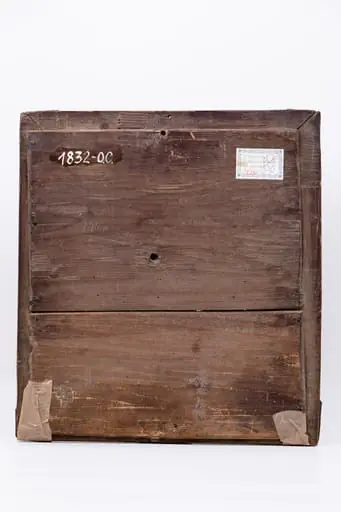 Icoana este rară prin tematica iconografică abordată, având o compoziție simetrică, echilibrată și armonioasă cromatic, structural și teologic. Central este Dumnezeu pe tron arhieresc Mare Judecător și Învățător. Este îmbrăcat cu sacos albastru cobalt-regal cu dungi albe, cu felon și omofor roșu vermillon, cu epitrahil-patrafir vernil-absint, cu trei cruci negre și o floare de lalea cu trei petale lunguiețe albe. Cu mâna dreaptă ține Sfânta Scriptură deschisă pe genunchi și cu mâna stângă Binecuvântează. Tronul arhieresc este bogat ornamentat cu elemente decorative geometrizante bronzii, albe și negre, având aripile de arhitectură umplute cu un caroiaj aparte. Mântuitorul Iisus Hristos are picioarele așezate pe o pernă roșie. În partea dreaptă a Lui Dumnezeu este Sfântul Ioan Botezătorul și Înaintemergătorul Domnului Iisus Hristos. Sfântul Ioan este îmbrăcat în sarică albastră de păr de cămilă și omofor-mantie verde kaki. În stânga Mântuitorului Iisus Hristos este Maica Domnului, în sacos albastru cobalt și mantie cu maforiom roșu vermillon, cu interiorul vernil-absint. În registrul mai îndepărtat sunt situați Sfinții Arhangheli Mihail și Gavriil, mai-marii oștilor cerești și încă doi sfinți arhangheli, din soborul îngerilor păzitori. În registrul superior este Dumnezeu-Tatăl, în veșmânt roșu, trimițând din Cerurile deschise, printr-o mandorlă de nouri albi, pe Sfântul Duh, sub forma porumbelului alb. Fondul icoanei este cerul albastru cobalt, încadrată icoana fiind de un chenar decorativ bronziu, lat, cu elemente florale stilizate mari roșii - 9 ruje. Inscripția din româno-chirilică este IC XC MP Iisus Hristos Maica Domnului. Cromatica este vie, luminoasă și armonioasă: roșu vermillon, verde absint, vernil, kaki, albastru cobalt, brun, bej, negru, alb. Icoana este din Țara Făgărașului.
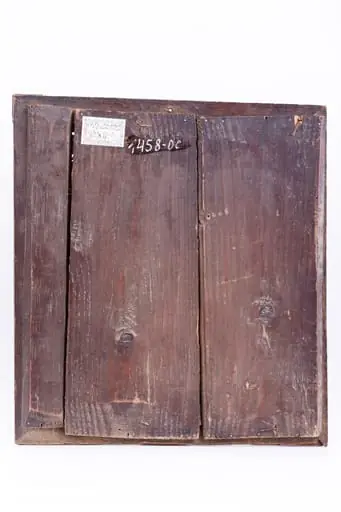 Icoana îi reprezintă împreună pe Sfântul Mare Ierarh Nicolae, Sfântul Ioan Botezătorul și Sfântul Mare Mucenic Teodor Tiron. Veșmintele Sfântului Nicolae sunt sacos gri și roșu vermillon, cu patrafir-epitrahil auriu cu verde, două bedernițe verzi, de o parte și de alta a veșmântului. În mijloc, este Sfântul Ioan Botezătorul și Înaintemergătorul Domnului Iisus Hristos îmbrăcat cu un himation alb-gri-negru, din păr de cămilă, și o mantie roșie, purtând crucea biruinței. Alături este Sfântul Mare Mucenic Teodor Tiron, îmbrăcat cu haine de oștean-militar, tunică și vestă de zale aurie, cu mantie roșie cu interiorul galben, de lumină. În mâna dreaptă are spada credinței. Fondul icoanei este albastru cobalt, în registrul superior și roz, în registrul inferior. Pe latura inferioară, icoana este încadrată de elemente florale - trei ruje mari, trandafiri roșii, cu frunze verzi. Inscripția din româno-chirilică se traduce Sf Nicolae Sf Ioan Botezătorul Sf Teodor Tiron. Icoana este de Țara Oltului.
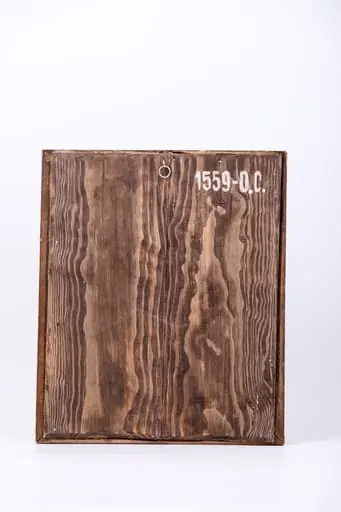 În centrul icoanei este Crucea roșie-vermillon, cu capetele brațelor împodobite verde-trilobat, pe care este Răstignit Mântuitorul Iisus Hristos, iar în dreapta crucii este Sfântul Împărat Constantin și în stânga este Împărăteasa Elena, mama sa. Sub Cruce este un spațiu galben izvorâtor de lumină. Crucea găsită este susținută cu bucurie de cei doi sfinți. Veșmintele Sfinților Constantin și Elena sunt într-o combinație de roșu vermillon și albastru cobalt. Spațiul galben de lumină duce cu gândul la Crucea de lumină apărută pe cer In hoc signo vinces - prin acest semn vei învinge. Fondul icoanei este cerul albastru bleu-ciel. Întreaga compoziție este încadrată armonios de un chenar fitomorf, format din rujele de Nicula, 6 trandafiri mari roșii cu motivul zăluței albe în interior. Cromatica este armonioasă și senină: roșu vermillon, galben-chihlimbar, albastru cobalt și bleu-ciel, verde brad, de China, alb, negru. Icoana este de Nicula. De menționat este că în icoană este Mântuitorul Iisus Hristos Răstignit pe Crucea, susținută de Sfinții Constantin și Elena. În această compoziție fiind, icoana este considerată mai rară prin tematica abordată, de obicei lângă Mântuitorul Răstignit sunt Maica Domnului și Sfântul Apostol și Evanghelist Ioan Teologul. Inscripția din româno-chirilică se traduce Restignirea.
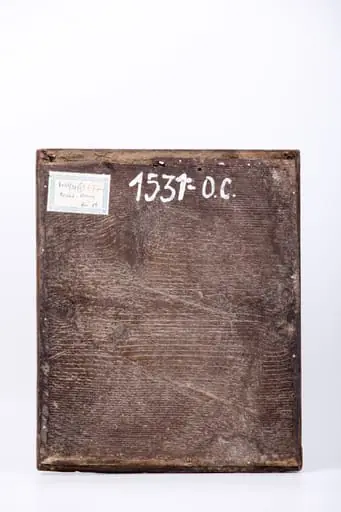 În centrul icoanei este Crucea aurie-bronzie, iar în dreapta crucii este Sfântul Împărat Constantin, și în stânga este Împărăteasa Elena, mama sa. Deasupra fiecăruia este inscripționat numele. În spatele Crucii, lipit de cruce, este un soare stilizat - Soarele alb al dreptății. Crucea găsită este susținută cu bucurie de cei doi sfinți. Veșmintele Sfinților Constantin și Elena sunt într-o combinație de roșu vermillon și verde kaki. Soarele din spatele Crucii și spațiul galben de lumină duce cu gândul la Crucea de lumină apărută pe cer In hoc signo vinces - prin acest semn vei învinge. Icoana este bogat ornamentată de culoare, lumină și detalii semnificative, elemente decorative geometrizante șerpuitoare și ondulatorii. Fondul icoanei este cerul de noapte, albastru ultramarin bleumarin întunecat. Întreaga compoziție este încadrată armonios de un chenar decorativ geometrizant roșu stacojiu-vișiniu cu linia albă șerpuitoare, specifică centrului de la Nicula. Cromatica este armonioasă și bogată: roșu vermillon, roșu stacojiu-vișiniu, galben-chihlimbar, albastru ultramarin bleumarin, verde kaki, ocru, alb, negru. Icoana este de Nicula. Inscripția din româno-chirilică se traduce Constantin Elena. Icoana este crăpată și lipită.