Artwork
Icoaori
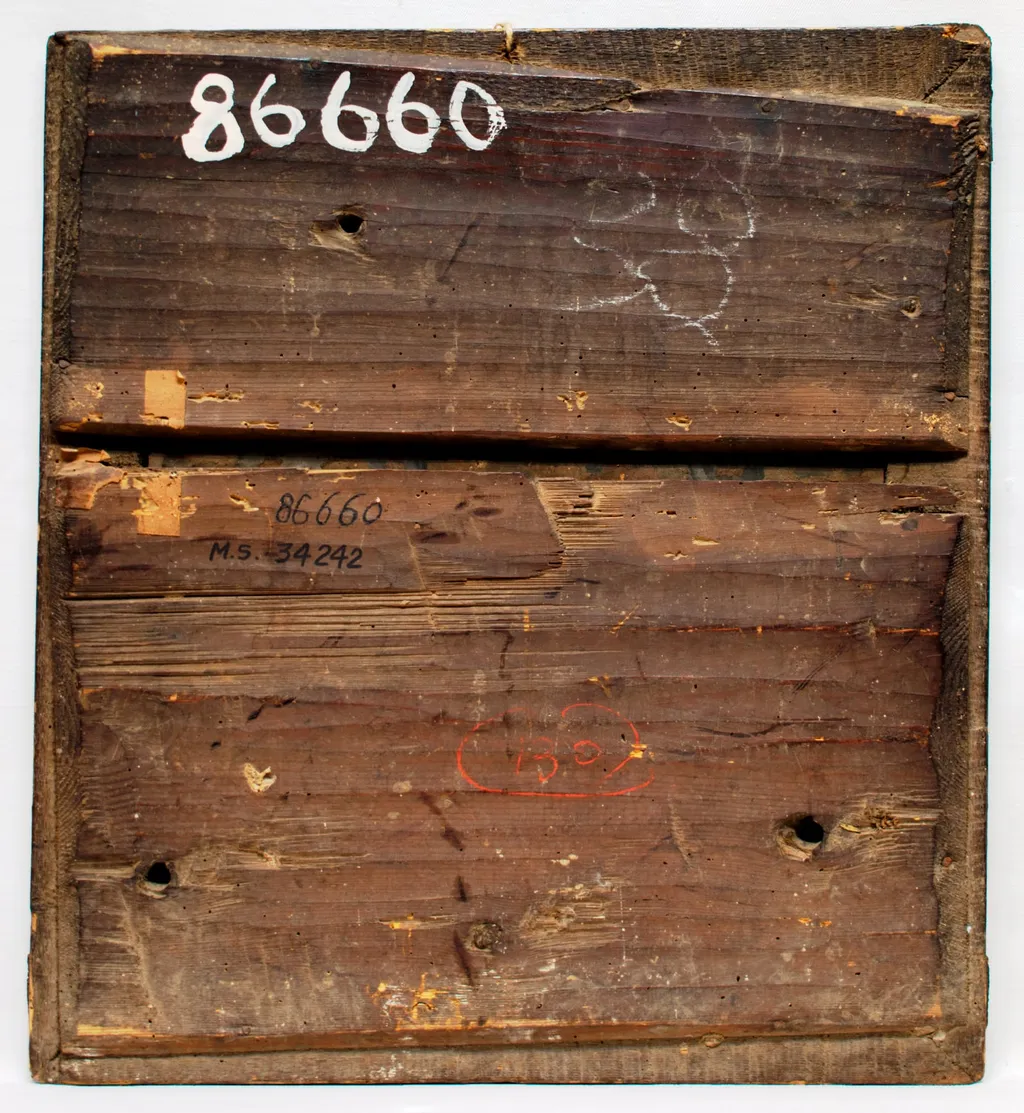
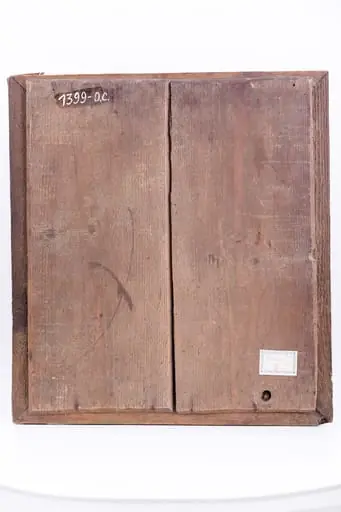
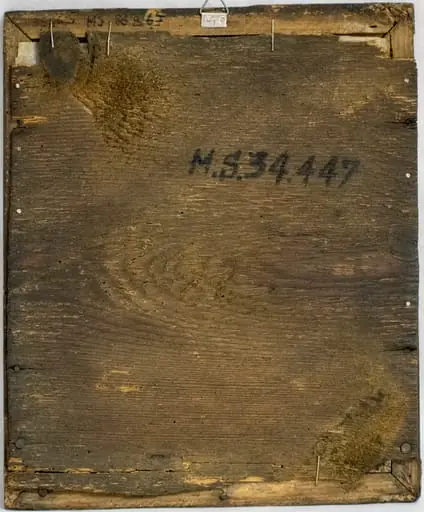
Icoaori is a drawing by Unknown. It dates from 1850 and is held in the collection of the "Dimitrie Gusti" National Village Museum. This object is the reverse side of a wooden panel, its surface marked by time and use.
About this work
Overview
Red circular shapes near the base imply an underlying image, partially obscured or erased, hinting at prior artistic or symbolic activity.
This object is the reverse side of a wooden panel, its surface marked by time and use. The wood is dark brown, weathered, and cracked, with small perforations and faint pencil traces. Two sets of numerical markings—painted in white and penciled below—suggest cataloging or inventory practices. Red circular shapes near the base imply an underlying image, partially obscured or erased, hinting at prior artistic or symbolic activity.
Subject & Meaning
The red circles may indicate the remnants of a previously painted composition, possibly ritual or decorative in nature, now hidden beneath layers of wear or deliberate concealment. Their presence suggests the panel once carried visual significance, though its original context is lost. The numbers appear administrative, not symbolic, pointing to institutional handling rather than cultural intent.
Technique & Style
No deliberate artistic technique is visible on this surface. The wood retains its natural texture, altered only by environmental exposure and handling. The white paint and pencil markings are utilitarian, applied with no aesthetic concern. The red circles, though faint, suggest a prior layer of pigment, possibly applied with brush or stencil, now partially degraded.
History & Provenance
The panel’s markings—'86660' and '86660 M.S. 34242'—indicate it was cataloged by a collecting institution, likely a museum or ethnographic archive. Its current state implies long-term storage or handling, with no evidence of conservation. The absence of provenance details leaves its origin and prior use uncertain, though its material suggests regional woodcraft traditions.
Context
As the reverse of a wooden panel, this surface was not intended for display. Its condition reflects use as a support, storage, or transport object, possibly from a cultural or religious artifact now missing. The red marks may relate to indigenous or folk practices where imagery was intentionally covered or reused, common in contexts of cultural suppression or material scarcity.
Legacy
This fragment survives as a silent witness to institutional collection practices and the erasure of original meaning. It holds no known artistic value in its current state, yet its traces invite inquiry into what was once present. It remains a material artifact of unseen histories, preserved not for display but as part of a larger, uncompleted record.
Artist & collection
Museum
"Dimitrie Gusti" National Village Museum
Continue through works from the same source collection.
 Domestic Scene
 Giacomo and Cardinal Marco, investing Andrea, Abbot of San Zeno, with his Benefice
 The Nymph of Fontainebleau
 Portrait of a Woman
 Madonna and Child with Saints in the Enclosed Garden
 Venus and Minerva
 Family Group of Four on Sofa
 Wall painting from Room H of the Villa of P. Fannius Synistor at Boscoreale
 Icoan mâ
 Icoasia,
 Răstignirea lui Iisus Hristos plasată pe un câmp central sub formă de cruce, împarte spațiul pictural în patru casete dreptunghiulare, Iisus Hristos răstignit pe crucea cu 6 brațe (specifică ortodoxiei ruse), cu un veșmânt alb în jurul mijlocului, ochii închișiNimbul cu inscripțiile consacrate. La baza crucii, sugerat dealul Golgota și craniul lui Adam. Pe latura de sus un nor cu inscripția XC Cele 4 casete conțin următoarele scene: Stânga sus Maica Domnului cu Pruncul tipul Kazanskaia. Este reprezentată până la piept, nu se văd mâinile. Capul ușor înclinat spre Prunc. Maforion roșu, pe frunte și pe umeri stelele Fecioriei, albe, discrete.Iisus – Emanuel, binecuvintează cu dreapta, nimbul cruciger. Chiton albastru și himationgalben. Dreapta sus - Sf. Nicolae în veșminte de arhiereu, cărunt, cu barba rotundă capul descoperit. Nu se văd mâinile.. Înveșmântat cu sacos roșu cu drapaj galben, omofor lat, închis la culoare. Stânga jos - Sf. Gheorghe, oștean, călare pe un cal alb în poziție cambrată.Înfige, cu ambele mâini, sulița în gura balaurului, redat aici ca un șarpe negru, subțire. În oglindă, sfântul mucenic Dimitrie, în veșminte identice, călare pe un cal negru, cu o suliță în mâini. Fondul: brun pentru scena centrală, scenele de sus: brun roșcat, cu o bandă îngustă, aurită sus, niburile cu linie albă, scenele de jos: inferior bandă brună, pământul cu galben, cerul - verde închis, nimburile galbene cu linie discretă, albă pe margine. Chenarul marginal specific icoanelor tip krasnushka.Inscripții caligrafice cu negru. Inscripții cu llitere negre, caligrafice la scenele de sus, alb central. Caracter popular
 Maica Domnului este Împărăteasa Cerurilor, ținând în brațe Pruncul Iisus Hristos care cu mâna dreaptă ține pe genunchi Sfânta Evanghelie închisă, un hrisov înfășurat și ne-o arată pe Maica Domnului cu mâna stângă. Maica Domnului ni-L arată pe Mântuitorul Iisus Hristos cu mâna dreaptă, ca fiind Calea, Adevărul și Viața, deci este Hodighitria. Maica Domnului este înveșmântată în mantie cu maforion roșu vermillon cu broderie dantelată bronzie, pe margini, cu sacos albastru și verde, dungat cu linii albe paralele. Maica Domnului poartă coroniță de împărăteasă, salbă de aur și aureolă. Pruncul Iisus Hristos este înveșmântat în crem-bej, dungat cu alb, și auriu ocru-brun-bronziu, cu coroană și aureolă. În registrul superior îndepărtat, stânga și dreapta, sunt cei doi îngeri arhangheli Mihail și Gavriil, cu aripile verzi, așezând cu mâinile coronița de Împărăteasă pe capul Maicii Domnului. Lateral Maicii Domnului și Pruncului Iisus Hristos sunt două flori, una cu interiorul albastru, reprezentând-o pe Împărăteasa Cerurilor și cealaltă cu interiorul galben, de Lumină, reprezentându-L pe Mântuitorul. Fondul icoanei este cerul de culoarea albastru ultramarin, în registrul superior, galben-verde, în câmpuri paralele, alternativ-cromatizate, în registrul inferior. Cromatica, specifică Țării Oltului, este vie, luminoasă și armonioasă: roșu vermillon, albastru ultramarin, cobalt, bleu-ciel, alb, verde spanac-avocado, galben-ocru, bej, brun, brun-bronziu, auriu, negru. Icoana este de Șcheii Brașovului, Țara Bârsei - Țara Oltului. Inscripția din româno-chirilică se traduce MP IC XC Maica Domnului Iisus Hristos.
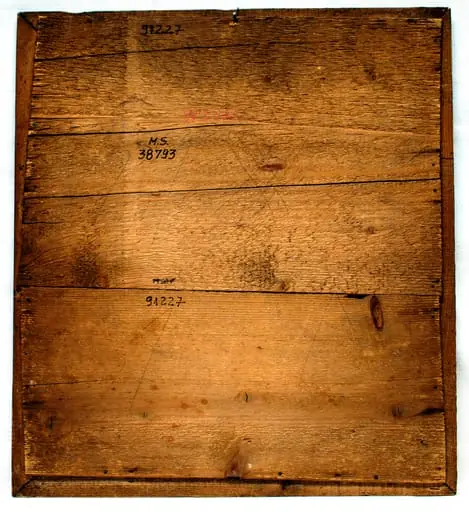 Icoari.
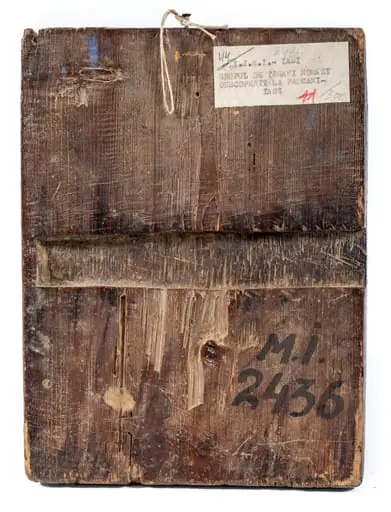 Iisus binecuvântând
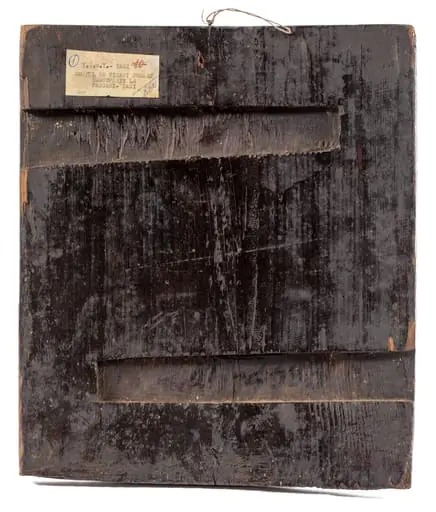 Sfântul Serghie
 Icoa
Icoa