Artwork
Icoan mâ
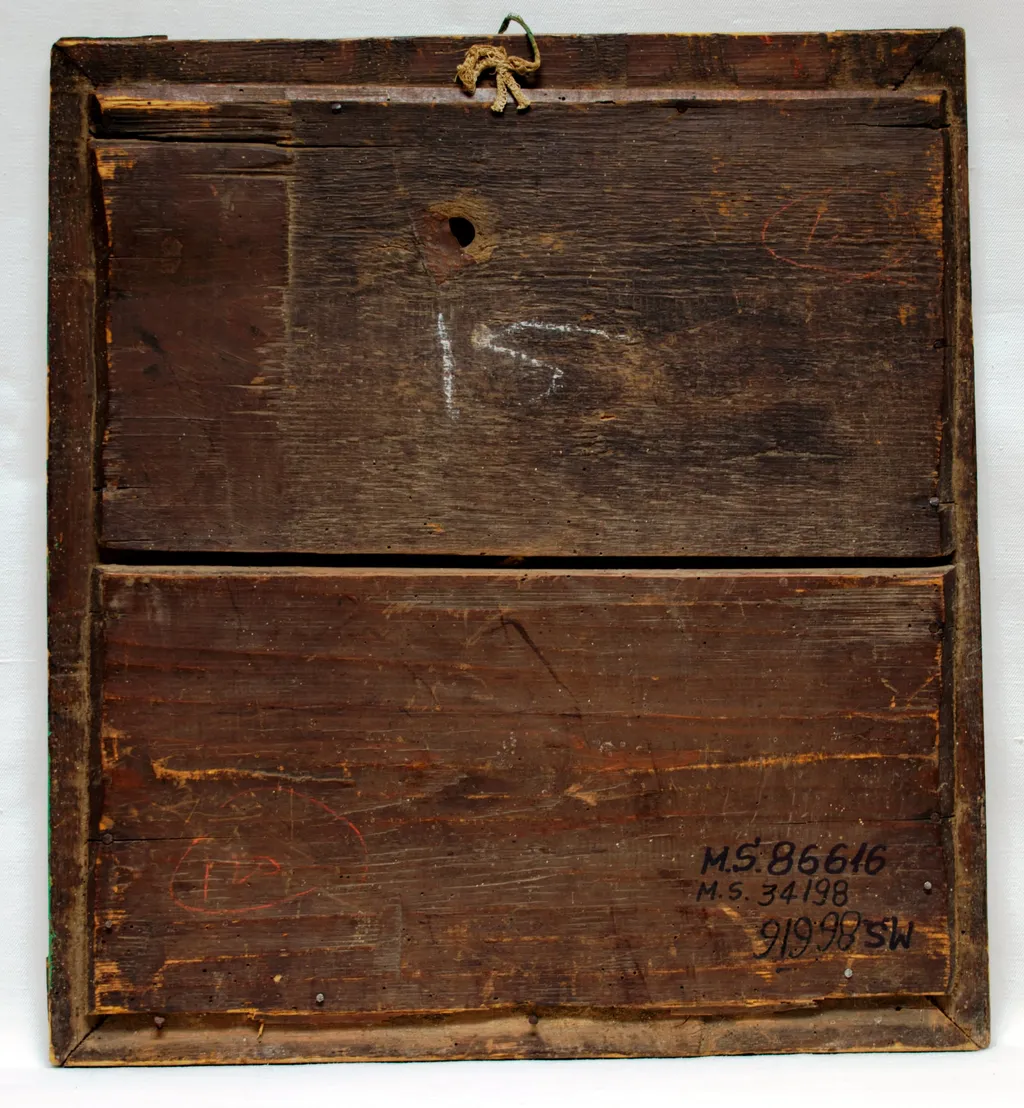
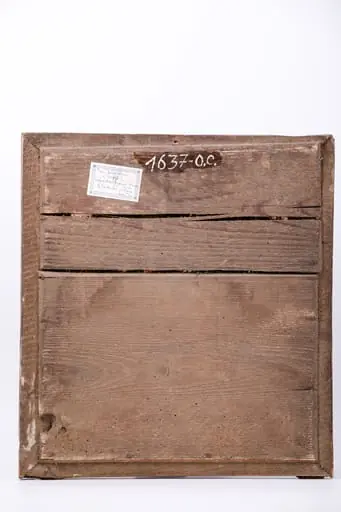
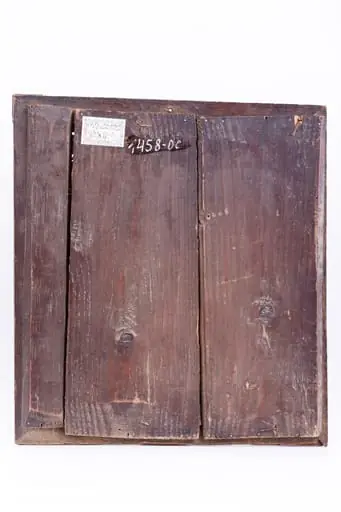
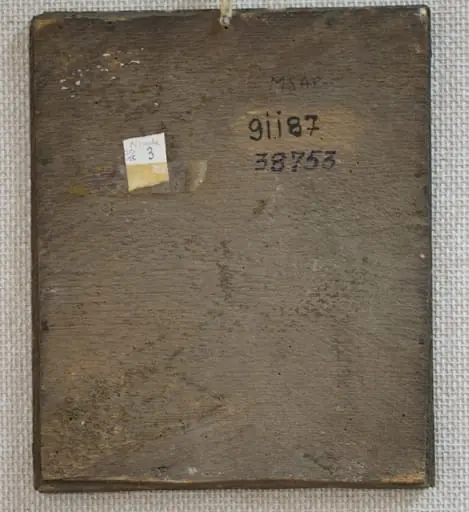
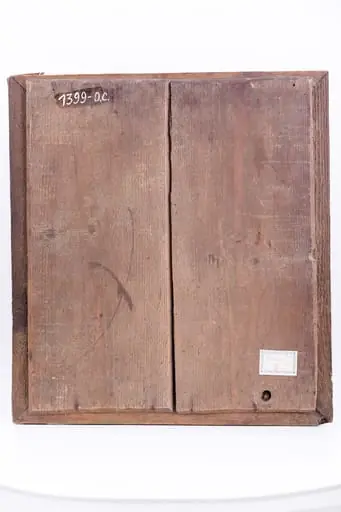
Icoan mâ is a drawing by Unknown. It dates from 1850 and is held in the collection of the "Dimitrie Gusti" National Village Museum. The object is the reverse side of a wooden panel, its surface worn by time and use.
About this work
Overview
Weathering has left cracks, scratches, and faint discolorations, while small perforations suggest past mounting or handling.
The object is the reverse side of a wooden panel, its surface worn by time and use. Weathering has left cracks, scratches, and faint discolorations, while small perforations suggest past mounting or handling. No image remains on the front, but the panel’s condition implies it once bore a painted icon. Blue ink markings in the lower right corner appear to be administrative labels, possibly from a museum collection.
Subject & Meaning
The original image is no longer present, so its religious or cultural subject cannot be determined. The panel’s form suggests it was part of a devotional icon, common in Eastern Orthodox traditions. Its survival as a backside implies the front was removed, damaged, or repurposed, leaving only the wooden support as evidence of its former function.
Technique & Style
No artistic technique is visible on this side, as the painted surface has been lost. The wood’s grain and wear patterns indicate it was carefully prepared and mounted, likely with a protective layer now gone. The absence of pigment or gilding leaves only the physical structure as a record of its construction.
History & Provenance
The blue ink inscriptions in the corner resemble museum catalog numbers, suggesting the panel entered a collection at some point. Its current location is not stated, but the reference to the Museum of Ethnography implies it may be held there. The panel’s journey from religious use to archival object remains undocumented.
Context
Wooden panels like this were standard supports for icons in Byzantine and Slavic traditions, often used in homes or churches. When icons were damaged, defaced, or replaced, their panels were sometimes preserved as fragments. This backside, stripped of its image, reflects the lifecycle of sacred objects in changing cultural contexts.
Legacy
Though devoid of its original imagery, the panel endures as a material witness to lost art and shifting practices. Its wear and markings offer quiet testimony to centuries of handling, storage, and institutional care. It invites reflection on how cultural heritage survives in fragments, even after meaning fades.
Artist & collection
Museum
"Dimitrie Gusti" National Village Museum
Continue through works from the same source collection.
 Domestic Scene
 Giacomo and Cardinal Marco, investing Andrea, Abbot of San Zeno, with his Benefice
 The Nymph of Fontainebleau
 Portrait of a Woman
 Madonna and Child with Saints in the Enclosed Garden
 Venus and Minerva
 Family Group of Four on Sofa
 Wall painting from Room H of the Villa of P. Fannius Synistor at Boscoreale
 Icoaori
 Icoambla
 Scena ridicării la cer a Sfântului Ilie(Răpirea la cer) redată într-o manieră populară, urmând indicațiile biblice: Sfântul Ilie, (într-un registru median) stăpân al tunetelor, fulgerelor și ploii, purtat într-un car (de foc) pe cer, proorocul Elisei în două ipostaze, (registrul inferior). Sfântul Ilie în picioare, înveșmântat cu mantie roșie,tunică verde, în mâna stângă hățurile. Părul și barba castaniu roșcate, Trăsura aurită, trasă de doi cai roșii, ușor diformi, cu cozile înnodate, deasupra unui registru în lanț de nouri pastelați alb-cafeniu Deasupra carului, pe fondul cerului albastru, trei heruvimi cu nimburi aurite. Două flori mari roșii iar la captele lanțului de nori flori pe tije înalte. În registrul inferior, colțul stâng, proorocul Elisei(înveșmântat cu tunică roșie, încins cu brâu verde. Nnimb aurit, părul și barba castanii ,corpul ușor diform)cu mâinile ridicate primește haina sf. Ilie, ca semn al investiturii cu puterile acestuia. În colțul drept , în ipostaza de agricultor, arînd pământul cu un plug miniatural tras de doi boi albi. Aici straie țărănești, cămășă scurtă de culoare galbenă și cioareci cafenii. Câmpul albastru -bleu, decorat cu flori roșii mari, în jumătatea inferioară, relief din benzi verzi, galbene și roșii, separat de lanțul de nori de o bandă cafenie decorată cu flori roșii cu frunze verzi. Inscripția, în chenare dreptunghiulare pe fond alb se referă la tema icoanei, dar și la sfinții îngeri. Compoziția este încărcată, desenul trasat cu o mână sigură, paleta cromatică variată, culorile intense. Stilul respectă trăsăturile picturii pe sticlă din Schei. Rama este alcătuită din patru șipci din lemn de brad, băițuite, îmbinate oblic la colțuri.
 În centrul icoanei este Crucea aurie, cu vrejul de ramificații fitomorfe orange, iar în stânga crucii este Sfântul Împărat Constantin și în dreapta este Împărăteasa Elena, mama sa. Crucea găsită este susținută cu bucurie de cei doi sfinți. Veșmintele Sfinților Constantin și Elena sunt într-o combinație de roșu vermillon, galben și orange. Spațiul albastru senin, din cerul din fondul icoanei, duce cu gândul la Crucea de lumină apărută pe cer In hoc signo vinces - prin acest semn vei învinge. În registrul inferior, este un câmp decorativ geometrizant alternativ de roșu-orange-roz-gri. În registrul superior, în colțurile stânga-dreapta sunt 2 îngeri serafimi. Cromatica este armonioasă: roșu vermillon, roz, galben-ocru, albastru cobalt, ceruleum, alb, negru. Icoana este de Țara Oltului. Inscripția din româno-chirilică se traduce Sf Constantin Elena.
 Sfântul Mare Ierarh Grigorie Cuvântătorul de Dumnezeu, sau Sfântul Grigorie Teologul sau de Nazianz. Este unul din cei Trei Sfinți Ierarhi, alături de Sfântul Vasile cel Mare și Sfântul Ioan Gură-de-Aur. Sfântul Grigorie are Sfânta Liturghie a Darurilor înainte Sfințite, care se săvârșește în timpul Postului Mare. Este îmbrăcat în veșminte liturgice arhierești, sacos roșu vermillon, epitrahil verde, nuanță de spanac-avocado, cu patru cruci. Poartă mithră și aureolă. Ține în mâna stângă Sfânta Evanghelie deschisă și binecuvintează cu mâna dreaptă. Fondul este albastru ceruleum cu stele albe. Icoana este de Țara Oltului. Cromatica este armonioasă: roșu vermillon, verde spanac-avocado, albastru ceruleum, nergu, alb. Inscripția din româno-chirilică se traduce Sf Grigorie.
 Icoana îi reprezintă împreună pe Sfântul Mare Ierarh Nicolae, Sfântul Ioan Botezătorul și Sfântul Mare Mucenic Teodor Tiron. Veșmintele Sfântului Nicolae sunt sacos gri și roșu vermillon, cu patrafir-epitrahil auriu cu verde, două bedernițe verzi, de o parte și de alta a veșmântului. În mijloc, este Sfântul Ioan Botezătorul și Înaintemergătorul Domnului Iisus Hristos îmbrăcat cu un himation alb-gri-negru, din păr de cămilă, și o mantie roșie, purtând crucea biruinței. Alături este Sfântul Mare Mucenic Teodor Tiron, îmbrăcat cu haine de oștean-militar, tunică și vestă de zale aurie, cu mantie roșie cu interiorul galben, de lumină. În mâna dreaptă are spada credinței. Fondul icoanei este albastru cobalt, în registrul superior și roz, în registrul inferior. Pe latura inferioară, icoana este încadrată de elemente florale - trei ruje mari, trandafiri roșii, cu frunze verzi. Inscripția din româno-chirilică se traduce Sf Nicolae Sf Ioan Botezătorul Sf Teodor Tiron. Icoana este de Țara Oltului.
 Icoa cen
 Maica Domnului este Împărăteasa Cerurilor, ținând în brațe Pruncul Iisus Hristos care cu mâna dreaptă ține pe genunchi Sfânta Evanghelie închisă, un hrisov înfășurat și ne-o arată pe Maica Domnului cu mâna stângă. Maica Domnului ni-L arată pe Mântuitorul Iisus Hristos cu mâna dreaptă, ca fiind Calea, Adevărul și Viața, deci este Hodighitria. Maica Domnului este înveșmântată în mantie cu maforion roșu vermillon cu broderie dantelată bronzie, pe margini, cu sacos albastru și verde, dungat cu linii albe paralele. Maica Domnului poartă coroniță de împărăteasă, salbă de aur și aureolă. Pruncul Iisus Hristos este înveșmântat în crem-bej, dungat cu alb, și auriu ocru-brun-bronziu, cu coroană și aureolă. În registrul superior îndepărtat, stânga și dreapta, sunt cei doi îngeri arhangheli Mihail și Gavriil, cu aripile verzi, așezând cu mâinile coronița de Împărăteasă pe capul Maicii Domnului. Lateral Maicii Domnului și Pruncului Iisus Hristos sunt două flori, una cu interiorul albastru, reprezentând-o pe Împărăteasa Cerurilor și cealaltă cu interiorul galben, de Lumină, reprezentându-L pe Mântuitorul. Fondul icoanei este cerul de culoarea albastru ultramarin, în registrul superior, galben-verde, în câmpuri paralele, alternativ-cromatizate, în registrul inferior. Cromatica, specifică Țării Oltului, este vie, luminoasă și armonioasă: roșu vermillon, albastru ultramarin, cobalt, bleu-ciel, alb, verde spanac-avocado, galben-ocru, bej, brun, brun-bronziu, auriu, negru. Icoana este de Șcheii Brașovului, Țara Bârsei - Țara Oltului. Inscripția din româno-chirilică se traduce MP IC XC Maica Domnului Iisus Hristos.
 Scen
Scen