Artwork
Iisus Hristos este reprezentat în plan central, așezat pe teasc. Din coasta dreaptă pornește vița de vie, care formează o arcadă deasupra lui Hristos și se termină cu un ciorchine în mâinile Mântuitorului, pe care Acesta îl stoarce în potirul Sfintei Euharistii. Fondul e decorat cu frunze simple, esențializate. Cromatica icoanei se compune din tonuri de portocaliu, verde, albastru, maro, alb și auriu. Rama icoanei e profilată, bicromă (latura interioară roșie, iar cea exterioară maronie) și e formată din îmbinarea a patru baghete de lemn.
Iisus Hristos este reprezentat în plan central, așezat pe teasc. Din coasta dreaptă pornește vița de vie, care formează o arcadă deasupra lui Hristos și se termină cu un ciorchine în mâinile Mântuitorului, pe care Acesta îl stoarce în potirul Sfintei Euharistii. Fondul e decorat cu frunze simple, esențializate. Cromatica icoanei se compune din tonuri de portocaliu, verde, albastru, maro, alb și auriu. Rama icoanei e profilată, bicromă (latura interioară roșie, iar cea exterioară maronie) și e formată din îmbinarea a patru baghete de lemn. is a drawing by Unknown. It dates from 1850 and is held in the collection of the Ethnographical Museum of Transylvania.
About this work
Overview
This wooden panel icon depicts Jesus Christ centrally seated on a beam, with a grapevine emerging from his right side, forming an arch above him and ending in a cluster of grapes in his hand, which he squeezes into the chalice of the Holy Eucharist.
Subject & Meaning
The icon's subject is Jesus Christ in a symbolic representation, emphasizing his role in the Eucharist through the grapevine and chalice. The composition conveys spiritual themes, with the vine (a symbol of Christ in Christian tradition) and the Eucharistic elements at its core.
Technique & Style
Executed on a worn wooden panel, the icon features a simplified, essentialized style, evident in the flat, decorative foliage background. The color palette is characterized by earthy tones (orange, green, blue, brown, white, and gold), while the bicolor, profiled frame (red inner side, maroon outer side) adds to the piece's decorative aspect.
History & Provenance
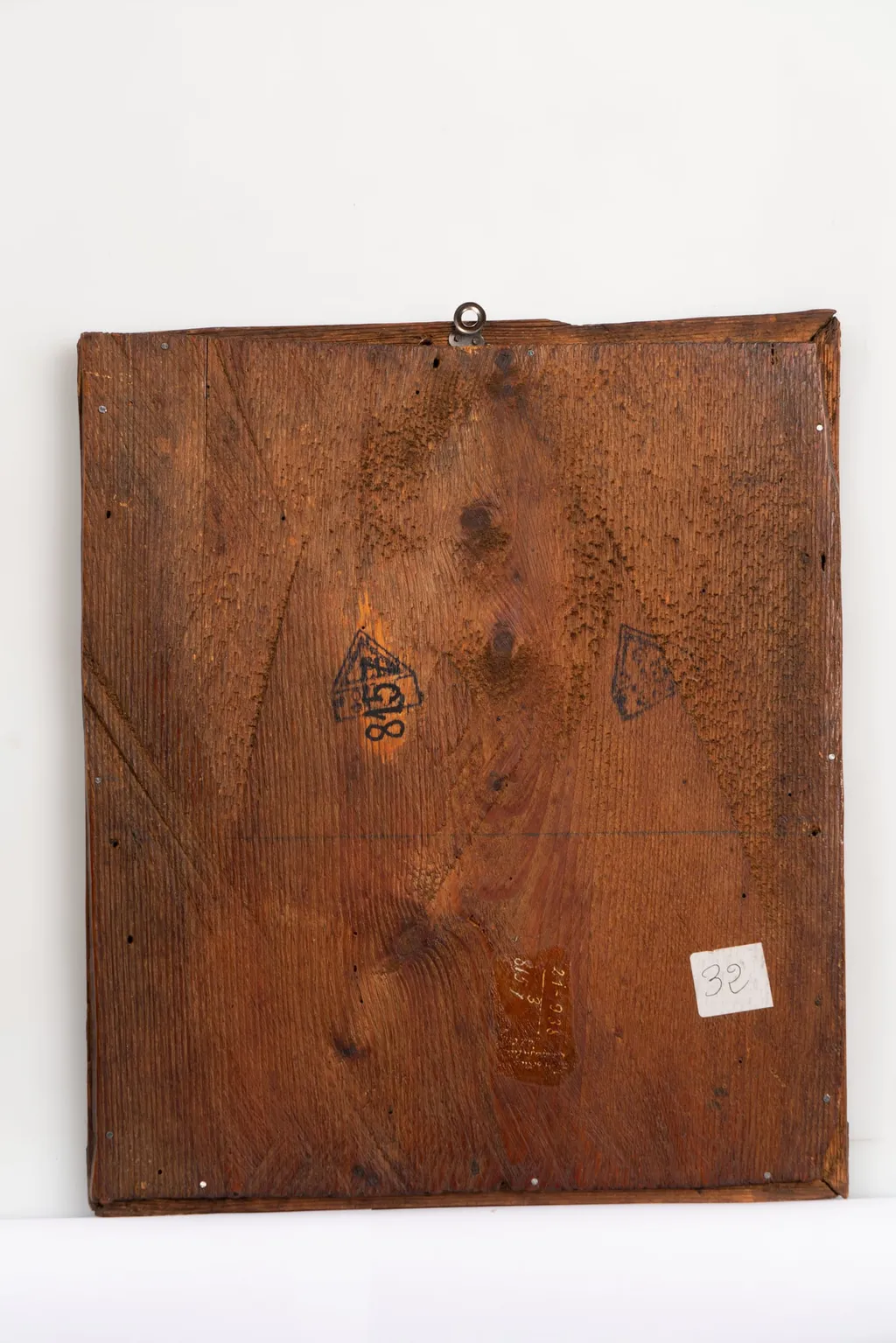
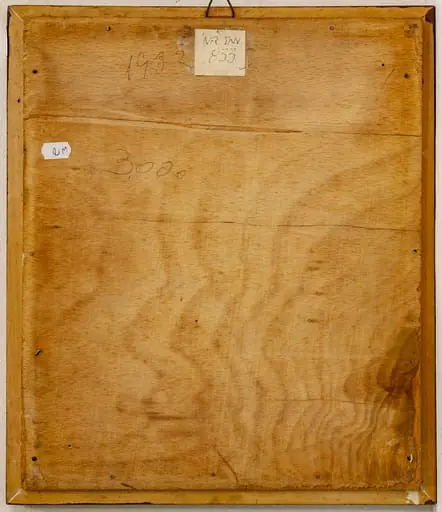
Visible wear, faded marks, dark patches, and a small paper label ('32') suggest an aged piece with a potentially undocumented or obscure history. Two faint symbols (a crowned '8' and a shield) offer minimal clues to its origins or significance.
Context
The use of wood as a medium and the style suggest the icon may originate from a traditional, possibly Eastern European or Orthodox, context where such devotional artworks were common. The Eucharistic theme aligns with Christian sacramental practices.
Legacy
Despite its worn condition and lack of clear provenance, the icon retains value as a religious artifact and an example of traditional iconographic themes, potentially offering insights into the devotion and artistry of its time.
Artist & collection
Museum
Ethnographical Museum of Transylvania
Continue through works from the same source collection.
 Domestic Scene
 Giacomo and Cardinal Marco, investing Andrea, Abbot of San Zeno, with his Benefice
 The Nymph of Fontainebleau
 Portrait of a Woman
 Madonna and Child with Saints in the Enclosed Garden
 Venus and Minerva
 Family Group of Four on Sofa
 Wall painting from Room H of the Villa of P. Fannius Synistor at Boscoreale
 Icoana Îl reprezintă pe Dumnezeu-Tatăl în Trei Fețe, Sfânta Treime sau Sfânta Troiță. Este redat șezând pe un tron arhieresc, cu o structură bogat ornamentată decorativ, cu elemente geometrizante. De remarcat este și perna rulou albastră cu ciucuri galbeni. Veșmântul arhieresc este roșu vermillon, cu elemente brun-bronzii. Aureola este și rotundă și hexagonală, înscrisă și circumscrisă. Fondul este albastru cobalt. Icoana este de Mărginimea Sibiului. Cromatica este puternic-vie: albastru cobalt, brun, bronziu, roșu vermillon, alb, negru.
 Trupul Mântuitorului Iisus Hristos, fiind coborât de pe cruce, este învelit în țesătura giulgiului alb. Maica Domnului împreună cu Sfinții Iosif din Arimateea, Nicodim și patru femei mironosițe aducătoare de mir țin în brațe trupul Mântuitorului. Compozițional se creează astfel o imagine concentrică de corabie, cu Crucea Răstignirii ca și catarg, corabia prefigurând Biserica. Giulgiul și îmbrățișarea celor apropiați, uniți întru dragoste și suferință, reprezintă axa orizontală perpendiculară pe Cruce. Icoana este o oglindă a Nașterii Mântuitorului-giulgiul fiind vechea înfășare in scutecele alb al Pruncului Iisus. În registrul inferior sunt doi îngeri îngenucheați, care susțin Trupul Mântuitorului, învelit în giulgiu. Lateral, stâng-dreapta, crucii sunt prezente soarele și luna, elemente astrale. Compoziția este echilibrată, simetrică și circulară. Cromatica, specifică autoarei Ana Deji, din Făgăraș, este alcătuită din roșu, albastru bleumari ceruleum, alb și negru. Stilul iconăriței Ana Deji se remarcă prin fondul icoanei cu un cer albastru cu stele albe și roșii, pensulațiiile albe și încadrarea tematicii narativ-iconografice într-un chenar din volutele unei draperii-drapaje.Trăsăturile personajelor sunt fin desenate, tristețea și durerea dezvăluindu-se. În inscripție se dezvăluie Mormântul Lui ICXC Iisus Hristos.
 Fecioara Maria, dispusă în partea stângă a compoziției, este pictată în genunchi, într-o atitudine plină de evlavie. Arhanghelul Gavriil, este pictat în picioare, în partea dreaptă a scenei, având ambele mâini îndreptate spre Maica Domnului. Duhul Sfânt, în chip de porumbel, se pogoară deasupra Fecioarei. Între cei doi sfinți, într-un chenar oval, apare scrisă tema icoanei pe fundal alb: "Buna Vestire". În spatele Maicii Domnului e schițată o clădire simplă. Decorul icoanei se compune din nori și lalele sintetizate. Cromatica icoanei se compune din tonuri de roșu vermillon, verde, albastru, ocru galben, alb, gri. Rama icoanei e simplă, băițuită și e formată din îmbinarea a patru baghete de lemn.
 Prăz6.
 Icoaă di
 Scena Cinei celei de Taină se desfășoară într-un interior sugerat de elemente arhitectonice, coloane, candelabru, candele. În centrul icoanei este Mântuitorul Iisus Hristos binecuvântând mâncarea, la masă, alături de ucenici și apostoli. Cu brațul stâng îl ține lipit de piept pe Ioan cel iubit. Pe masă sunt așezate un potir pentru vin și tacâmuri și farfurioare mici.Personajele au chipurile expresive, veșmintele personajelor și faldurile feței de masă, cât și draperiile sunt pictate cu măiestrie de pictor. Veșmintele sunt predominant roșii. Cromatica este armonioasă și echilibrată, pornindu-se gradual dinspre exterior înspre interior, de la albastru spre alb, ajungându-se la albul luminos al mesei celor dăruite. Compoziția este încadrată de elemente de arhitectură, coloane, arcade, creându-se, astfel, intimitatea Cinei celei de Taină. Totul este concentric, strângându-se în jurul Potirului. Elemente de arhitectură se întrezăresc printre cele 5 coloane. Se întrezărește o cruce formată din axa verticală Potirul și candela și cea orizontală - brațele Îmbrățișării Mântuitorului - Dragostea jertfelnică atotcuprinzătoare. Icoana este a lui Savu Moga, din Arpașu de Sus, Țara Făgărașului. Icoana este datată 1877. Inscripția din româno-chirilică se traduce Cina cea de Taină.
 La împlinirea a trei ani de la Nașterea Preacuratei Fecioare Maria, Drepții Părinți Ioachim și Ana, aducându-și aminte de făgăduința făcută, ca să dea în dar Lui Dumnezeu pe cea născută, cheamă toate rudeniile de neam împărătesc și arhieresc, și cete de fecioare, cu făclii aprinse, pentru a o conduce pe Pruncă la Templu. Icoana este bogată în narațiune, numărul personajelor este foarte mare, realizându-se trei cortegii unduitoare: oamenii, îngerii și Împărăția Cerurilor. Aducerea la Templu, în Biserică, este deja o ridicare la Ceruri, prin creșterea duhovnicească. Mandorlele de nouri, se întrepătrund armonios cu elementele de arhitectură ale cetații și Bisericii, creându-se drumuri spațiale, dar și ideatice. Personajele sunt pictate mai mult din profil și semiprofil, o caracteristică a zugravului iconar Ioan Pop de Făgăraș. Cromatica este vie, luminoasă, bucuroasă: roșu, galben chihlimbar, albastru ceruleum, albastru bleuciel, verde, brun, bej, gri, alb, negru. Inscripția din româno-chirilică se traduce: Intrarea în Biserică a PreaSfintei noastre Născătoare de Dumnezeu 1865. Icoana are semnătura zugravului iconar, ascunsă și dezvăluită totodată, pe chenarul decorativ geometrizant auriu-bronziu: Ioan Pop Zugrav la Făgăraș la anul 1865. Icoana este deosebită, o bijuterie a colecției de icoane a Muzeului ASTRA.
 Pasăre