Artwork
Indra
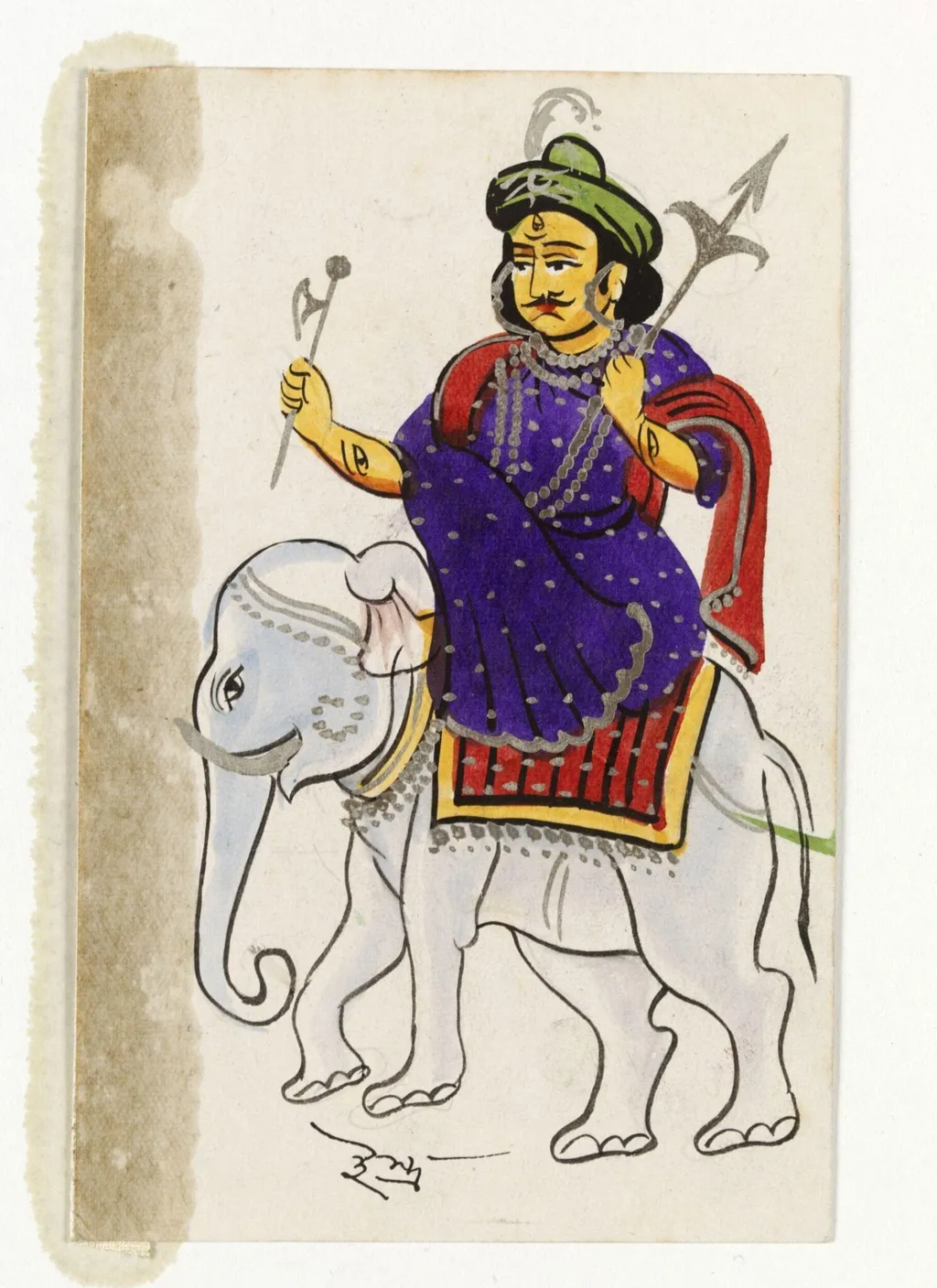
Indra is a paint painting by the Impressionist artist Unknown. It dates from 1890 and is held in the collection of the Victoria and Albert Museum.
About this work
Overview
This watercolour and tin alloy painting on cardboard portrays Indra, the Vedic deity of rain and war, mounted on his sacred elephant, Airavata.
This watercolour and tin alloy painting on cardboard portrays Indra, the Vedic deity of rain and war, mounted on his sacred elephant, Airavata. The composition emphasizes regal presence through vivid hues and deliberate detail, with metallic accents adding luminosity. The background remains muted, allowing the figures to dominate visually. The medium and support suggest a regional artistic tradition, distinct from Western techniques.
Subject & Meaning
Indra, depicted with a spear and hand resting on Airavata’s ear, embodies authority and divine control. His purple robe, silver-dotted fabric, and green turban signify status, while the white elephant—adorned in red and yellow trappings—represents purity and royal power in South Asian cosmology. The serious expression conveys solemn duty, aligning with Indra’s role as a protector and cosmic order-keeper in Hindu mythology.
Technique & Style
The artist employed watercolour for broad, flat areas of colour, enhanced by tin alloy to create shimmering highlights on garments and ornaments. Fine lines define facial features and textile patterns, while the elephant’s form is rendered with solid, rounded contours. The lack of perspective and flattened space reflect a stylized, non-naturalistic approach common in devotional art traditions of the region.
History & Provenance
The work likely originates from a devotional or illustrative manuscript tradition in northern India, possibly linked to Rajasthani or Pahari schools. Its use of cardboard as a support and tin alloy for embellishment suggests a 19th- or early 20th-century production, when such materials became accessible to regional artisans. Exact provenance remains undocumented, but stylistic cues point to temple or courtly patronage.
Context
This painting belongs to a broader corpus of Indian devotional imagery that visualizes deities in narrative or ceremonial contexts. Unlike Western impressionism, which sought to capture fleeting light, this work prioritizes symbolic clarity and spiritual presence. Its aesthetic aligns with miniature painting conventions, where colour and adornment convey theological meaning rather than optical realism.
Legacy
While not part of a widely recognized school, the painting exemplifies the persistence of traditional iconography in regional art practices into the modern era. Its preservation offers insight into how mythological figures were sustained in visual culture beyond textual sources. Such works continue to inform contemporary interpretations of Hindu iconography in museum and scholarly settings.
Artist & collection

 Domestic Scene
 Giacomo and Cardinal Marco, investing Andrea, Abbot of San Zeno, with his Benefice
 The Nymph of Fontainebleau
 Portrait of a Woman
 Madonna and Child with Saints in the Enclosed Garden
 Venus and Minerva
 Family Group of Four on Sofa
 Wall painting from Room H of the Villa of P. Fannius Synistor at Boscoreale
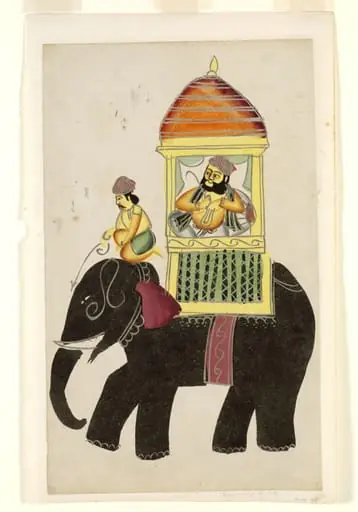 Madhavchandra Giri
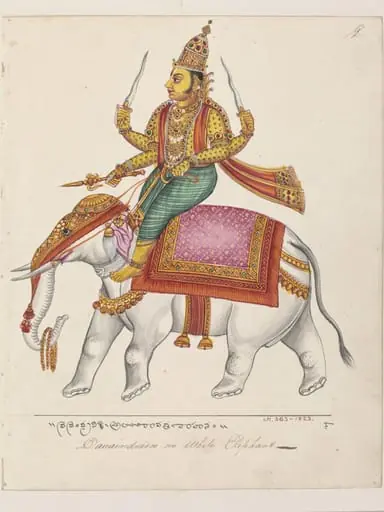 Indra, the god of storms, riding on a white elephant, Airavata.
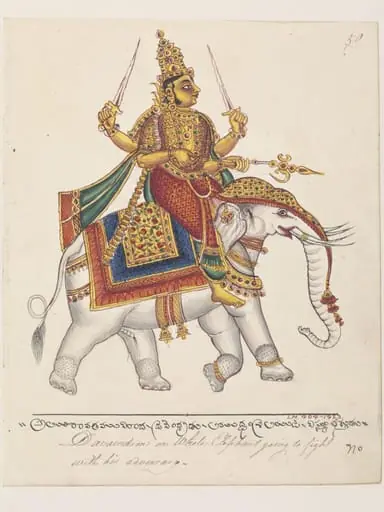 Indra, chief of the gods and the guardian of the east, on his elephant, Airavata.
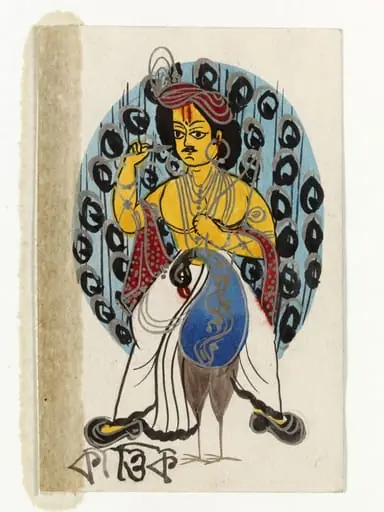 Karttikeya
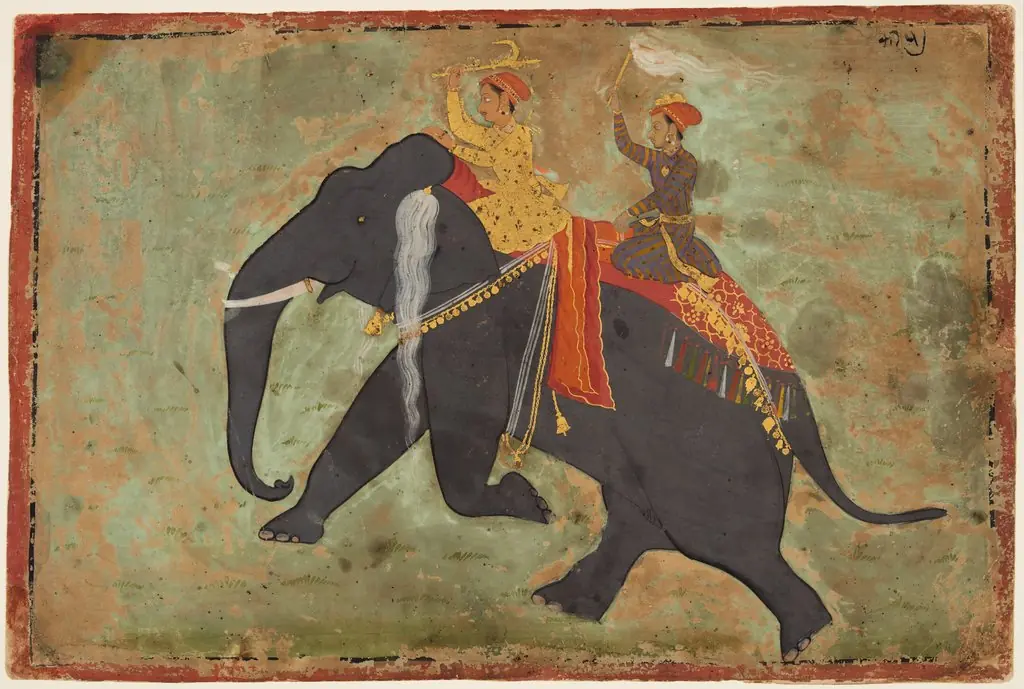 Prince Amar Singh (1672–1710) Drives His Own Elephant
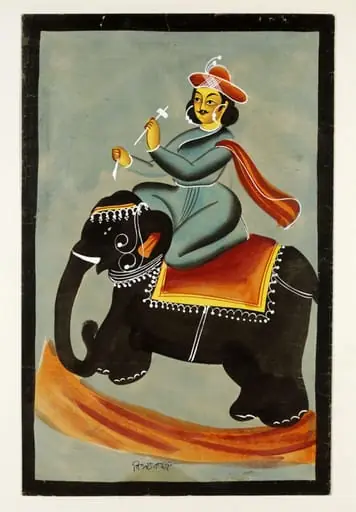 Visvakarma on a black elephant
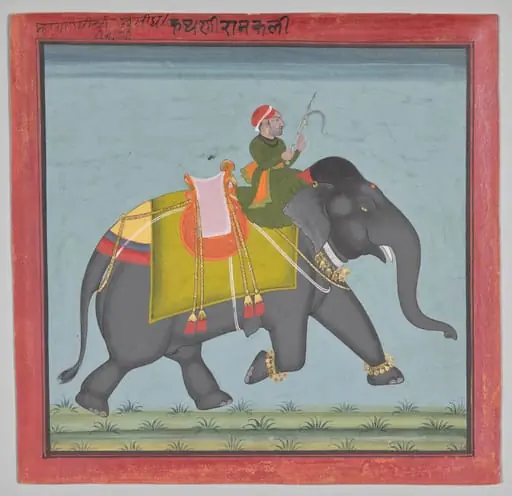 Royal Elephant Ramkali with a Mahout
 Shiva and Nandi
 Purvasharha
 Pura Raja