Artwork
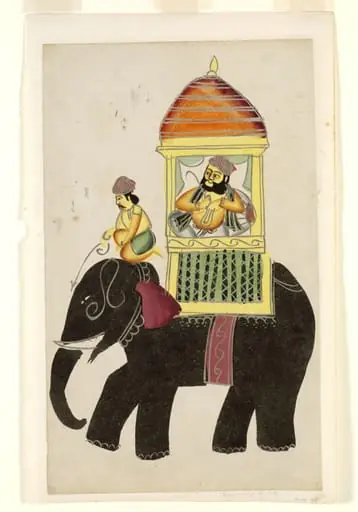
Visvakarma on a black elephant
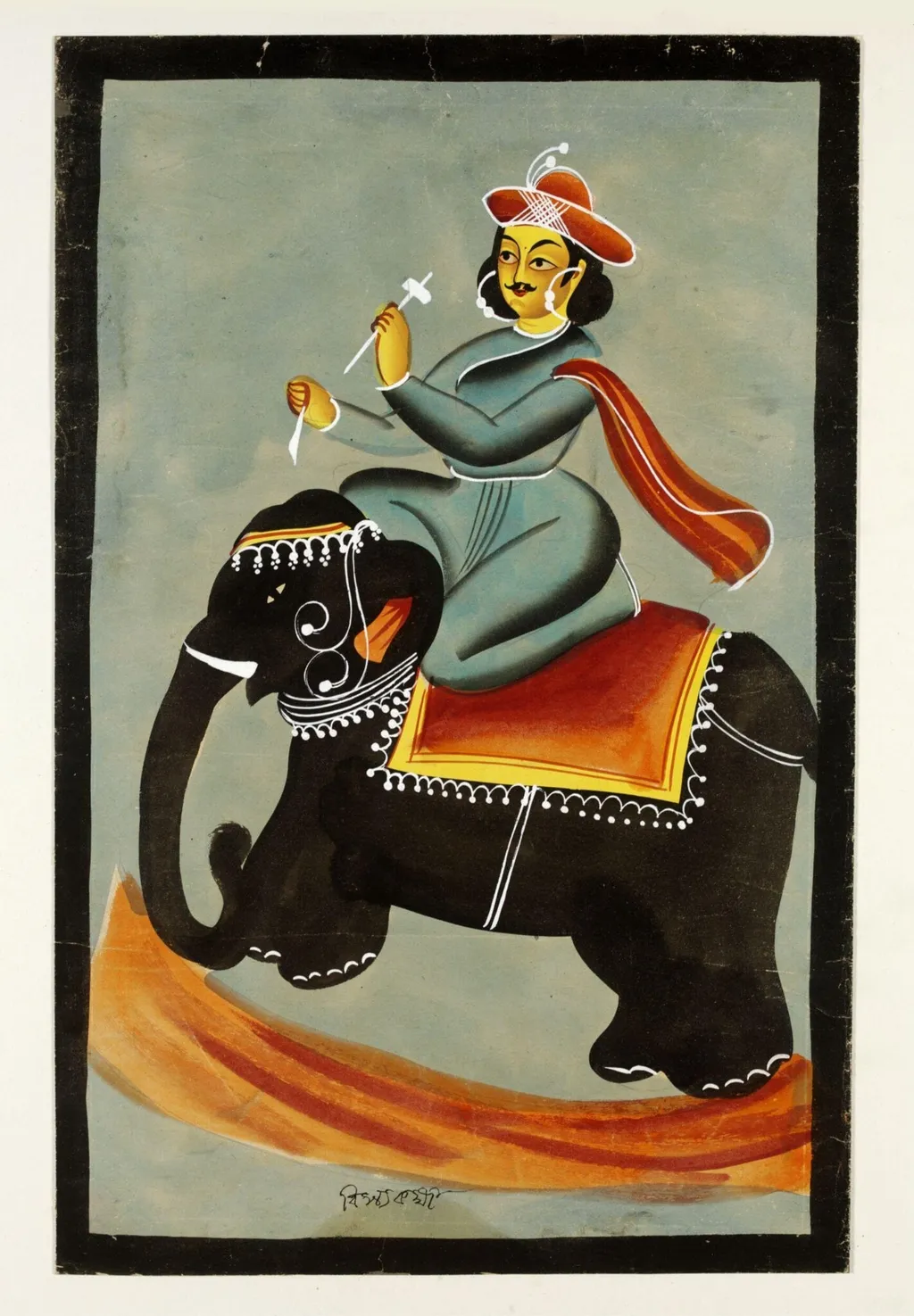
Visvakarma on a black elephant is a paint painting by the Impressionist artist Unknown. It dates from 1885 and is held in the collection of the Victoria and Albert Museum. This opaque watercolor on paper portrays Vishvakarma, the divine architect of Hindu cosmology, mounted on a black elephant.
About this work
Overview
This opaque watercolor on paper portrays Vishvakarma, the divine architect of Hindu cosmology, mounted on a black elephant.
This opaque watercolor on paper portrays Vishvakarma, the divine architect of Hindu cosmology, mounted on a black elephant. Executed with flat, unmodulated pigments, the composition emphasizes symbolic clarity over naturalism. The work was acquired by the museum in 1894 from Miss M. Steele, whose family maintained scholarly connections to India, suggesting the painting may have originated from a private collection assembled during the early colonial period.
Subject & Meaning
Vishvakarma, depicted with a hammer and a small tool, embodies the divine craftsman responsible for creating the universe’s structures. His seated posture on the elephant—a symbol of strength and royal authority—reinforces his cosmic role. The absence of narrative context focuses attention on his identity as a primordial artisan, rendered with deliberate simplicity to convey timeless authority rather than earthly realism.
Technique & Style
The painting employs bold, unshaded areas of color—vivid blues, reds, and golds—applied with precision but without gradation or texture. Forms are outlined clearly, and the background is reduced to a flat light blue with a single wavy orange band suggesting ground. The lack of perspective and shadow aligns with regional devotional painting traditions, prioritizing symbolic presence over spatial illusion.
History & Provenance
The painting entered the museum’s collection in 1894 through Miss M. Steele, whose family had longstanding ties to India and a documented interest in Sanskrit texts. It likely passed down through generations, possibly acquired by her grandmother during the early 19th century. Its survival in private hands before institutional acquisition reflects the movement of South Asian artworks into European collections during the colonial era.
Context
This work belongs to a tradition of devotional paintings produced in northern India, often for private worship or scholarly use. Its stylistic economy and symbolic focus resemble illustrated manuscripts and temple art from the 18th to 19th centuries. While not part of a larger series, its iconography aligns with regional depictions of Vishvakarma as a celestial engineer, distinct from more elaborate Mughal or Rajput court styles.
Legacy
The painting contributes to the understanding of how Hindu deities were visually codified outside major courtly centers. Its preservation in a Western institution highlights the complex pathways of cultural transmission during colonialism. Though modest in scale, it remains a representative example of devotional art that sustained religious imagery through intimate, non-monumental formats.
Artist & collection

 Domestic Scene
 Giacomo and Cardinal Marco, investing Andrea, Abbot of San Zeno, with his Benefice
 The Nymph of Fontainebleau
 Portrait of a Woman
 Madonna and Child with Saints in the Enclosed Garden
 Venus and Minerva
 Family Group of Four on Sofa
 Wall painting from Room H of the Villa of P. Fannius Synistor at Boscoreale