Artwork
Jagaddhatri
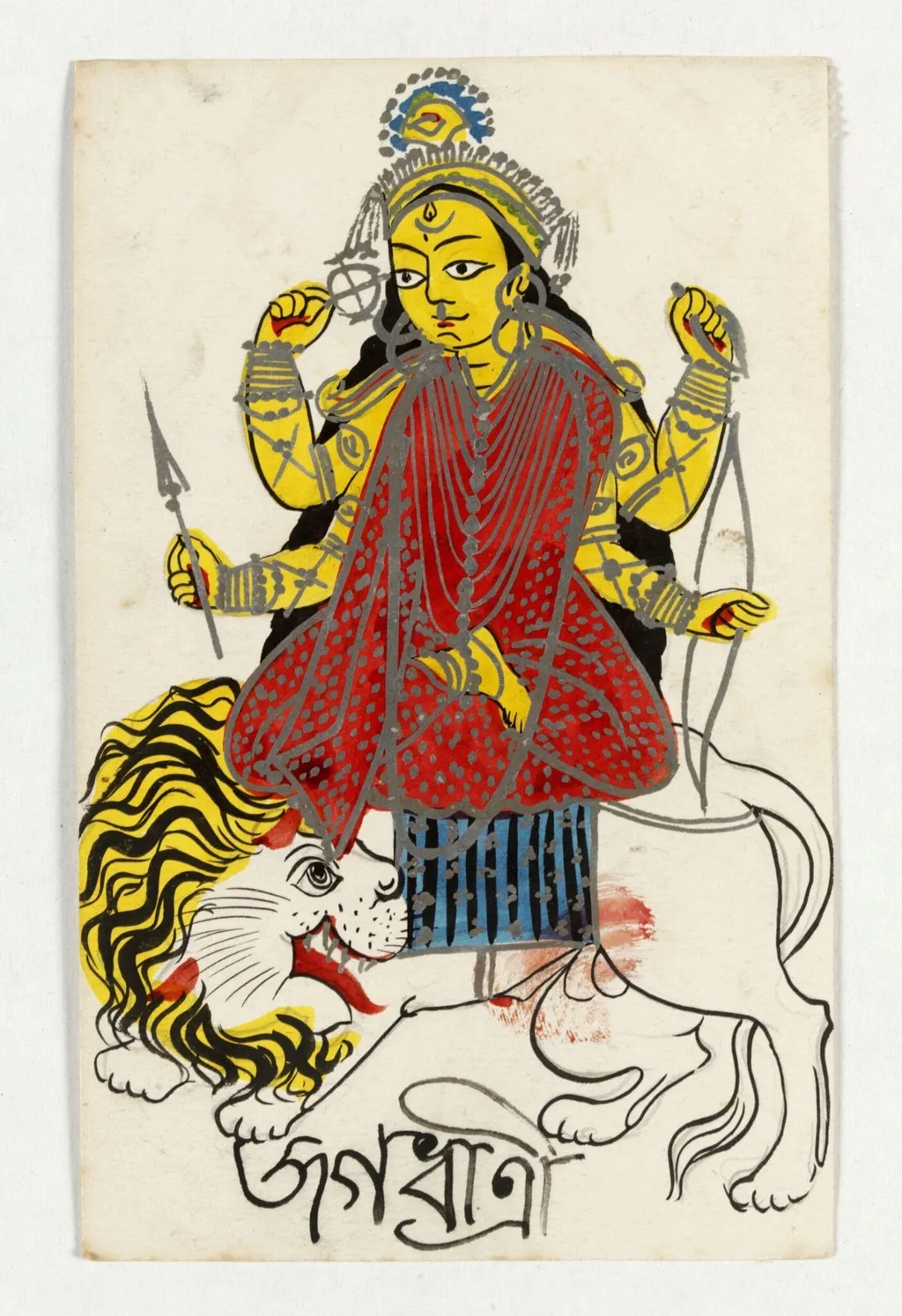
Jagaddhatri is a paint painting by the Impressionist artist Unknown. It dates from 1890 and is held in the collection of the Victoria and Albert Museum.
About this work
Overview
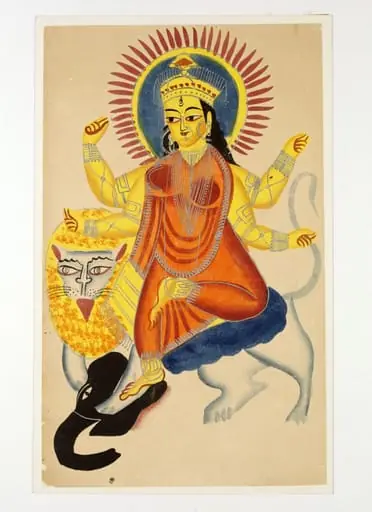
This watercolor and tin alloy painting on cardboard, dated 1890, portrays the Hindu goddess Jagaddhatri in a style characteristic of the Kalighat tradition.
This watercolor and tin alloy painting on cardboard, dated 1890, portrays the Hindu goddess Jagaddhatri in a style characteristic of the Kalighat tradition. Created in Bengal, it reflects the commercial art practices of 19th-century Indian painters who catered to pilgrims and local patrons. The work combines pigment with metallic accents to enhance visual impact, typical of the genre’s blend of devotional imagery and folk aesthetics.
Subject & Meaning
Jagaddhatri, meaning 'supporter of the world,' is depicted as a powerful, four-armed deity seated on a tiger, symbolizing control over primal forces. Her weapons—a sword, a circular disc, and gestures of protection and blessing—convey her role as protector and destroyer of evil. The third eye on her forehead signifies divine insight, while the tiger’s aggressive posture reinforces her dominance over chaos and danger.
Technique & Style
The painting employs bold, flat areas of color and sharp, inked outlines, hallmarks of Kalighat art. Tin alloy is applied sparingly to highlight ornaments and clothing details, adding subtle luminosity. The tiger’s striped fur and red tongue are rendered with rhythmic precision, contrasting with the goddess’s stylized, almost mask-like face. The composition is tightly framed, minimizing background detail to focus attention on the central figure.
History & Provenance
Produced in the late 19th century in the Kalighat region of Kolkata, the painting was likely made for domestic worship or sale to visitors of the nearby temple. It entered public awareness through its inclusion in the 1971 'Tantra' exhibition at London’s Hayward Gallery, which helped introduce South Asian tantric iconography to a Western audience. Its current location is not specified, but similar works are held in the Victoria and Albert Museum’s collection.
Context
Kalighat paintings emerged alongside the growth of urban centers and temple tourism in colonial Bengal. Artists adapted traditional iconography to meet the demands of a changing market, producing affordable, portable devotional images. This work reflects a fusion of religious symbolism with the visual language of urban popular art, bridging sacred tradition and commercial practice during a period of cultural transition.
Legacy
The painting exemplifies how regional Indian art forms preserved spiritual themes while evolving in response to modernity. Its inclusion in international exhibitions helped shift perceptions of folk art from mere craft to significant cultural expression. Today, Kalighat works like this are studied for their visual economy and their role in documenting religious life during British colonial rule.
Artist & collection

 Domestic Scene
 Giacomo and Cardinal Marco, investing Andrea, Abbot of San Zeno, with his Benefice
 The Nymph of Fontainebleau
 Portrait of a Woman
 Madonna and Child with Saints in the Enclosed Garden
 Venus and Minerva
 Family Group of Four on Sofa
 Wall painting from Room H of the Villa of P. Fannius Synistor at Boscoreale