Artwork
Durga and Mahishasura
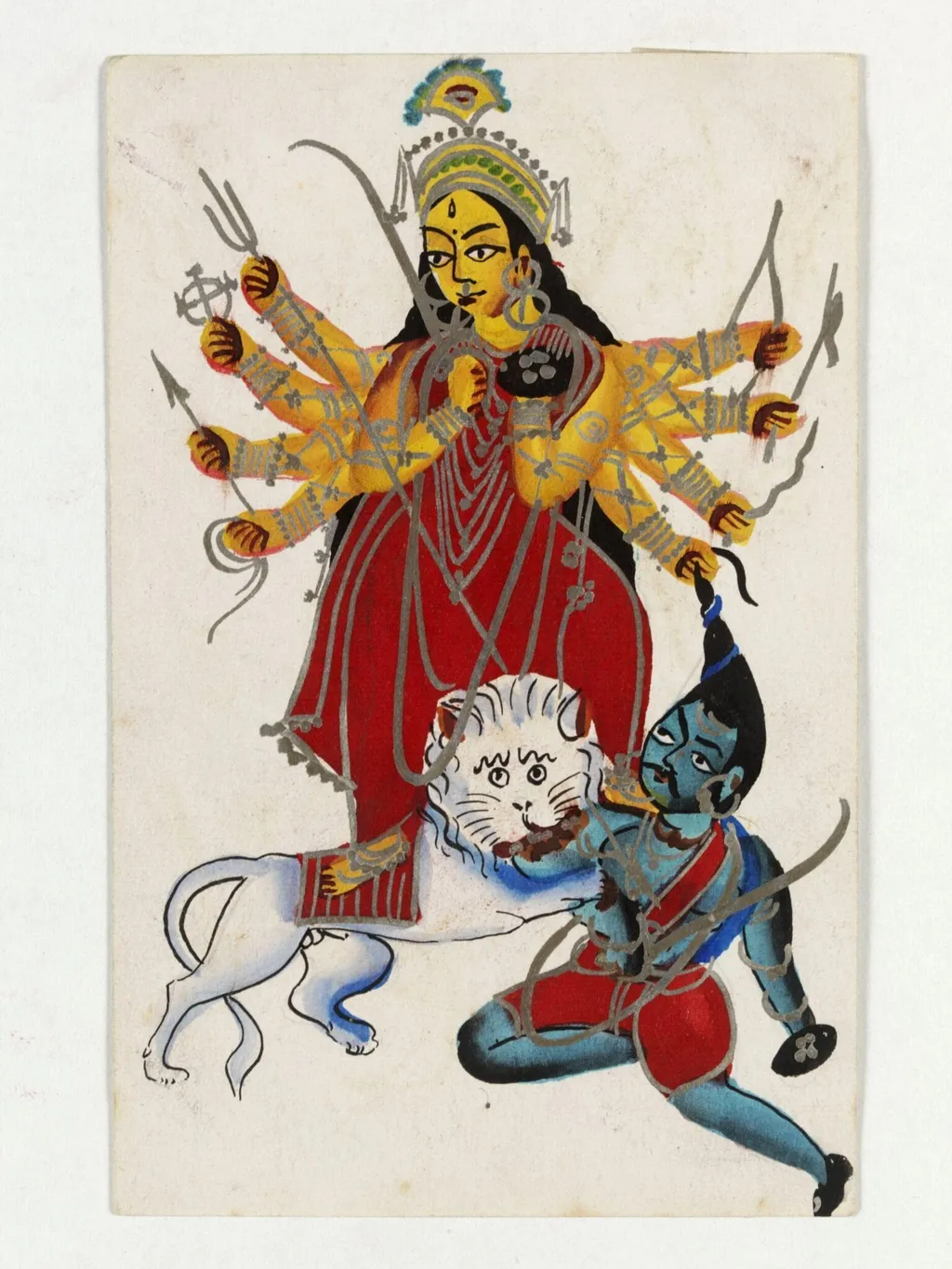
Durga and Mahishasura is a paint painting by the Impressionist artist Unknown. It dates from 1890 and is held in the collection of the Victoria and Albert Museum.
About this work
Bright colors—reds, yellows, and blues—pop against a light background, and the lines are bold and simple.
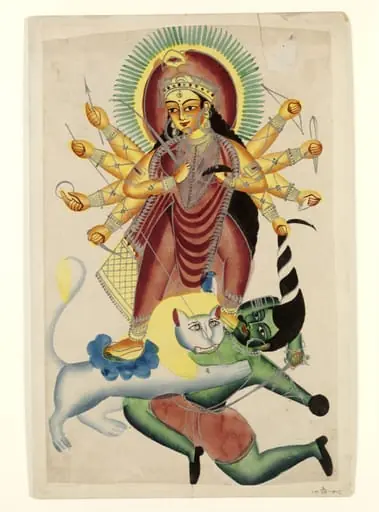
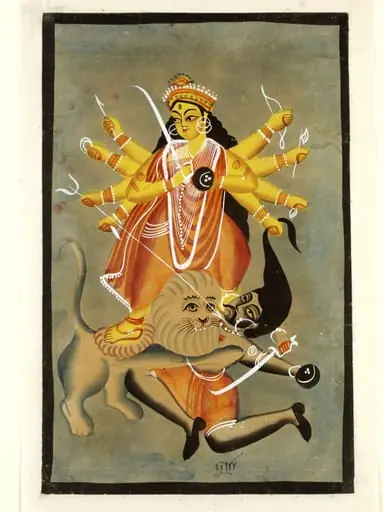
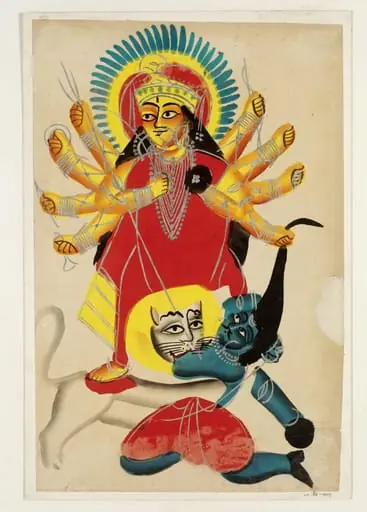
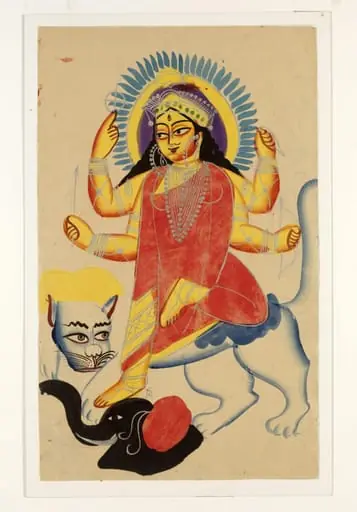
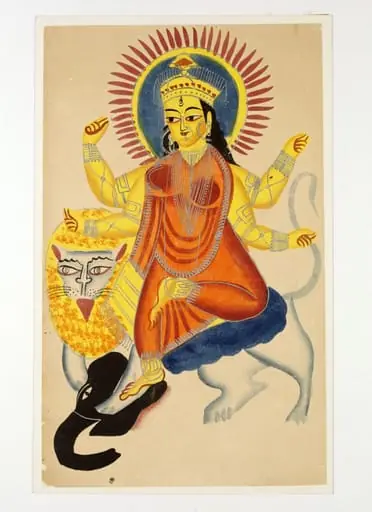
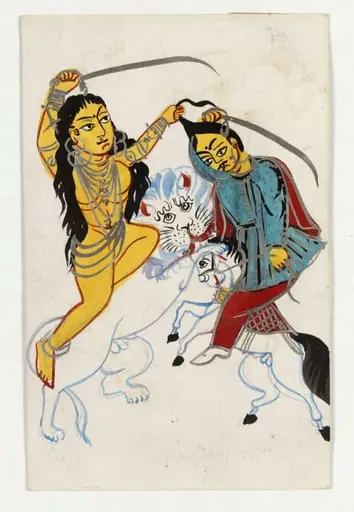
This painting shows a fierce goddess with four arms, standing over a blue-skinned man on a lion. The goddess wears a red sari and a golden crown, holding weapons like a sword and a disc. The man below looks scared, clutching the lion’s mane while the lion roars. Bright colors—reds, yellows, and blues—pop against a light background, and the lines are bold and simple.
This style is called *kalighat*, a type of Indian painting from the 19th century. The bold outlines and flat colors make it easy to read at a glance, almost like a storybook illustration.
Look up kalighat next to see more paintings like this.
Overview
This 1890 watercolour and tin alloy on cardboard painting depicts the mythological battle between the goddess Durga and the demon Mahishasura, characteristic of the Kalighat style of 19th-century Indian painting.
Subject & Meaning
The artwork illustrates a pivotal moment from Hindu mythology: Durga's triumph over Mahishasura. Durga, with four arms and adorned in a red sari and golden crown, dominates the scene, wielding a sword and disc. The cowering Mahishasura, blue-skinned, clings to a lion's mane as the beast roars, capturing the drama and power imbalance of the myth.
Technique & Style
Executed in bold, simple lines and vibrant, flat colors (notably reds, yellows, and blues against a light background), the painting embodies the Kalighat style. This approach, reminiscent of storybook illustrations, ensures immediate visual clarity and narrative understanding.
History & Provenance
Created in 1890, the painting's materials (watercolour, tin alloy on cardboard) and style (Kalighat) place it within the broader context of 19th-century Indian artistic practices. Specific provenance details are not provided.
Context
The Kalighat style, popular in 19th-century India, often depicted mythological and everyday scenes in accessible, illustrative forms. This painting reflects the style's emphasis on clear narrative and vibrant aesthetics, likely intended for a broad audience.
Legacy
As a representative of the Kalighat painting tradition, the artwork contributes to the understanding and appreciation of 19th-century Indian folk art. Its clear, bold style has influenced subsequent artistic movements in India.
Artist & collection

 Domestic Scene
 Giacomo and Cardinal Marco, investing Andrea, Abbot of San Zeno, with his Benefice
 The Nymph of Fontainebleau
 Portrait of a Woman
 Madonna and Child with Saints in the Enclosed Garden
 Venus and Minerva
 Family Group of Four on Sofa
 Wall painting from Room H of the Villa of P. Fannius Synistor at Boscoreale