Artwork
Jagannath traid
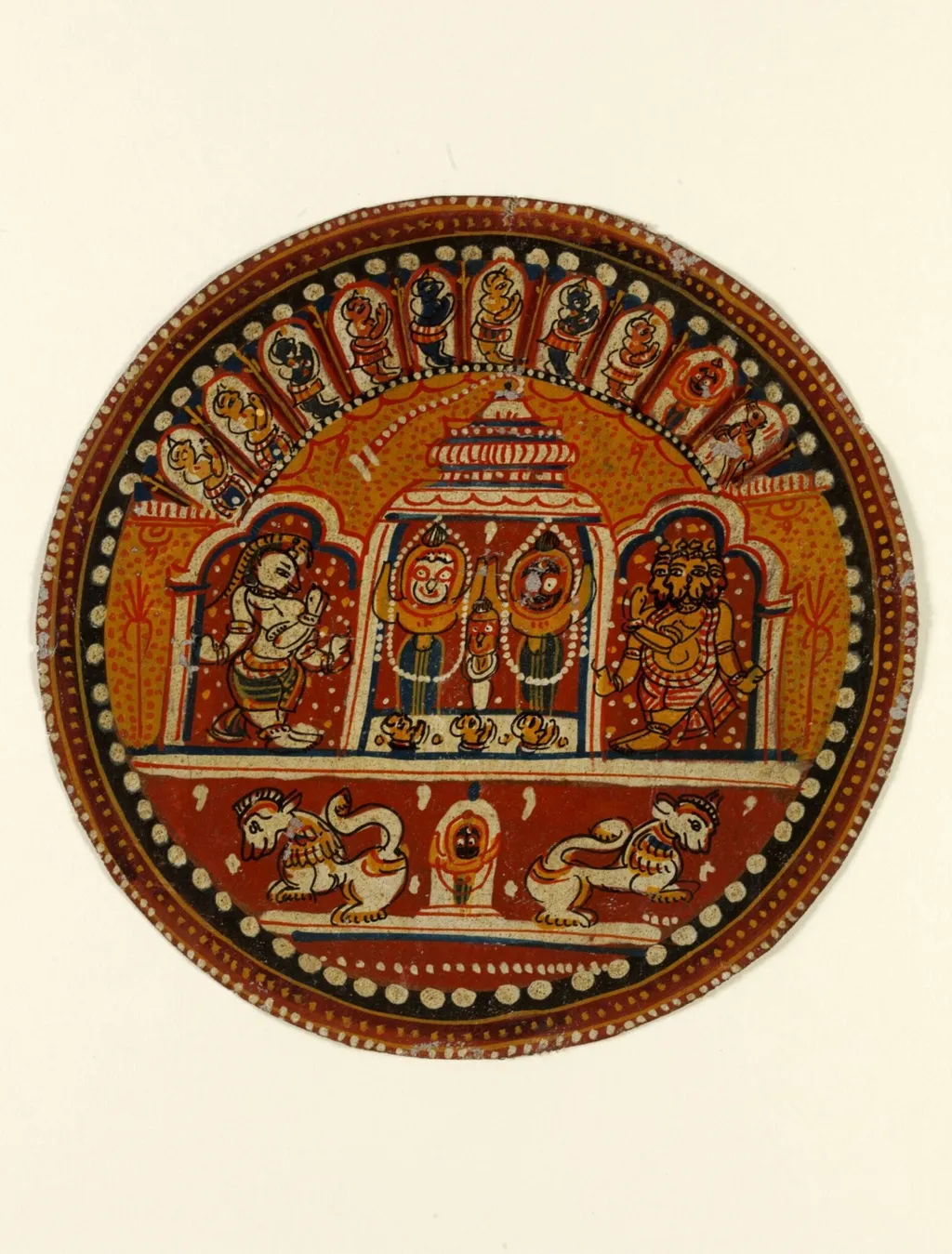
Jagannath traid is a paint painting by Unknown. It dates from 1910 and is held in the collection of the Victoria and Albert Museum.
About this work
Overview
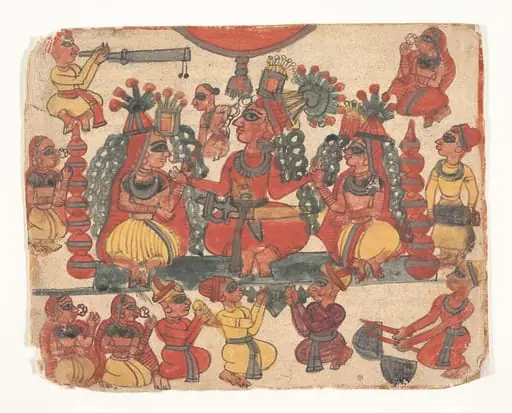
The composition is densely packed, with figures arranged under a canopy-like structure, surrounded by symbolic elements that reinforce its ritual significance.
This circular tempera painting on cloth, dated to 1910, portrays the Jagannath triad—Krishna with his siblings Subhadra and Balarama—within a devotional context. Executed in a traditional Pattachitra style, it features flat planes of vivid color, strong outlines, and no attempt at perspective or shading. The composition is densely packed, with figures arranged under a canopy-like structure, surrounded by symbolic elements that reinforce its ritual significance.
Subject & Meaning
The central triad represents the divine siblings worshipped in the Jagannath tradition of Odisha. Flanking them are Shiva on the left and Brahma with multiple heads on the right, signifying the unity of the Hindu trinity in devotion to Jagannath. The lions beneath the throne symbolize protection and royal authority, while the row of small faces above may depict celestial beings or deities witnessing the scene, emphasizing its sacred nature.
Technique & Style
The painting employs tempera pigments on cloth, a hallmark of Odisha’s Pattachitra tradition. Artists used natural pigments and fine brushes to create bold, unmodulated colors and crisp outlines. The absence of chiaroscuro and the stylized, flattened forms reflect a devotional aesthetic prioritizing symbolic clarity over naturalism. The intricate border, composed of minute dots and swirling patterns, serves both decorative and ritualistic functions.
History & Provenance
Created in the early 20th century, this work emerged from a lineage of temple-based artists in Odisha who produced devotional paintings for ritual use and pilgrimage souvenirs. It likely originated in Puri or a nearby center known for Pattachitra production. The painting entered the Victoria and Albert Museum’s collection as part of its broader effort to document South Asian religious art during the colonial era.
Context
This painting reflects the enduring tradition of Jagannath worship, centered in Puri, where the deities are annually paraded in a grand chariot festival. Such artworks were not merely decorative but served as aids for meditation and ritual remembrance. The inclusion of Shiva and Brahma aligns with regional theological interpretations that position Jagannath as a supreme form encompassing all aspects of divinity.
Legacy
The painting preserves a visual language passed down through generations of Odia artists, maintaining stylistic continuity despite modern influences. It stands as a testament to the persistence of devotional art in everyday religious life. Today, it contributes to scholarly understanding of how regional traditions adapted to changing patronage while retaining core iconographic principles.
Artist & collection

 Domestic Scene
 Giacomo and Cardinal Marco, investing Andrea, Abbot of San Zeno, with his Benefice
 The Nymph of Fontainebleau
 Portrait of a Woman
 Madonna and Child with Saints in the Enclosed Garden
 Venus and Minerva
 Family Group of Four on Sofa
 Wall painting from Room H of the Villa of P. Fannius Synistor at Boscoreale