Artwork
Lava, Kusha and Hanuman
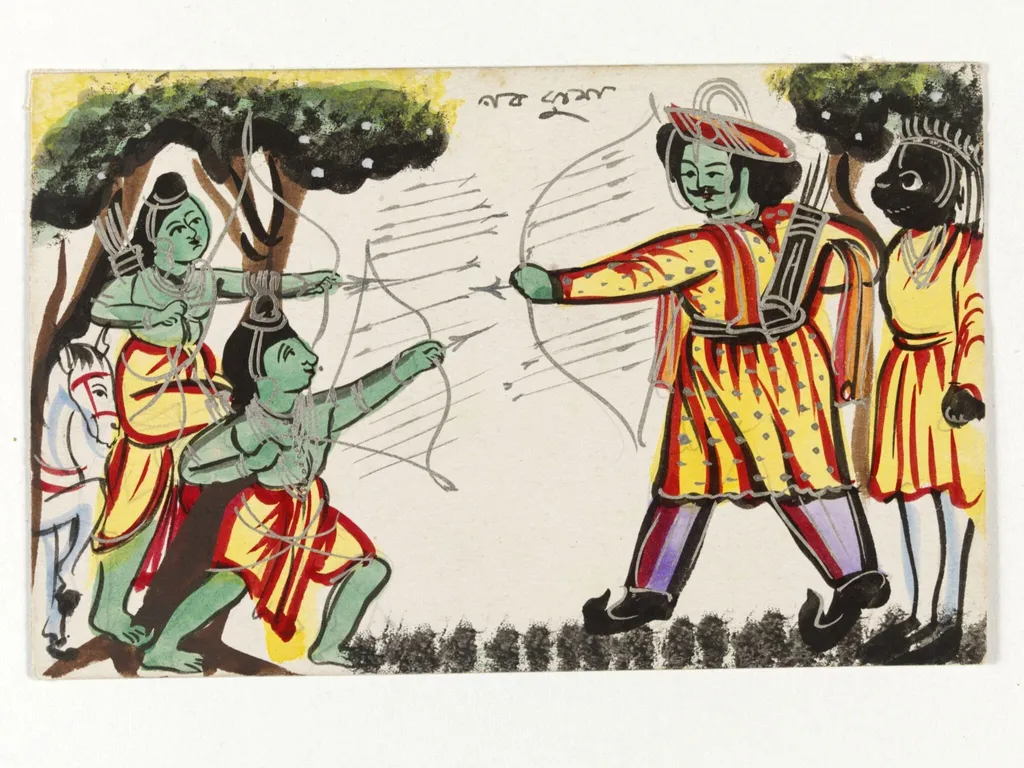
Lava, Kusha and Hanuman is a paint painting by the Impressionist artist Unknown. It dates from 1890 and is held in the collection of the Victoria and Albert Museum.
About this work
Overview
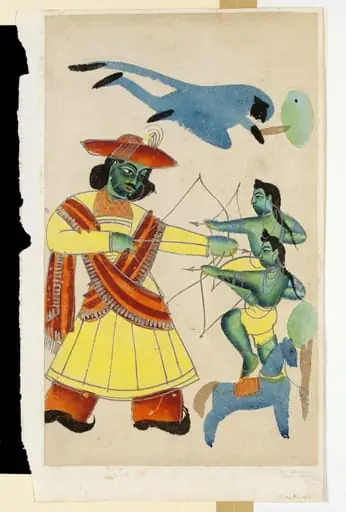
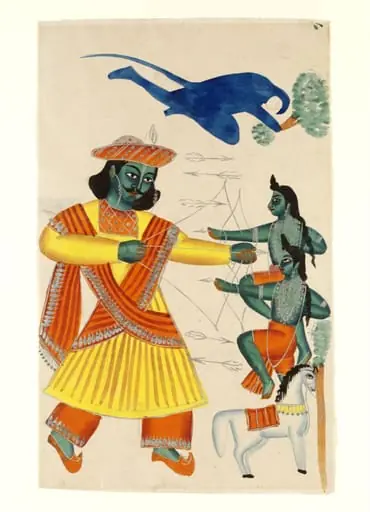
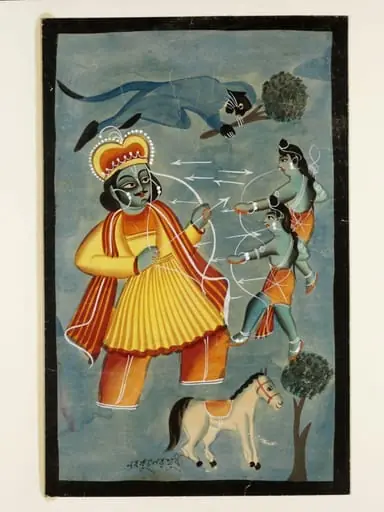
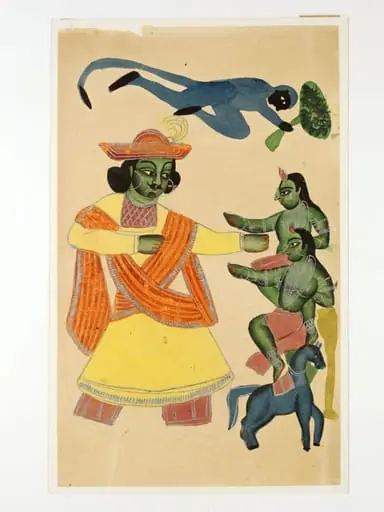
The composition is compact, with figures rendered in vivid, flat hues against a minimal landscape.
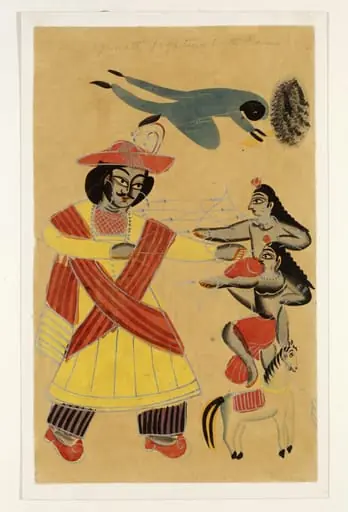
This 1890 watercolor and tin alloy painting on cardboard depicts a moment from the Ramayana, capturing Lava and Kusha in conflict with Hanuman after the detention of a sacred white horse. Executed in the Kalighat style, it reflects the urban artistic traditions of 19th-century Calcutta, where artists adapted religious narratives for a growing market of local and colonial patrons. The composition is compact, with figures rendered in vivid, flat hues against a minimal landscape.
Subject & Meaning
The scene portrays Lava and Kusha, twin sons of Rama, confronting Hanuman, the devoted monkey god, during the Ashvamedha sacrifice. Their confrontation arises from a test of loyalty and divine authority. Hanuman, though powerful, is restrained, while the princes assert their lineage. The moment carries theological weight, emphasizing duty and familial identity within the epic’s moral framework, rendered here with dramatic immediacy rather than elaborate symbolism.
Technique & Style
The painting employs bold, unmodulated colors and thick black outlines typical of Kalighat art. Short, energetic brushstrokes convey motion—particularly in the archer’s drawn bow and the trajectory of arrows. Tin alloy adds subtle metallic sheen to garments, enhancing luminosity. The figures are flattened and stylized, with little depth or perspective, focusing attention on gesture and expression. The background, sparse with trees and a rainbow, isolates the drama in a symbolic space.
History & Provenance
Created in Calcutta during British colonial rule, this work emerged from a community of artists who produced devotional imagery for pilgrims and collectors. Kalighat painters often worked near the Kalighat temple, adapting traditional iconography to contemporary tastes. This piece likely originated from such a studio, possibly commissioned as a devotional object or decorative item. Its survival reflects the enduring appeal of Ramayana narratives in popular visual culture.
Context
In 19th-century Bengal, traditional religious art evolved alongside urbanization and colonial influence. Kalighat paintings responded to changing audiences by simplifying forms and intensifying color, making complex myths accessible. While European styles gained traction among elites, these works preserved indigenous aesthetics. This painting sits at the intersection of spiritual tradition and commercial art, illustrating how sacred stories remained vital in a transforming society.
Legacy
Kalighat paintings like this one influenced later Indian modernists and remain key examples of folk-art innovation. They document how religious narratives were visually reinterpreted for everyday life, bridging temple culture and market demand. Today, such works are studied for their formal economy and cultural resilience, offering insight into how art sustained identity amid colonial disruption. Collections in institutions like the Victoria and Albert Museum preserve this legacy for ongoing scholarly engagement.
Artist & collection

 Domestic Scene
 Giacomo and Cardinal Marco, investing Andrea, Abbot of San Zeno, with his Benefice
 The Nymph of Fontainebleau
 Portrait of a Woman
 Madonna and Child with Saints in the Enclosed Garden
 Venus and Minerva
 Family Group of Four on Sofa
 Wall painting from Room H of the Villa of P. Fannius Synistor at Boscoreale