Artwork
Lehrunterlagen Theorie Farbenlehre
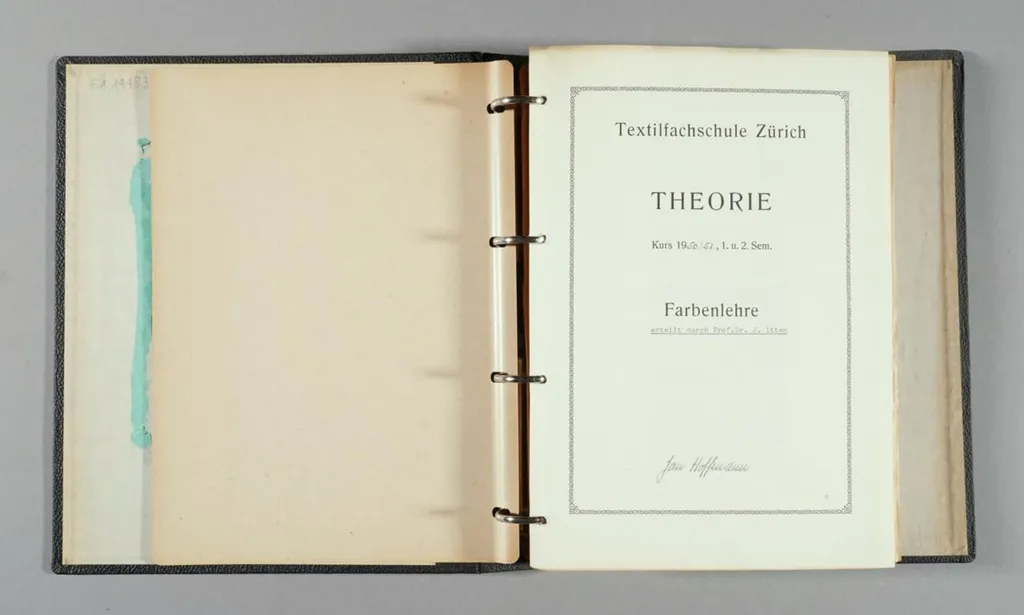
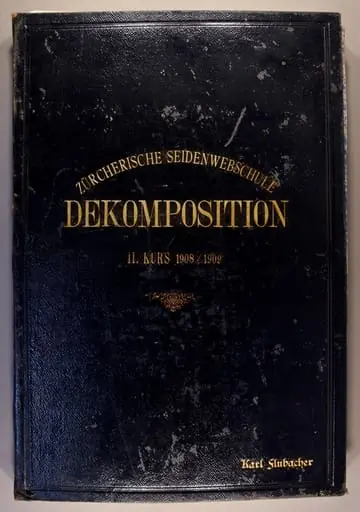
Lehrunterlagen Theorie Farbenlehre is an unspecified painting by Unknown. It dates from 1950 and is held in the collection of the Archaeology and Museum Baselland. This painting presents a detailed still life of an open textbook, rendered with careful attention to material and light.
About this work
Overview
The composition emphasizes texture and spatial depth through subtle shifts in tone, suggesting a study rooted in observation rather than narrative.
This painting presents a detailed still life of an open textbook, rendered with careful attention to material and light. The book, bound in black leather with metal rings, lies open to a page inscribed with German text related to color theory. The left page is blank, contrasting with the right, which displays structured typography. The composition emphasizes texture and spatial depth through subtle shifts in tone, suggesting a study rooted in observation rather than narrative.
Subject & Meaning
The depicted textbook, labeled 'Textilfachschule Zürich' and 'Farbenlehre,' indicates its function as an educational resource for textile design students. The presence of theoretical text implies a focus on systematic knowledge—color relationships, pigments, or application in fabric. The blank page opposite may suggest potential, unformed understanding, or the act of learning itself. The work treats pedagogy as a quiet, tangible subject, valuing structure over spectacle.
Technique & Style
The artist employs chiaroscuro to model the book’s leather binding and paper surfaces, creating a sense of volume and material presence. The black ink text stands sharply against the off-white pages, enhancing legibility while reinforcing contrast. Brushwork is restrained, favoring precision over expressiveness. Metal rings and the book’s spine are rendered with subtle highlights, suggesting a deliberate focus on the physicality of the object rather than its symbolic weight.
History & Provenance
The painting likely originated in a Swiss art or design school context, possibly as a student exercise or instructor’s reference piece. The illegible signature prevents definitive attribution, but the subject aligns with early 20th-century pedagogical practices in textile education. No documented exhibition or ownership history is known; its survival suggests it was retained within an academic setting, valued for its instructional clarity rather than artistic fame.
Context
In early 20th-century Switzerland, textile design schools integrated scientific approaches to color, influenced by industrial needs and modernist pedagogy. Color theory was not merely aesthetic but functional, tied to dye chemistry and production. This painting reflects that intersection—artistic representation serving educational utility. It belongs to a broader tradition of didactic still lifes, where objects become vessels for transmitted knowledge.
Legacy
Though not widely exhibited or reproduced, the work endures as a quiet testament to the material culture of design education. It captures a moment when color was taught as a discipline, grounded in observation and precision. Its significance lies not in fame but in its embodiment of a specific pedagogical ethos—one that valued clarity, structure, and the physicality of learning tools.
Artist & collection
 Domestic Scene
 Giacomo and Cardinal Marco, investing Andrea, Abbot of San Zeno, with his Benefice
 The Nymph of Fontainebleau
 Portrait of a Woman
 Madonna and Child with Saints in the Enclosed Garden
 Venus and Minerva
 Family Group of Four on Sofa
 Wall painting from Room H of the Villa of P. Fannius Synistor at Boscoreale