Artwork
Magha
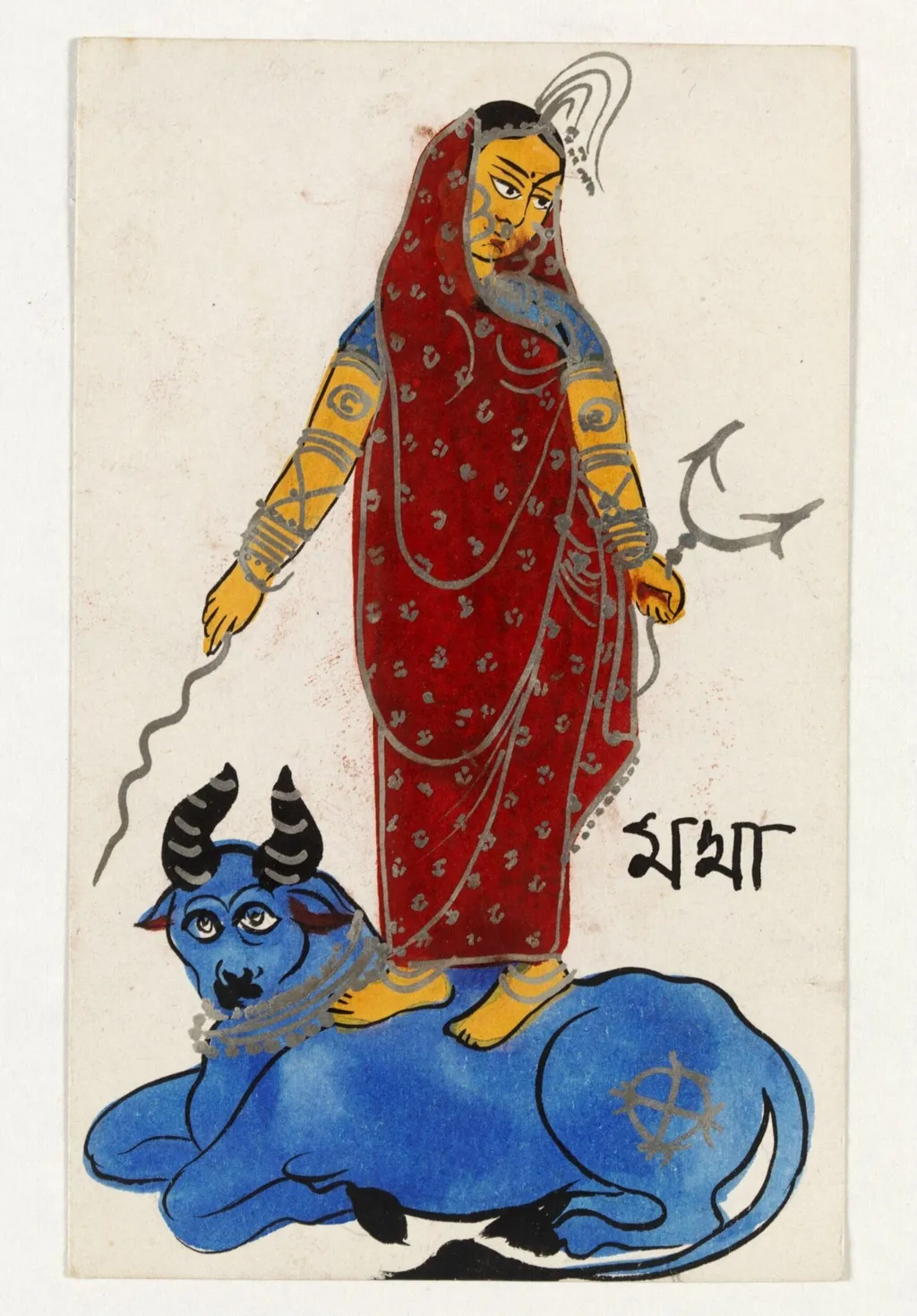
Magha is a paint painting by the Impressionist artist Unknown. It dates from 1890 and is held in the collection of the Victoria and Albert Museum.
About this work
Overview
This work is a watercolor and tin alloy painting on cardboard, representing Magha, the tenth lunar mansion in Indian astronomical tradition. The figure is depicted standing atop a bull, holding a thunderbolt and lightning shaft. The composition is rendered with minimal, rapid brushwork, suggesting an informal or preparatory study rather than a finished piece.
Subject & Meaning
Magha, associated with the constellation Regulus, is linked to ancestral power and royal authority in Vedic astrology. The figure’s posture and attributes—thunderbolt and lightning—evoke divine force and cosmic order. The bull symbolizes stability and fertility, grounding the celestial symbolism in earthly imagery common in regional astrological iconography.
Technique & Style
The overall effect resembles an artist’s working sketch, prioritizing gesture over finish, possibly intended as a study for a larger composition.
The artist employed loose, swift brushstrokes and sparse detailing, particularly in the facial features, which are suggested with faint light marks against a dark ground. Tin alloy was likely used for subtle metallic highlights, adding a tactile contrast. The overall effect resembles an artist’s working sketch, prioritizing gesture over finish, possibly intended as a study for a larger composition.
History & Provenance
The painting’s origin is tied to regional astrological manuscript traditions in northern India, likely from the 18th or 19th century. Such works were often created by itinerant artists for use in calendrical or ritual contexts. Its survival as a standalone piece suggests it may have been detached from a larger manuscript or used as a teaching aid.
Context
In pre-modern Indian astronomy, lunar mansions like Magha were used to track time and guide ritual activity. Paintings of these constellations were typically part of illustrated texts or temple diagrams. This piece reflects a more personal or experimental approach, possibly made by an artist familiar with formal conventions but working outside institutional constraints.
Legacy
Though not widely documented, such works contribute to understanding how astrological knowledge was visually transmitted beyond formal manuscripts. Their informal style reveals the fluidity of artistic practice in regional traditions, offering insight into the everyday processes behind more polished religious and scientific imagery.
Artist & collection

 Domestic Scene
 Giacomo and Cardinal Marco, investing Andrea, Abbot of San Zeno, with his Benefice
 The Nymph of Fontainebleau
 Portrait of a Woman
 Madonna and Child with Saints in the Enclosed Garden
 Venus and Minerva
 Family Group of Four on Sofa
 Wall painting from Room H of the Villa of P. Fannius Synistor at Boscoreale