Artwork
Maharaja Ajit Singh
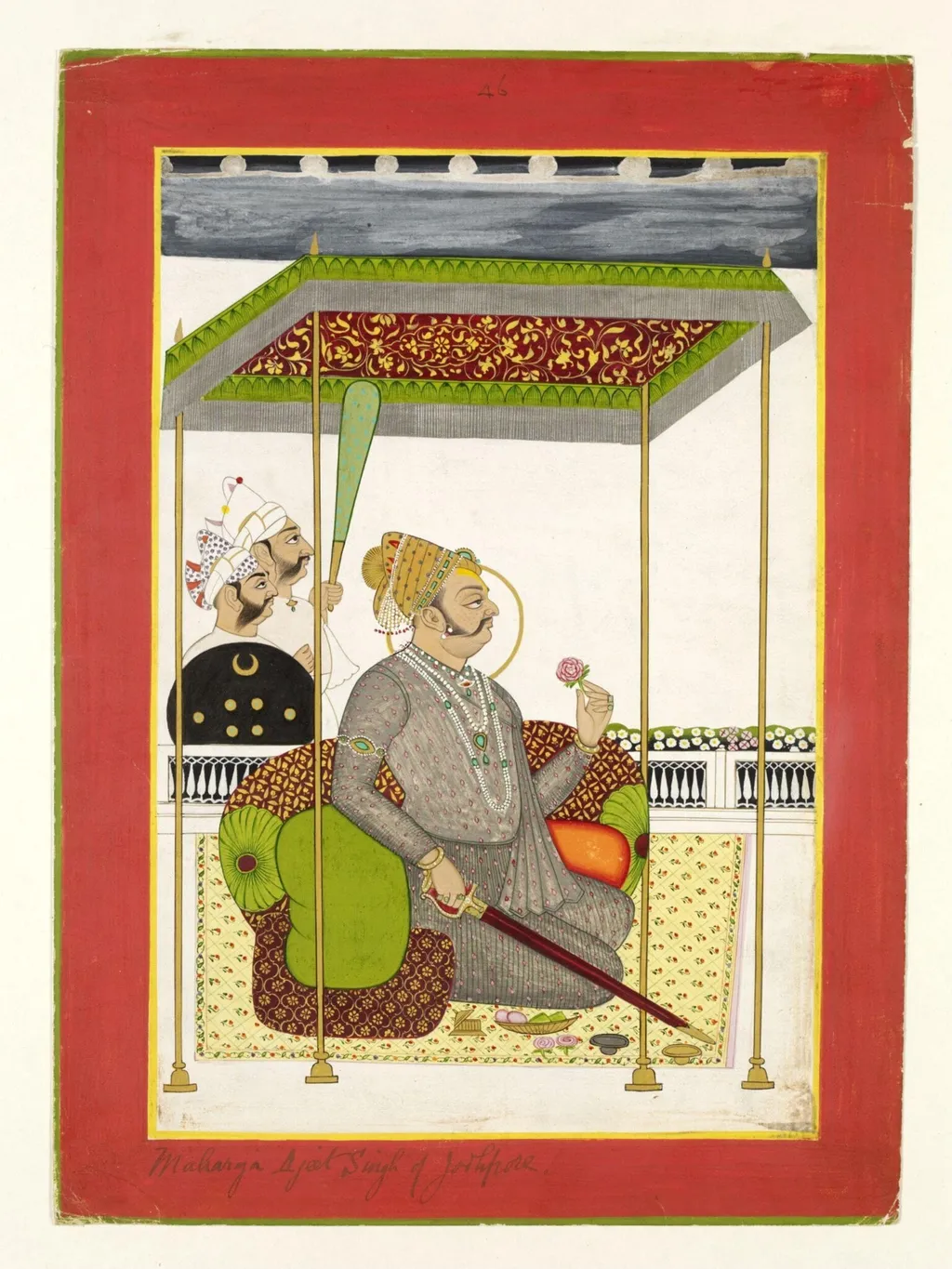
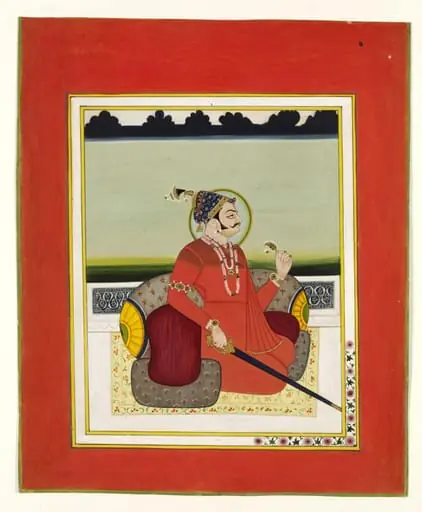
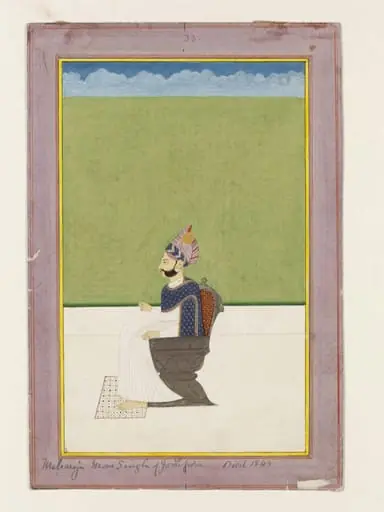
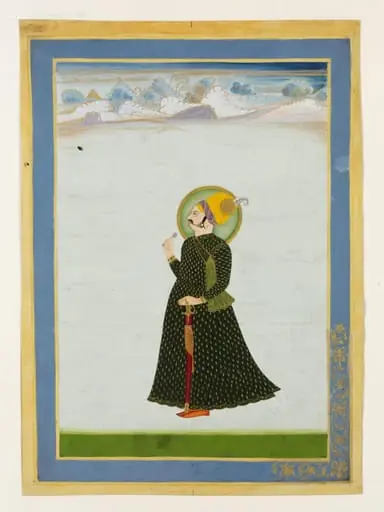
Maharaja Ajit Singh is a paint painting by the Impressionist artist Unknown. It dates from 1890 and is held in the collection of the Victoria and Albert Museum.
About this work
Overview
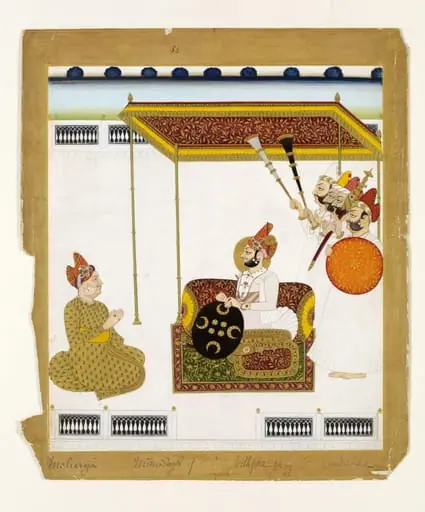
The work is a portrait of Maharaja Ajit Singh executed in opaque watercolor with gold accents on paper. The composition places the ruler seated beneath a richly colored canopy, flanked by two attendants, and framed by a red border that outlines the white background.
Subject & Meaning
Maharaja Ajit Singh is shown on a throne, dressed in a gray garment with elaborate patterns, a turban, and a moustache, holding a rose in his right hand. The presence of attendants in contrasting white and black attire, one bearing a long green object, underscores his status and the ceremonial context of the portrait.
Technique & Style
The artist employed opaque watercolor to achieve solid, vivid tones, while gold leaf highlights accentuate the canopy and throne. The careful rendering of textiles, jewelry, and the patterned rug reflects a realist approach, emphasizing precise detail and naturalistic color relationships.
History & Provenance
The painting originates from a period when Indian royalty commissioned portraiture to affirm authority and lineage. Though specific commissioning details are not recorded, the work has been preserved on paper, suggesting it was intended for private display within the Maharaja’s household.
Context
Portraits of Indian rulers in the 19th‑century often combined indigenous artistic conventions with European techniques such as watercolor and gold detailing. This synthesis mirrors broader cultural exchanges during the colonial era, where local elites adopted new media to convey traditional power.
Artist & collection

 Domestic Scene
 Giacomo and Cardinal Marco, investing Andrea, Abbot of San Zeno, with his Benefice
 The Nymph of Fontainebleau
 Portrait of a Woman
 Madonna and Child with Saints in the Enclosed Garden
 Venus and Minerva
 Family Group of Four on Sofa
 Wall painting from Room H of the Villa of P. Fannius Synistor at Boscoreale