Artwork
Maharaja Man Singh
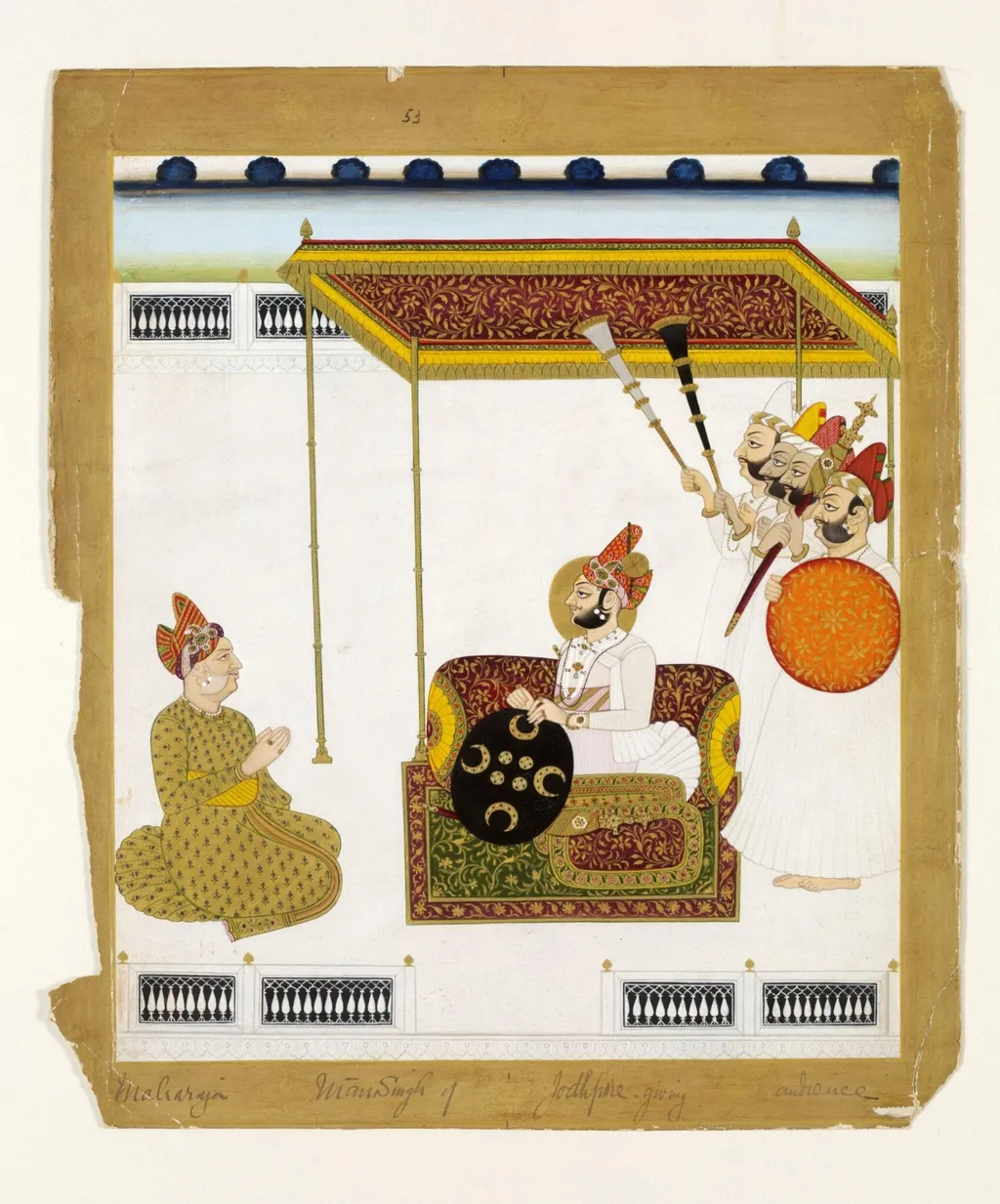
Maharaja Man Singh is a paint painting by the Impressionist artist Unknown. It dates from 1890 and is held in the collection of the Victoria and Albert Museum.
About this work
Overview
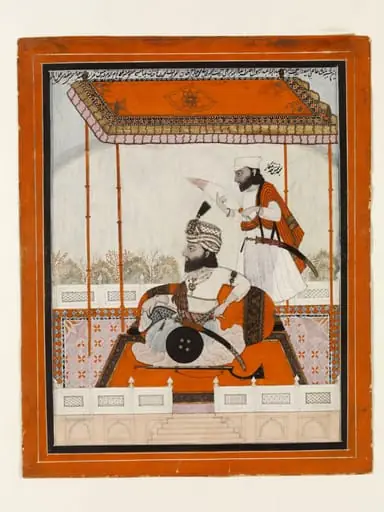
This painting portrays Maharaja Man Singh in a formal courtly setting, rendered in opaque watercolor and gold on paper. He is seated on an ornate couch beneath a patterned canopy, surrounded by attendants. The composition emphasizes hierarchy and ritual, with figures arranged to highlight the ruler’s centrality. The background is minimal, drawing focus to the figures and their elaborate attire.
Subject & Meaning
The central figure, Maharaja Man Singh, is depicted in a moment of quiet authority, holding a dark circular object possibly a ceremonial item or instrument.
The central figure, Maharaja Man Singh, is depicted in a moment of quiet authority, holding a dark circular object possibly a ceremonial item or instrument. Surrounding attendants, dressed in white and green, convey service and observation. The kneeling figure before him suggests an act of tribute or petition. The scene reflects the conventions of Rajput court portraiture, where status and ritual are visually encoded.
Technique & Style
The work employs fine brushwork and rich pigments, with gold leaf used to accentuate textiles and architectural details. Colors are saturated but controlled, avoiding naturalism in favor of symbolic clarity. Patterns on clothing and furnishings are meticulously rendered, reinforcing the opulence of the setting. The flat, decorative space contrasts with the three-dimensional modeling of figures, characteristic of Mughal-influenced Rajput painting.
History & Provenance
The painting originates from a Rajput court workshop, likely in Amber or Jaipur, during the late 17th or early 18th century. It was likely commissioned to commemorate the ruler’s presence or a ceremonial event. Its survival suggests it was preserved within royal collections, possibly passed through generations or gifted to allies. No documented exhibition history is known prior to modern cataloging.
Context
This work belongs to a tradition of Indian court painting that merged Persian miniature techniques with local aesthetics. Unlike European Impressionism, it prioritizes symbolic representation over atmospheric effect. The emphasis on pattern, color, and hierarchical composition aligns with broader South Asian visual culture, where power was expressed through visual order rather than naturalistic depth.
Legacy
The painting remains an example of Rajput portraiture’s refinement, illustrating how rulers used art to project legitimacy and cultural sophistication. While not widely known outside specialized collections, it contributes to understanding the diversity of Indian artistic practices during the early modern period. Its stylistic choices continue to inform scholarly analysis of courtly identity in pre-colonial India.
Artist & collection

 Domestic Scene
 Giacomo and Cardinal Marco, investing Andrea, Abbot of San Zeno, with his Benefice
 The Nymph of Fontainebleau
 Portrait of a Woman
 Madonna and Child with Saints in the Enclosed Garden
 Venus and Minerva
 Family Group of Four on Sofa
 Wall painting from Room H of the Villa of P. Fannius Synistor at Boscoreale
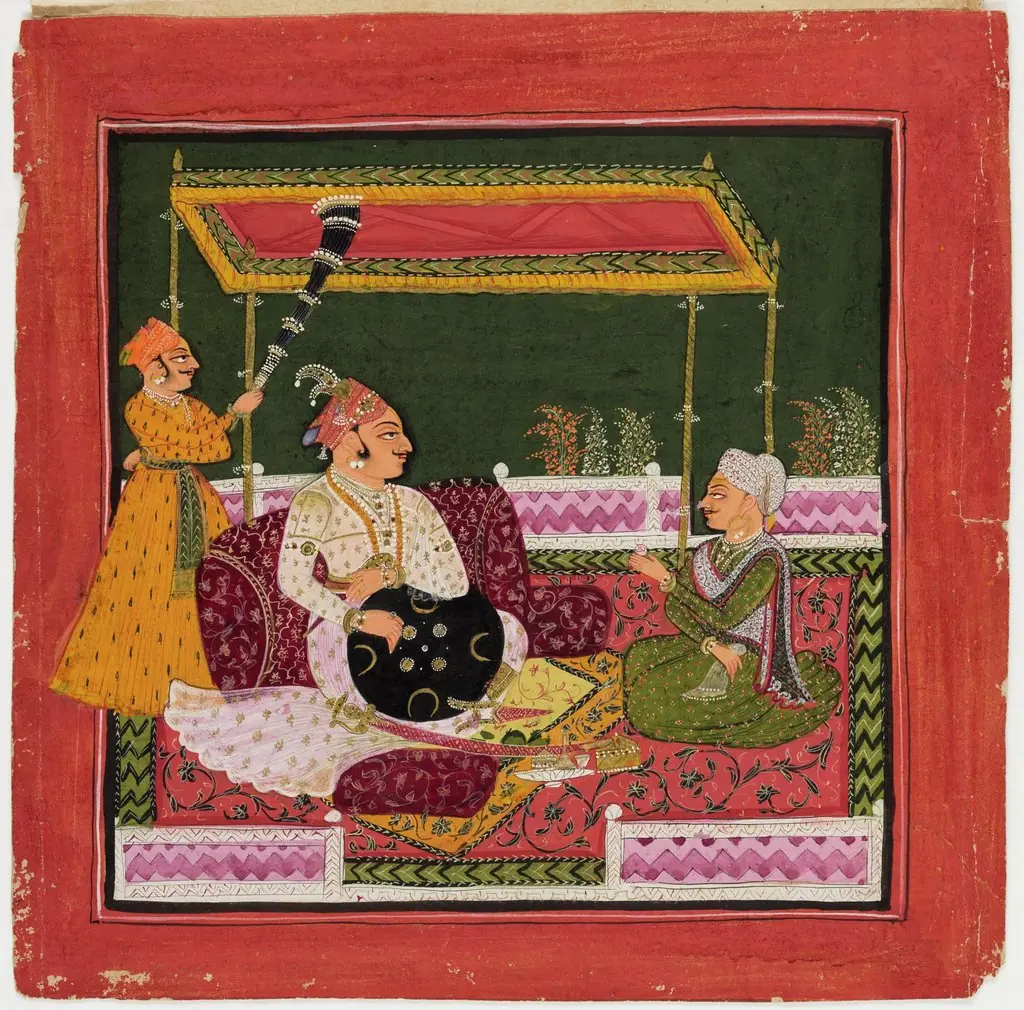 Raja and Courtiers Seated Beneath a Canopy
 Untitled
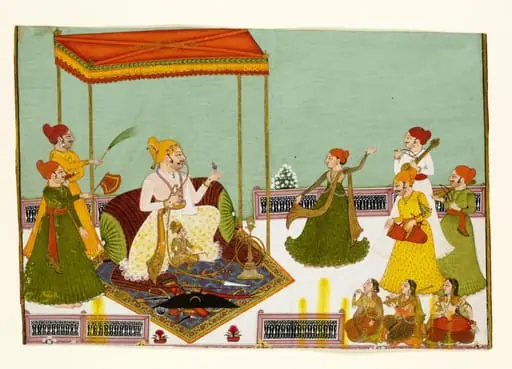 Raja Ajit Singh of Bundi
 Raja Bhupal Dev of Jasrota, Raja Dalip Singh and Raja Daya Dhat
 Muhammed Haji Khan
 Untitled
 Untitled
 Portrait of Raja with Nobles (probably Raja Jaswant Singh)
 Vivaca Ragaputra, a Leaf from Ragamala Series
 Shishupala arguing with Rukmini’s father, Bhishmaka, from a Rukmini Haran