Artwork
Marquetry Design
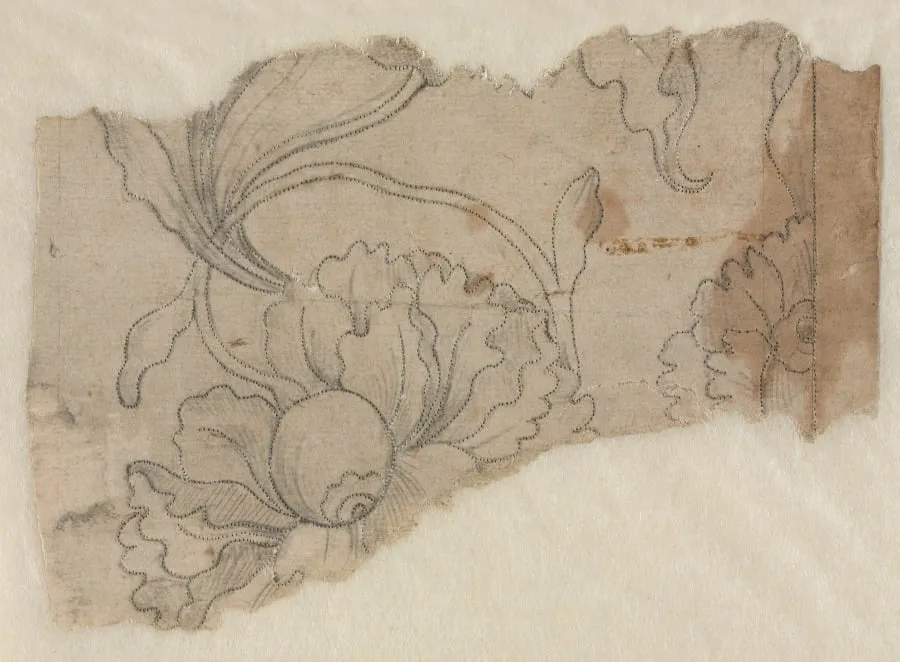
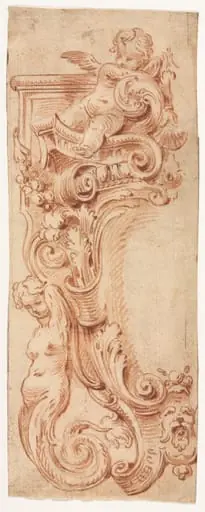
Marquetry Design is a drawing by the Baroque artist Unknown. It dates from 1745 and is held in the collection of the Cleveland Museum of Art. This drawing is a preparatory design for marquetry, a decorative craft involving inlaid wood.
About this work
Overview
The paper support appears aged and partially torn, suggesting use in a workshop rather than as a finished artwork.
This drawing is a preparatory design for marquetry, a decorative craft involving inlaid wood. Executed in fine black ink, it depicts stylized floral forms with elongated, curving petals and delicate stems. The paper support appears aged and partially torn, suggesting use in a workshop rather than as a finished artwork. Its function was likely to guide craftsmen in assembling intricate wood patterns.
Subject & Meaning
The subject consists of naturalistic flowers, rendered with botanical precision but adapted for geometric repetition. The design does not represent a specific species but rather an idealized floral motif common in 17th-century ornamentation. Such patterns conveyed harmony and abundance, aligning with decorative ideals of the period rather than symbolic narratives.
Technique & Style
The drawing employs continuous, fluid linework to define each petal and leaf, emphasizing rhythm over shading. Fine cross-hatching suggests volume without modeling, typical of workshop drawings meant for transfer. The precision of the lines indicates skilled draftsmanship, likely executed with a fine quill or pen, suited for replication in wood inlay.
History & Provenance
Though no documented origin is recorded, the style and medium align with European workshop practices of the late 1600s, particularly in France or the Netherlands. The torn edge and worn surface suggest repeated handling during production. It may have been part of a larger collection of patterns used by cabinetmakers or royal ateliers.
Context
This drawing reflects the broader Baroque emphasis on ornate, organic decoration in interior design. Marquetry flourished in aristocratic furniture and paneling, where natural forms were abstracted into repeatable motifs. Such designs bridged fine art and craft, serving as templates for artisans who translated ink on paper into wood and veneer.
Legacy
As a functional artifact, this drawing exemplifies the unseen labor behind decorative arts. While rarely preserved, such sketches reveal the transition from artistic conception to material execution. Today, they offer insight into the collaborative nature of Baroque craftsmanship, where draftsmen and woodworkers jointly shaped aesthetic outcomes.
Artist & collection

 Domestic Scene
 Giacomo and Cardinal Marco, investing Andrea, Abbot of San Zeno, with his Benefice
 The Nymph of Fontainebleau
 Portrait of a Woman
 Madonna and Child with Saints in the Enclosed Garden
 Venus and Minerva
 Family Group of Four on Sofa
 Wall painting from Room H of the Villa of P. Fannius Synistor at Boscoreale
 Untitled
 Gothic Ornament with a Lady and a Parrot
 The Gardens of the Villa Medici
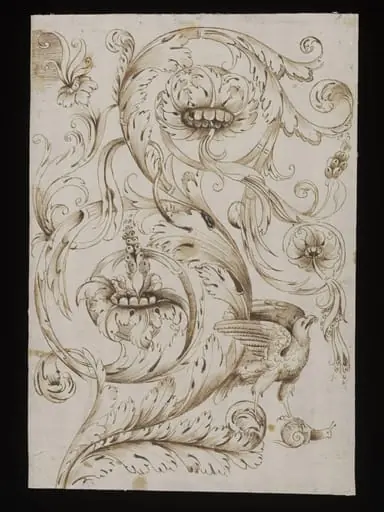 Decorative acanthus scrollwork with bird of prey and snail
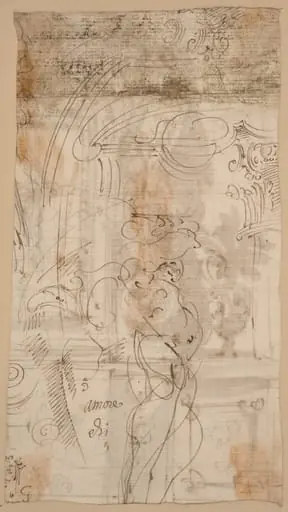 An Architectural Study with an Atlantid
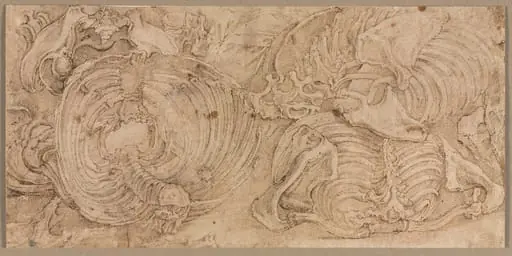 Rib Cages
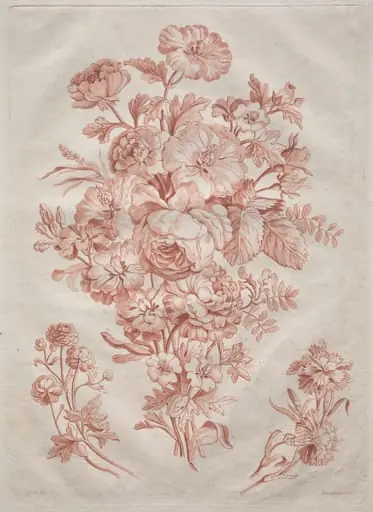 Spray of Flowers
 An Oak Leaf Ornament
 Composition avec bouquet de fleurs, guirlandes et frises de feuilles et de fleurs stylisées, projets de broderies de gilet, XVIIIème siècle
 Ornament print by Jacob Bonneau
 Kalpa Sutra
 Design for a Cartouche