Artwork
Mother and Sons
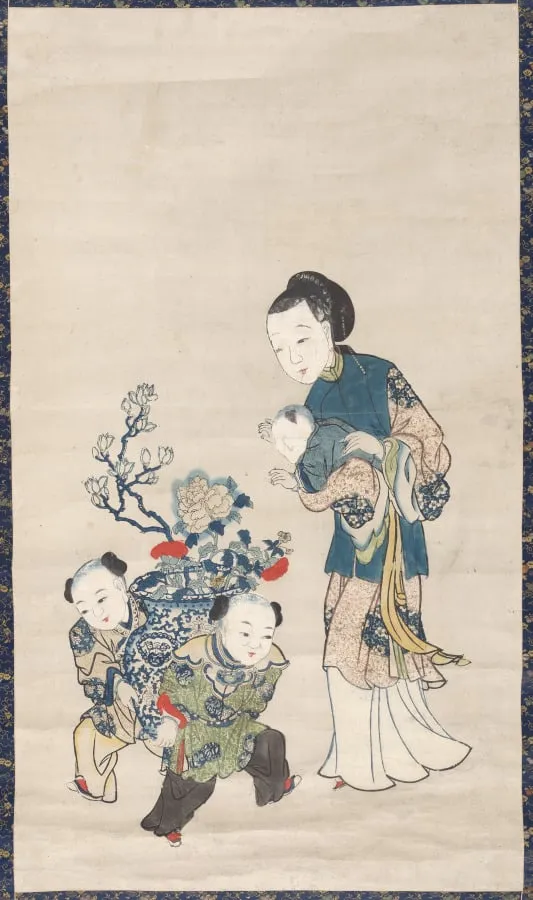
Mother and Sons is a print by the Baroque artist Unknown. It dates from 1766 and is held in the collection of the Cleveland Museum of Art. This color woodblock print dates to the Qianlong era of the Qing dynasty, a period when technical precision in multi-block printing peaked.
About this work
You see a woman in a blue robe sitting on a carved chair, two boys beside her, all against a plain background.
You see a woman in a blue robe sitting on a carved chair, two boys beside her, all against a plain background. Delicate flowers and birds decorate the edges.
This painting was made during the Qianlong reign in China, when woodblock printing in color was at its best. Each color came from a separate carved block, pressed one after another. The artist’s name is lost, but the work feels personal—like a family portrait.
To see more like it, look up *qing dynasty (1644–1911)*.
Overview
This color woodblock print dates to the Qianlong era of the Qing dynasty, a period when technical precision in multi-block printing peaked. Created through a sequence of individually carved blocks, each applying a single hue, the image captures a quiet domestic moment. The composition is restrained, with no elaborate setting, drawing focus to the figures and subtle decorative borders.
Subject & Meaning
A woman in a blue robe sits beside two young boys, their proximity suggesting familial intimacy. The absence of context or narrative detail invites interpretation as a private portrait, possibly commemorating a mother’s role within the household. The delicate floral and avian motifs along the edges may symbolize harmony or seasonal renewal, reinforcing themes of continuity and care.
Technique & Style
The print was produced using the traditional Chinese method of separate woodblocks for each color, requiring precise alignment and sequential pressing. Lines are fine and controlled, with soft transitions between hues. The background remains unadorned, emphasizing the figures, while the ornamental borders reflect the era’s preference for refined, non-intrusive decoration.
History & Provenance
Though the artist’s identity is unknown, the work originates from the mid-18th century, during the height of imperial patronage for decorative arts. Such prints were often produced for domestic use rather than public display, suggesting a private commission. Its survival reflects the durability of the medium and the value placed on intimate, handcrafted imagery within elite households.
Context
During the Qianlong reign, woodblock printing flourished as both an artistic and commercial craft, supported by imperial workshops and urban artisans. While grander works adorned temples or imperial collections, smaller prints like this one catered to private tastes, blending aesthetic refinement with personal sentiment in a society increasingly attentive to domestic life.
Legacy
This print exemplifies the quiet sophistication of Qing-era color woodblock printing, a tradition that influenced later East Asian printmaking. Though overshadowed by later Western developments, such works remain vital records of everyday visual culture, preserving the dignity of familial relationships through meticulous, labor-intensive craftsmanship.
Artist & collection

 Domestic Scene
 Giacomo and Cardinal Marco, investing Andrea, Abbot of San Zeno, with his Benefice
 The Nymph of Fontainebleau
 Portrait of a Woman
 Madonna and Child with Saints in the Enclosed Garden
 Venus and Minerva
 Family Group of Four on Sofa
 Wall painting from Room H of the Villa of P. Fannius Synistor at Boscoreale
 Untitled
 Untitled
 Untitled
 Yang Guifei Leaving the Bath
 Child Reaching for a Fishbowl
 Dongfang Shuo (Tongbang Sak), one of the Eight Chinese Immortals
 Yang Guifei Leaving the Bath
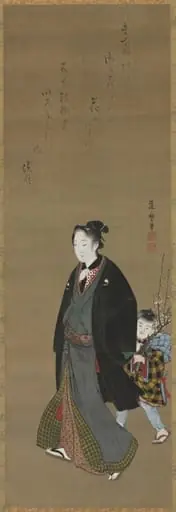 A Beauty
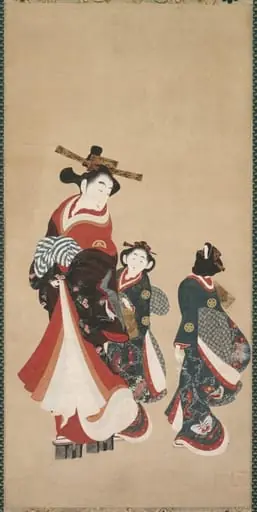 Courtesan and Attendants
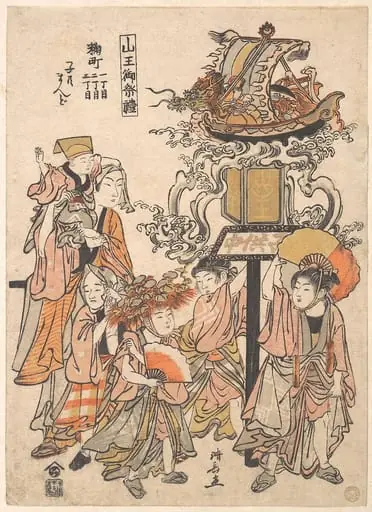 Kodomo Mando, Kojimachi 1,2, 3-chome, Sanno Go-sairei|Childrens' Lantern Float, Kojimachi 1,2, 3-chome Block Association, Sanno Festival