Artwork
În centrul icoanei este Crucea galbenă, cu terminațiile brațelor trilobate pictate cu roșu-alb-gri, iar în dreapta crucii este Sfântul Împărat Constantin, și în stânga este Împărăteasa Elena, mama sa. În spatele Crucii, este cerul albastru regal, încadrat de o ghirlandă de 4 ruje. Crucea găsită este susținută cu bucurie de cei doi sfinți. Veșmintele Sfinților Constantin și Elena sunt într-o combinație de roșu vermillon, gri antracit. Fondul icoanei este cerul albastru-cobalt, în registrul superior, iar în registrul inferior, este un câmp de galben luminos. În registrul superior, este o boltă-cupolă-arcadă albă luminoasă. Cromatica este armonioasă: roșu vermillon, galben-ocru, albastru regal, gri antracit, alb, negru. Icoana este de Nicula. Inscripția din româno-chirilică se traduce Constantin cu Elena. Postamentul Crucii este realizat printr-un caroiaj alb-negru.
În centrul icoanei este Crucea galbenă, cu terminațiile brațelor trilobate pictate cu roșu-alb-gri, iar în dreapta crucii este Sfântul Împărat Constantin, și în stânga este Împărăteasa Elena, mama sa. În spatele Crucii, este cerul albastru regal, încadrat de o ghirlandă de 4 ruje. Crucea găsită este susținută cu bucurie de cei doi sfinți. Veșmintele Sfinților Constantin și Elena sunt într-o combinație de roșu vermillon, gri antracit. Fondul icoanei este cerul albastru-cobalt, în registrul superior, iar în registrul inferior, este un câmp de galben luminos. În registrul superior, este o boltă-cupolă-arcadă albă luminoasă. Cromatica este armonioasă: roșu vermillon, galben-ocru, albastru regal, gri antracit, alb, negru. Icoana este de Nicula. Inscripția din româno-chirilică se traduce Constantin cu Elena. Postamentul Crucii este realizat printr-un caroiaj alb-negru. is a print by Unknown. It dates from 1850 and is held in the collection of the ASTRA National Museum Complex. The panel presents a central yellow cross whose arms terminate in trilobate shapes rendered in red, white and gray.
About this work
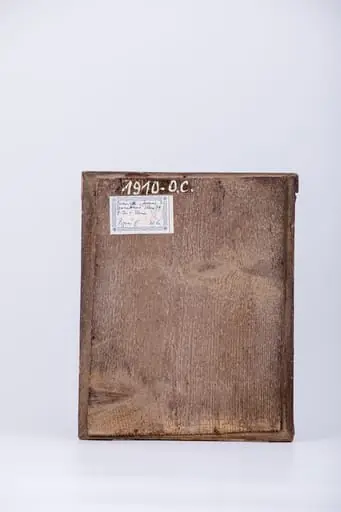
Two small labels are stuck on it—one with handwritten text, the other with a faded blue border and more writing.
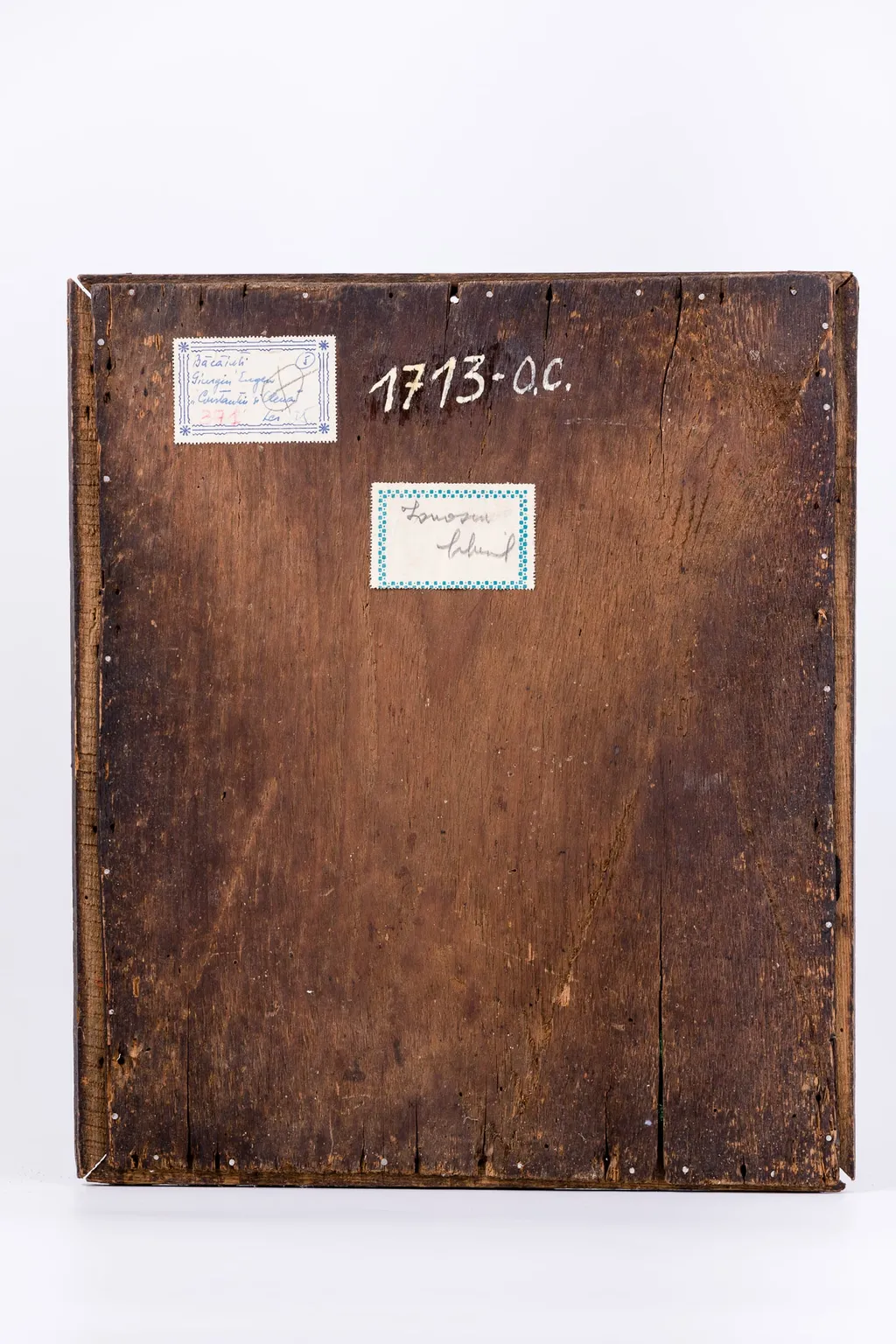
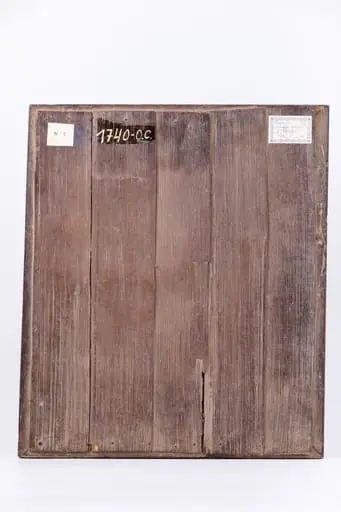
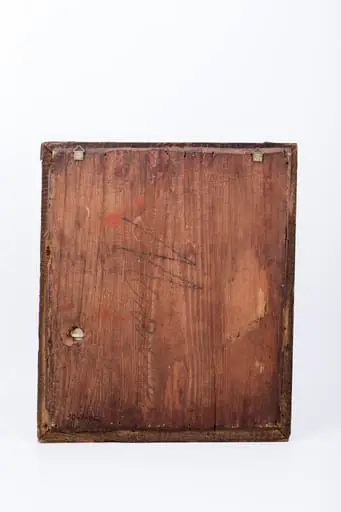
This is the back of an old wooden panel. The wood is dark, worn, and cracked in places. Two small labels are stuck on it—one with handwritten text, the other with a faded blue border and more writing. The date "1713" is scrawled in pencil near the top right corner.
The labels hint at a story hidden on the other side. The wood looks like it’s been around for a long time, maybe holding a painting or religious image.
Look up inscription to see how these notes might reveal clues about the art.
Overview
The panel presents a central yellow cross whose arms terminate in trilobate shapes rendered in red, white and gray. Flanking the cross, Saint Emperor Constantine appears on the right and his mother, Empress Helena, on the left, both shown in reverent posture. Behind the cross a regal blue sky is framed by a garland of four roses, while the lower register is filled with a luminous yellow field.
Subject & Meaning
The composition emphasizes the Christian triumph symbolized by the cross, supported joyfully by the two imperial saints. The presence of Constantine and Helena reflects their historical role in legitimizing Christianity within the Roman Empire, a theme commonly invoked in Eastern Orthodox iconography to underscore divine authority.
Technique & Style
The icon employs a harmonious palette of vermilion red, ochre yellow, royal blue, anthracite gray, white and black. The cross’s support is rendered in a black‑and‑white lattice, and the upper register features a luminous white arch‑like vault. The background sky is depicted in cobalt blue, creating a vivid contrast with the golden lower field.
History & Provenance
The work originates from the Nicula region and bears a Romanian‑Cyrillic inscription identifying the figures as Constantine and Helena. A pencil date of 1713 appears on the reverse, suggesting the panel’s completion or later documentation in the early eighteenth century.
Context
Created within the tradition of Romanian Orthodox devotional art, the icon reflects the liturgical practice of venerating imperial saints alongside the crucifix. The inclusion of a rose garland and the specific chromatic scheme align with contemporary regional aesthetic preferences.
Legacy
Although the painted surface is no longer visible, the surviving back of the panel, with its aged wood and marginal labels, offers insight into the material history of religious artworks in the area and the continued reverence for the imperial saints in local devotional culture.
Artist & collection

 Domestic Scene
 Giacomo and Cardinal Marco, investing Andrea, Abbot of San Zeno, with his Benefice
 The Nymph of Fontainebleau
 Portrait of a Woman
 Madonna and Child with Saints in the Enclosed Garden
 Venus and Minerva
 Family Group of Four on Sofa
 Wall painting from Room H of the Villa of P. Fannius Synistor at Boscoreale
 În centrul icoanei este Crucea aurie, cu vrejul de ramificații fitomorfe orange, iar în stânga crucii este Sfântul Împărat Constantin și în dreapta este Împărăteasa Elena, mama sa. Crucea găsită este susținută cu bucurie de cei doi sfinți. Veșmintele Sfinților Constantin și Elena sunt într-o combinație de roșu vermillon, galben și orange. Spațiul albastru senin, din cerul din fondul icoanei, duce cu gândul la Crucea de lumină apărută pe cer In hoc signo vinces - prin acest semn vei învinge. În registrul inferior, este un câmp decorativ geometrizant alternativ de roșu-orange-roz-gri. În registrul superior, în colțurile stânga-dreapta sunt 2 îngeri serafimi. Cromatica este armonioasă: roșu vermillon, roz, galben-ocru, albastru cobalt, ceruleum, alb, negru. Icoana este de Țara Oltului. Inscripția din româno-chirilică se traduce Sf Constantin Elena.
 Sfânta Mare Cuvioasă Parascheva de la Iași are crucea și o ramură de finic verde brad, în mâna dreaptă. Este îmbrăcată în veșmânt roșu vermillon, cu interiorul căptușit cu verde, vernil, crem și galben, cu sacosul alb ivoriu, cu dungi crem-bej. Sacosul este alb ivoriu crem-bej, cu danteluță și guleraș galben. Sfânta Cuvioasă are părul negru lung, ondulat, lăsat pe umeri, coroană roșie și aureolă. Fondul icoanei este cerul albastru-negru întunecat, în registrul superior și un câmp înalt luminos de grâu galben-copt, în registrul mediu și inferior, de culoare ocru-muștar. Întreaga compoziție iconografică este încadrată de un chenar decorativ geometrizant alb și unul paralel, fitomorf, format dintr-o ghirlandă de 6 ruje - margarete, cu petale roșii. Ghirlanda excelează prin delicatețea desenului și bogăția cromatică armonioasă. Cromatica este armonioasă: roșu vermillon, albastru-negru, verde forest, kaki, vernil-măr, olive, bej-crem, negru, galben chihlimbar, ocru, muștar, negru, alb. Icoana este din Nordul Transilvaniei, Nicula.
 În centrul icoanei este Crucea aurie-bronzie, iar în dreapta crucii este Sfântul Împărat Constantin, și în stânga este Împărăteasa Elena, mama sa. Deasupra fiecăruia este inscripționat numele. În spatele Crucii, lipit de cruce, este un soare stilizat - Soarele alb al dreptății. Crucea găsită este susținută cu bucurie de cei doi sfinți. Veșmintele Sfinților Constantin și Elena sunt într-o combinație de roșu vermillon și verde kaki. Soarele din spatele Crucii și spațiul galben de lumină duce cu gândul la Crucea de lumină apărută pe cer In hoc signo vinces - prin acest semn vei învinge. Icoana este bogat ornamentată de culoare, lumină și detalii semnificative, elemente decorative geometrizante șerpuitoare și ondulatorii. Fondul icoanei este cerul de noapte, albastru ultramarin bleumarin întunecat. Întreaga compoziție este încadrată armonios de un chenar decorativ geometrizant roșu stacojiu-vișiniu cu linia albă șerpuitoare, specifică centrului de la Nicula. Cromatica este armonioasă și bogată: roșu vermillon, roșu stacojiu-vișiniu, galben-chihlimbar, albastru ultramarin bleumarin, verde kaki, ocru, alb, negru. Icoana este de Nicula. Inscripția din româno-chirilică se traduce Constantin Elena. Icoana este crăpată și lipită.
 Sfântul Mare Mucenic Gheorghe este așezat călare pe un cal alb cu șa galbenă-ocru-brună, omorând balaurul alb-albastru-gri cu creastă roșie-acajou, solzi și coadă lungă, cu lancea, pe care o ține cu amândouă mâinile, înfingându-i-o animalului în gâtlej. Fondul este cerul albastru bleu-ciel senin și văzduhul vernil, în registrul superior. În registrul inferior, fondul este brun-ocru și albastru cobalt, cu linii ondulatorii albe-negre, cele două registre în centrul icoanei ușor întrepătrundu-se. Mantia Sfântului Mucenic Purtător de Biruință este roșie-brună-acajou, având cămașa de cavaler cu zale. Culoarea roșie este caracteristică mucenicilor și martirilor. Cerul albastru este acoperit cu elemente fitomorfe - flori ocru-roșii. Icoana, fiind din Mărginimea Sibiului, are desenul mai neglijent, cromatica vie puternică, fauvistă. Cromatica este armonioasă: roșu vermillon-stacojiu, albastru-cobalt, bleu-ciel, vernil, roz, brun, galben-ocru, gri, alb, negru. Vernilul superior și albastrul cobalt inferior sunt împodobite armonios, simetric și echilibrant - compozițional cu crenguțe de măr înflorite - elemente fitomorfe.
 Mântuitorul Iisus Hristos, fiind răstignit pe Cruce, are în stânga pe Sfântul Împărat Constantin cel Mare, în locul uceniculuil cel iubit, care a stat lipit de pieptul Învățătorului, la Cina cea de Taină, mai precis, în locul Sfântului Apostol și Evanghelist Ioan Teologul, Evanghelistul Iubirii și în dreapta pe Sfânta Împărăteasă Elena, mama Sfântului Constantin, în locul Maicii Domnului Îndurerate, Jalnică și Plângătoare. Veșmintele Sfinților Împărați sunt sacosuri albastre cobalt și mantii roșii vermillon. Mântuitorul Iisus Hristos Răstignit pe Cruce are o țesătură verde-gri-antracit în jurul mijlocului și a coapselor. Fondul icoanei este cerul albastru bleu-ciel senin și în registrul inferior, în spatele Crucii este un spațiu galben-chihlimbar, prefigurând Lumina Învierii Domnului Iisus Hristos. Întreaga tematică iconografică este încadrată de un chenar decorativ fitomorf, format dintr-o ghirlandă de bujori și trandafiri, 4 ruje. Cromatica este armonioasă: roșu vermillon, albastru ceruleum, cobalt și bleu-ciel, gri antracit, verde forest, galben chihlimbar alb, negru. Inscripția din româno-chirilică se traduce Constantin cu Elena. Icoana este mai rară, datorită abordării tematicii iconografice. Icoana este din Nordul Transilvaniei, Nicula.
 În centrul icoanei este Crucea, iar în stânga crucii este Sfântul Împărat Constantin, și în dreapta este Împărăteasa Elena, mama sa. Deasupra fiecăruia este inscripționat numele inversat. Veșmintele sfinților împărați sunt pictate cu roșu vermillon, roz, brun, bej, verde kaki. Poartă coroane împărătești și aureole de sfinți, mantiiile de împărați le au prinse la gât cu fibulă. În spatele fiecăruia este câte un înger păzitor. În registrul superior, deasupra crucii, sunt ramuri de finic. Fondul este verde, culoarea Sfântului Duh, la Pogorâre, cu stele albe și roșii, reprezentând cerul și văzduhul de Duh Sfânt. În registrul inferior este o alternanță de câmpuri paralele, cromatizate cu albastru și alb, cu pete și tușe de roșu. Cromatica este armonioasă și puternic vie și pastelată: roșu vermillon, verde spanac-avocado, kaki, roz, brun, bej, albastru, alb, negru. Inscripția dn româno-chirilică se traduce IC XC Iisus Hristos Sf Constantin Sf Elena. Icoana reprezintă pictura Țării Oltului.