Artwork
Nașterea lui Iisus
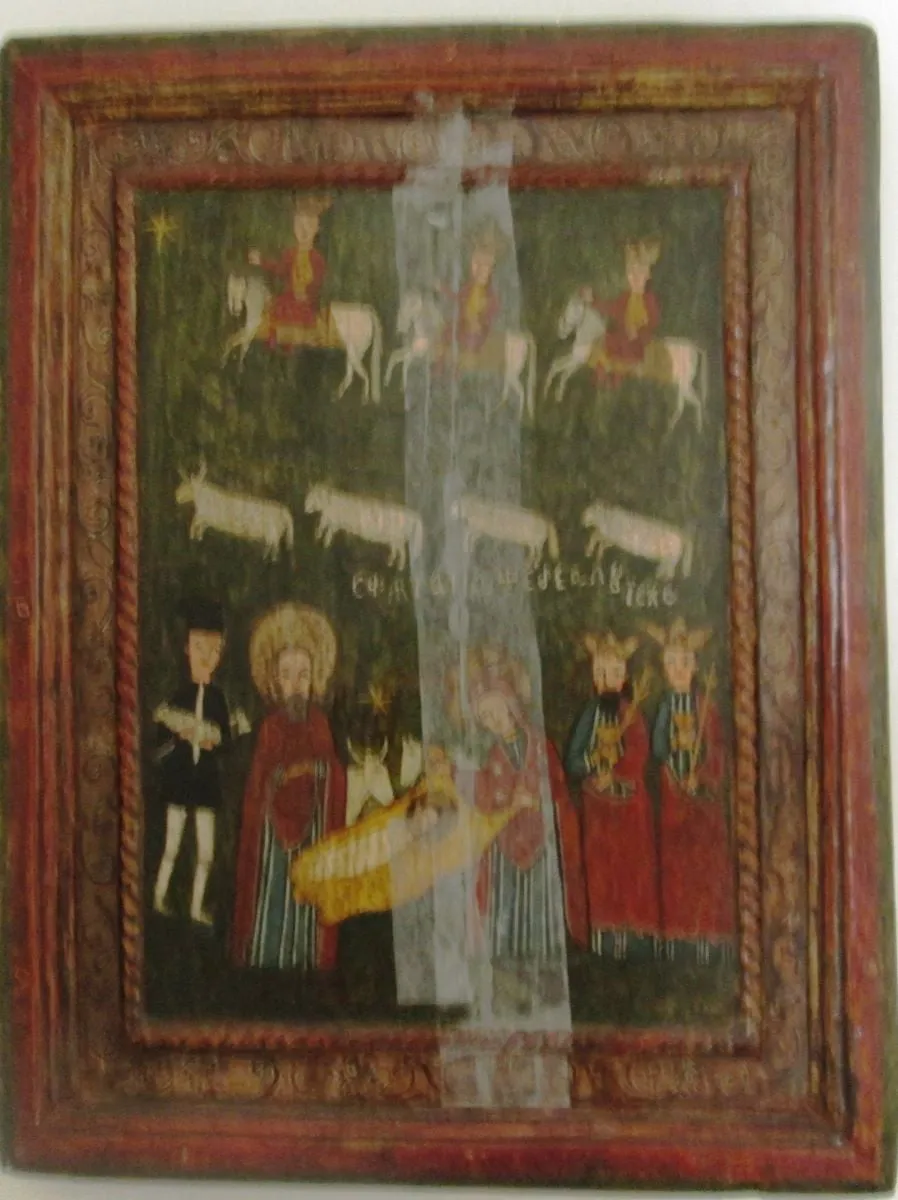
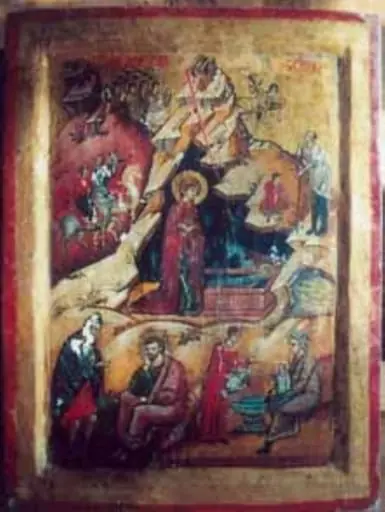
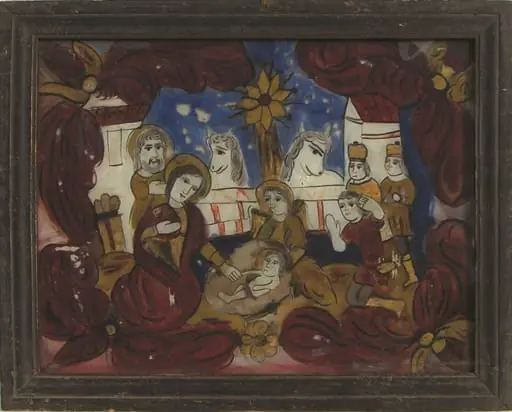
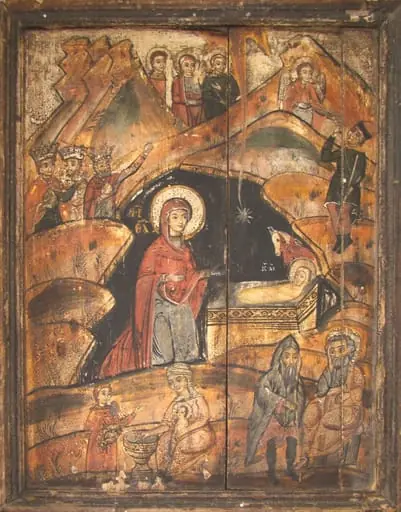
Nașterea lui Iisus is a drawing by Unknown. It dates from 1850 and is held in the collection of the National Museum of Romanian History. This drawing depicts the Nativity, rendered in a straightforward, graphic style.
About this work
Overview
The composition uses flat, saturated colors—reds, blues, and golds—to define forms without shading, emphasizing clarity over realism.
This drawing depicts the Nativity, rendered in a straightforward, graphic style. Central figures include the infant Jesus in a manger, flanked by a man and woman, likely Joseph and Mary. Above, celestial beings on horseback play instruments, while livestock populate the background. The composition uses flat, saturated colors—reds, blues, and golds—to define forms without shading, emphasizing clarity over realism.
Subject & Meaning
The scene illustrates the birth of Jesus Christ as described in Christian tradition. The presence of angels, animals, and the inscription 'Iisus Hristos' affirms the sacred nature of the event. The inclusion of shepherds’ livestock and the manger underscores humility, while the celestial figures convey divine intervention, reinforcing the theological significance of the moment.
Technique & Style
The artist employs bold, unmodulated colors and simplified forms to create immediate visual legibility. Figures are outlined clearly, with no attempt at perspective or depth. The absence of cross-hatching or tonal gradation suggests a deliberate choice to prioritize symbolic representation over naturalism, aligning with folk or devotional traditions that favor clarity over complexity.
History & Provenance
The work appears to originate from a regional religious tradition, possibly Eastern European, given the use of 'Iisus Hristos' in an archaic script. Its style resembles liturgical illustrations or folk art used in domestic or church settings. No documented provenance is available, but its format suggests it was produced for private devotion or educational purposes within a faith community.
Context
Created in a cultural environment where religious narratives were often transmitted visually, this image reflects a time when literacy was limited and imagery served as a primary means of conveying scripture. Similar depictions appear in illuminated manuscripts, icons, and printed broadsheets, where symbolic elements replaced naturalistic detail to ensure universal understanding.
Legacy
This drawing exemplifies how sacred stories were preserved and shared through accessible visual language. Its enduring structure—central figure, celestial witnesses, humble surroundings—echoes centuries of Nativity imagery across cultures. Though unattributed and modest in execution, it continues to function as a quiet testament to the persistence of religious iconography in everyday life.
Artist & collection

 Domestic Scene
 Giacomo and Cardinal Marco, investing Andrea, Abbot of San Zeno, with his Benefice
 The Nymph of Fontainebleau
 Portrait of a Woman
 Madonna and Child with Saints in the Enclosed Garden
 Venus and Minerva
 Family Group of Four on Sofa
 Wall painting from Room H of the Villa of P. Fannius Synistor at Boscoreale