Artwork
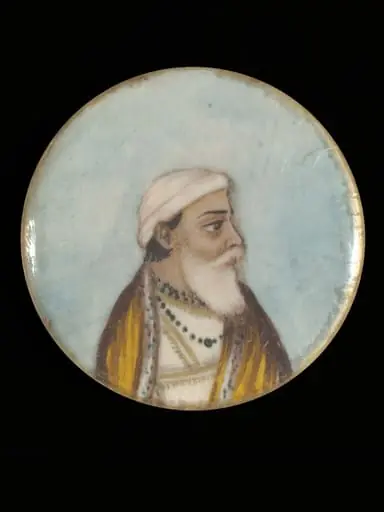
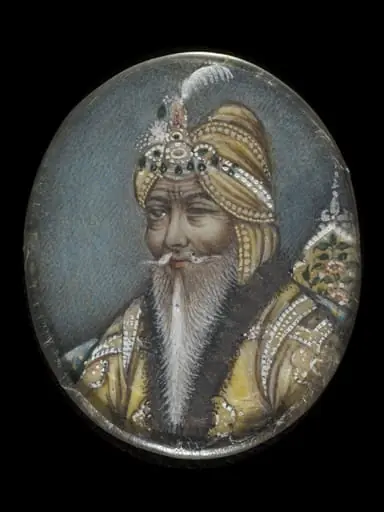
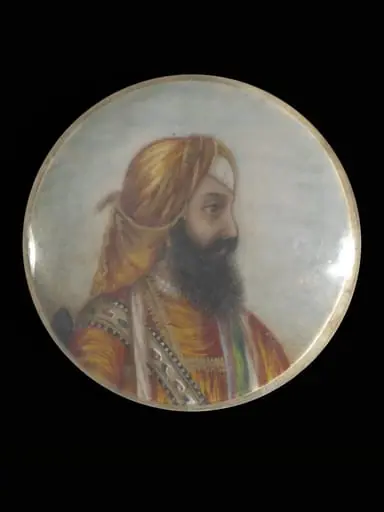
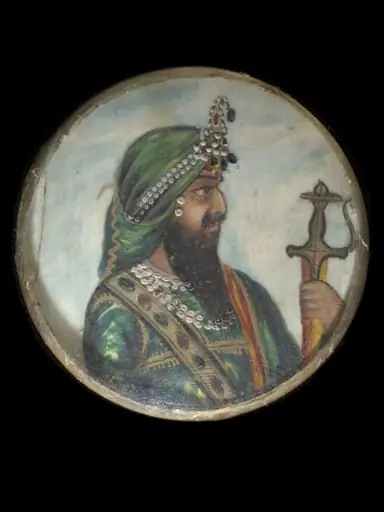
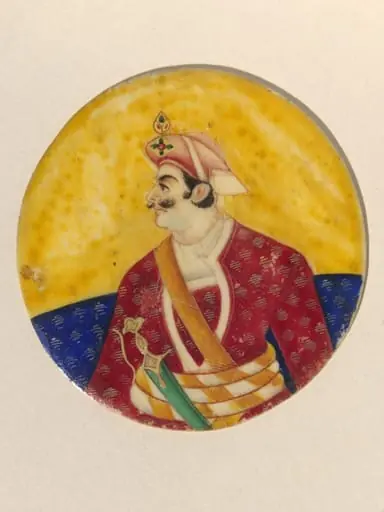
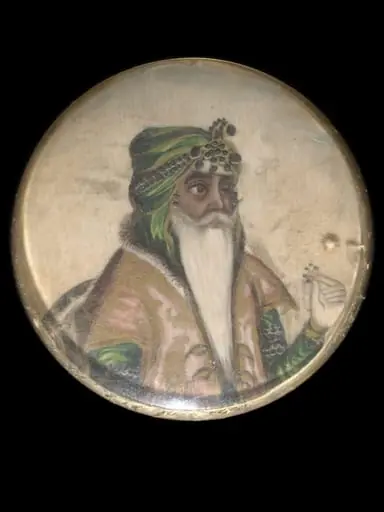
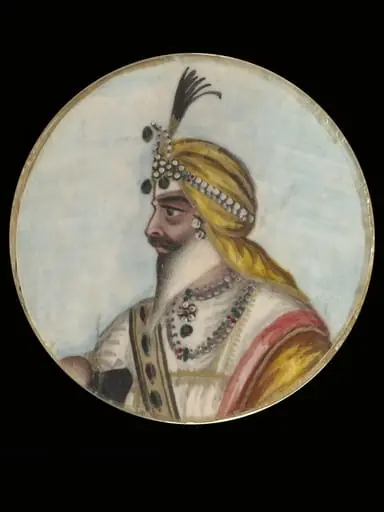
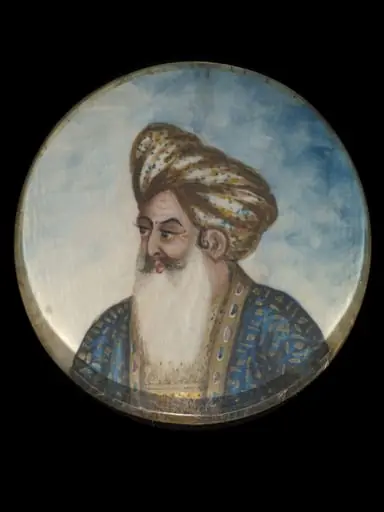
One of twelve tiny paintings depictsing Mughal emperors, Afghan and Sikh nobles, and Mughal ladies.
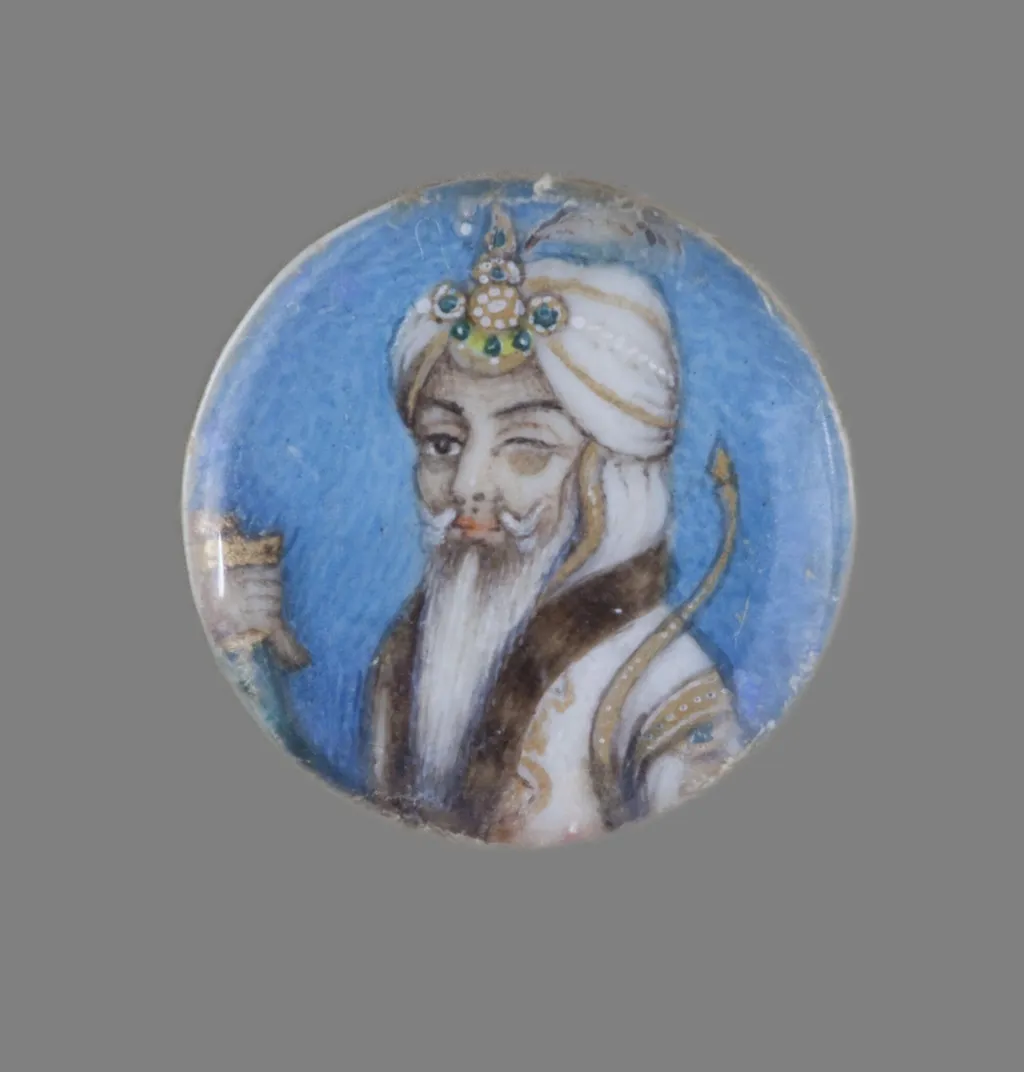
One of twelve tiny paintings depictsing Mughal emperors, Afghan and Sikh nobles, and Mughal ladies. is a paint painting by the Mughal Painting artist Unknown. It dates from 1850 and is held in the collection of the Victoria and Albert Museum.
About this work
Overview
This miniature is one of a set of twelve small-scale portraits that together represent a range of figures from the Mughal, Afghan and Sikh worlds, including emperors, nobles and court ladies. The work focuses on Maharaja Ranjit Singh, the Sikh ruler whose reign spanned from 1780 to 1839.
Subject & Meaning
The portrait shows a bearded man in a circular format, his white turban tipped with a gold and blue jewel and a white robe edged in gold. He holds a sword in his right hand and a gold‑tipped arrow rests on his back, symbols that emphasize his martial authority and noble status.
Technique & Style
Executed in the refined miniature tradition associated with Mughal court art, the painting employs delicate brushwork and vivid pigments to render intricate details on a compact surface. The use of bright whites, gold accents and precise line work reflects the aesthetic conventions of the period’s elite portraiture.
History & Provenance
The work forms part of a series likely commissioned to celebrate the diverse ruling elites of northern India during the early nineteenth century. While the exact patron remains unidentified, the inclusion of Ranjit Singh situates the set within the political landscape following the decline of Mughal power and the rise of Sikh authority.
Context
Miniature portraiture served both documentary and decorative purposes in Mughal and related courts, providing visual records of rulers and dignitaries. This series, by juxtaposing figures from different dynasties, underscores the complex inter‑regional relationships and shifting allegiances of the era.
Legacy
The painting exemplifies the cross‑cultural artistic exchanges that persisted after the Mughal empire’s apex, influencing later Sikh patronage of the arts. Its preservation offers scholars a tangible reference for studying the visual language of power in early nineteenth‑century South Asia.
Artist & collection

 Domestic Scene
 Giacomo and Cardinal Marco, investing Andrea, Abbot of San Zeno, with his Benefice
 The Nymph of Fontainebleau
 Portrait of a Woman
 Madonna and Child with Saints in the Enclosed Garden
 Venus and Minerva
 Family Group of Four on Sofa
 Wall painting from Room H of the Villa of P. Fannius Synistor at Boscoreale