Artwork
Patron's Day at the Seven Churches, Glendalough
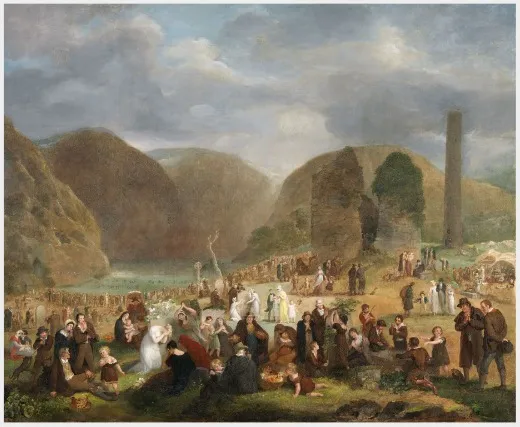
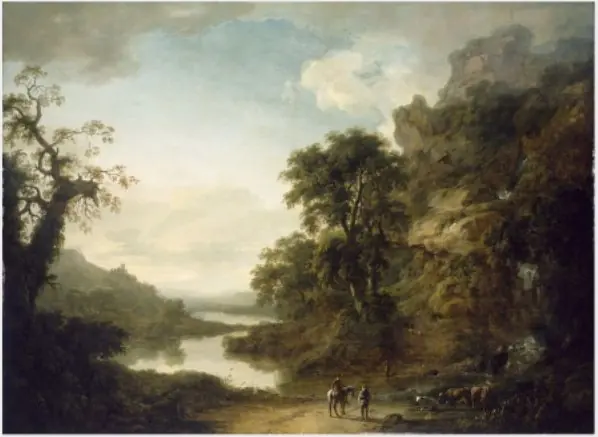
Patron's Day at the Seven Churches, Glendalough is an oil painting by Unknown. It dates from 1816 and is held in the collection of the National Gallery of Ireland. This oil painting depicts a traditional gathering at Glendalough, a historic monastic site in County Wicklow, Ireland.
About this work
Overview
This oil painting depicts a traditional gathering at Glendalough, a historic monastic site in County Wicklow, Ireland. A crowd of figures in 19th-century attire is shown outdoors, dispersed across a grassy field beneath a overcast sky. Distant stone structures, likely remnants of early Christian buildings, rise behind them, anchoring the scene in a place of spiritual and cultural significance.
Subject & Meaning
The scene captures Patron’s Day, an annual pilgrimage and communal event tied to local religious observance. Though the weather is subdued, the figures engage in quiet conversation, rest, and shared presence, suggesting a ritual of collective memory rather than festive revelry. The gathering reflects enduring rural traditions where faith, ancestry, and community intersect.
Technique & Style
The artist employs muted tones and soft brushwork to convey the damp, overcast atmosphere. Figures are rendered with loose detail, emphasizing group dynamics over individual identity. The composition directs the eye from foreground gatherings toward the hazy silhouette of monastic ruins, reinforcing the connection between human activity and sacred landscape.
History & Provenance
Painted in the late 19th century, the work entered the National Gallery of Ireland’s collection in the early 20th century. It is attributed to an Irish artist who documented regional customs during a period of cultural revival. Its preservation reflects growing institutional interest in vernacular Irish life beyond elite or romanticized subjects.
Context
During the 1800s, rural Ireland maintained pilgrimage practices despite political and economic upheaval. Glendalough, once a major monastic center, remained a site of annual gatherings. This painting records one such event, offering a quiet counterpoint to the era’s more dramatic historical narratives, and preserving a fading social rhythm.
Legacy
The painting endures as a documentary record of a localized tradition that has since faded. It contributes to the understanding of how Irish communities sustained identity through ritual, even amid modernization. Its quiet realism distinguishes it from idealized depictions of rural life, offering a grounded view of collective memory.
Artist & collection

 Domestic Scene
 Giacomo and Cardinal Marco, investing Andrea, Abbot of San Zeno, with his Benefice
 The Nymph of Fontainebleau
 Portrait of a Woman
 Madonna and Child with Saints in the Enclosed Garden
 Venus and Minerva
 Family Group of Four on Sofa
 Wall painting from Room H of the Villa of P. Fannius Synistor at Boscoreale
 The Israelites after Crossing the Red Sea
 Quitting the Manse
 The Village Orphans
 Landscape
 A View of Belleek, County Fermanagh
 Castell Dinas Bran
 Coracle makers
 Chermesa
 Pastoral Scene
 Napoleon I, at the Boulogne camp, distributes the crosses of the Legion of Honor, August 16, 1804
 Classical Landscape with Trees and a Lake
 A Landscape