Artwork
Perspective design for a panelled dining-room to be executed by William Henry Haynes & Co. Design
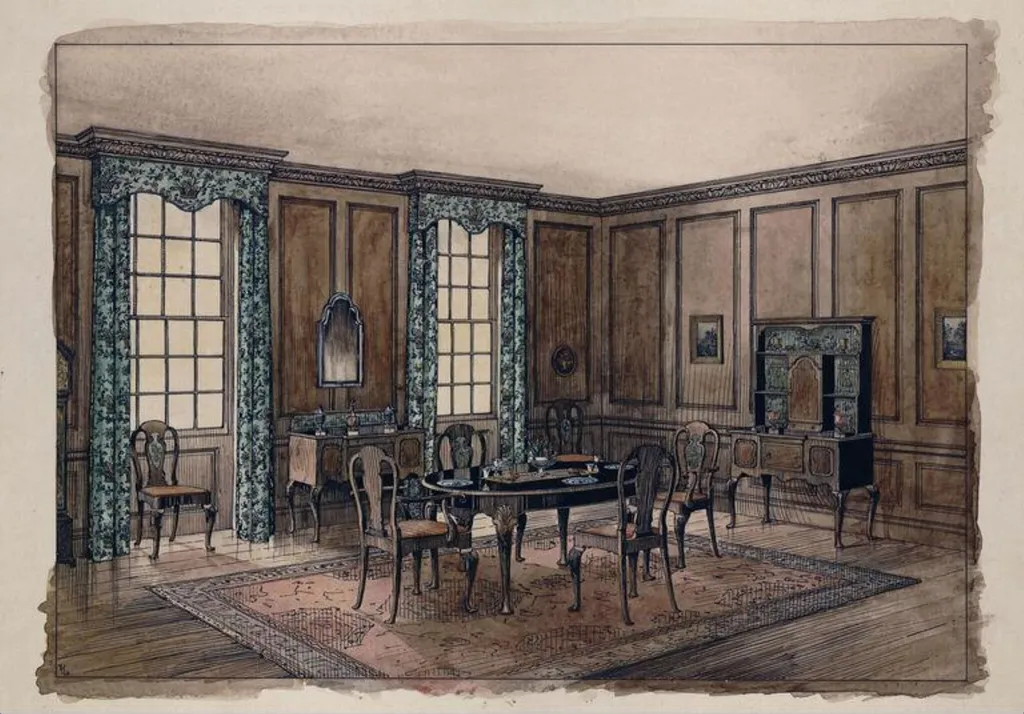
Perspective design for a panelled dining-room to be executed by William Henry Haynes & Co. Design is a watercolor work on paper by the Arts and Crafts movement artist Unknown. It dates from 1925 and is held in the collection of the Victoria and Albert Museum.
About this work
Overview
This 1925 watercolour is a preparatory design for a residential dining room, created as a blueprint for execution by William Henry Haynes & Co.
This 1925 watercolour is a preparatory design for a residential dining room, created as a blueprint for execution by William Henry Haynes & Co. It presents a fully realized interior scheme in soft washes, detailing architectural elements and furnishings without depicting human presence. The work functions as a commercial proposal, translating aesthetic ideals into tangible specifications for a client’s space.
Subject & Meaning
The composition centers on a formal dining environment evoking early 20th-century domestic elegance. Wooden panelling, ornate chair carvings, and heavy drapery suggest a preference for traditional, handcrafted interiors. The absence of people and decorative objects conveys a sense of restraint, emphasizing architectural form over personal expression. The design reflects a period ideal of refined, orderly domesticity.
Technique & Style
Executed in watercolour, the design employs subtle layering to suggest wood grain, fabric texture, and ambient light. Clean lines define the panelling and furniture, while muted greens and browns unify the palette. The perspective is precise but not overly technical, balancing artistic presentation with functional clarity. Details like the mirror and sideboard are rendered with careful economy, prioritizing legibility over ornament.
History & Provenance
Commissioned in 1925, the drawing was part of a series of interior designs produced by Haynes & Co., a firm known for bespoke residential work in the interwar period. Likely created for a private client, it remained in the firm’s archives before entering institutional collection. Its survival offers rare insight into the workflow of early 20th-century interior design studios.
Context
This design emerged during a time when traditional craftsmanship was being reevaluated amid industrialization. While modernist movements gained traction, many affluent clients still favored historicist interiors. The room’s emphasis on woodwork, symmetry, and decorative restraint aligns with the Arts and Crafts legacy, even as it anticipates the streamlined tastes of the coming decades.
Legacy
The drawing serves as a document of period-specific interior practice, illustrating how design concepts were communicated before digital tools. It contributes to the understanding of domestic aesthetics in interwar Britain and remains a reference for historians studying the transition from handcrafted to mass-produced interiors. Its preservation underscores the value placed on design documentation in professional practice.
Artist & collection

 Domestic Scene
 Giacomo and Cardinal Marco, investing Andrea, Abbot of San Zeno, with his Benefice
 The Nymph of Fontainebleau
 Portrait of a Woman
 Madonna and Child with Saints in the Enclosed Garden
 Venus and Minerva
 Family Group of Four on Sofa
 Wall painting from Room H of the Villa of P. Fannius Synistor at Boscoreale