Artwork
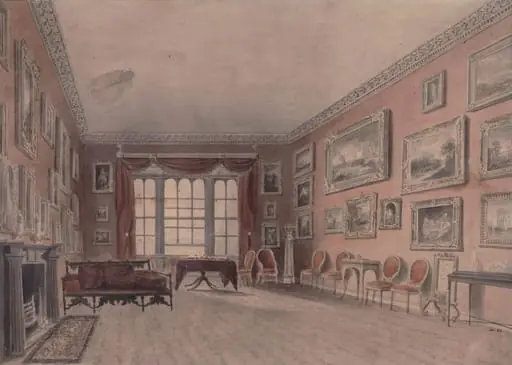
View of a room at Christ Church, Oxford
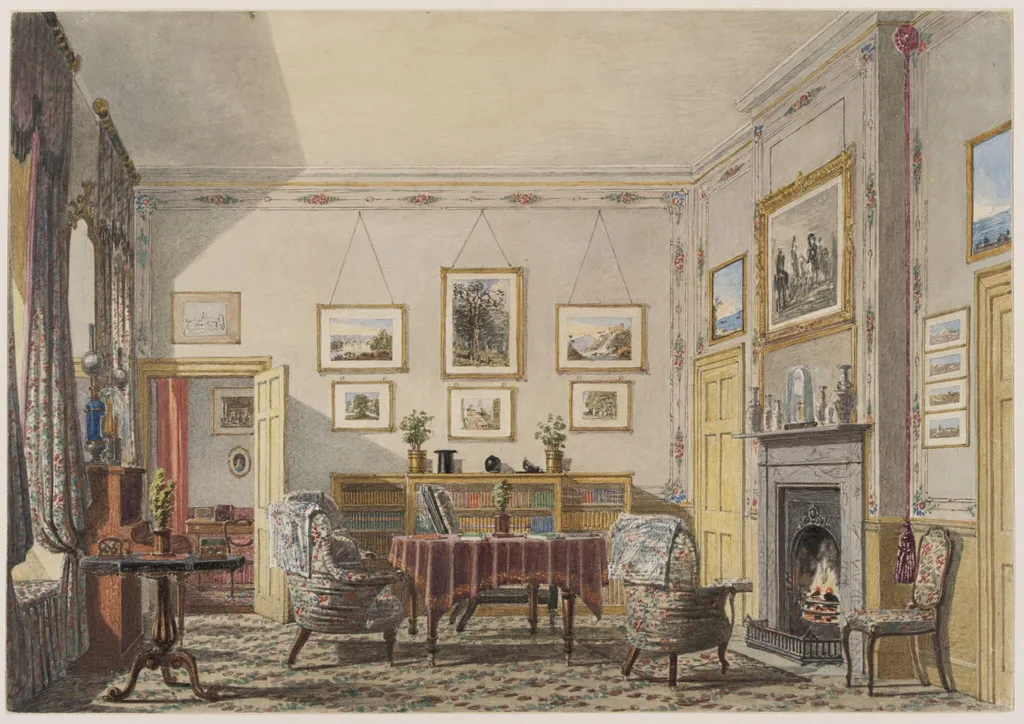
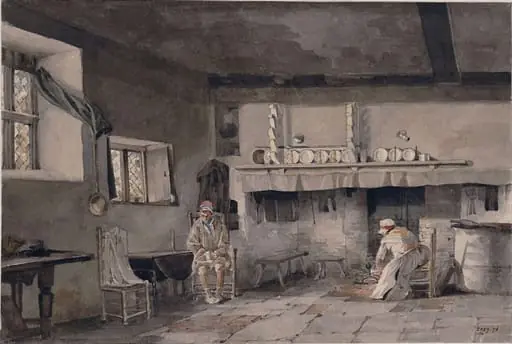
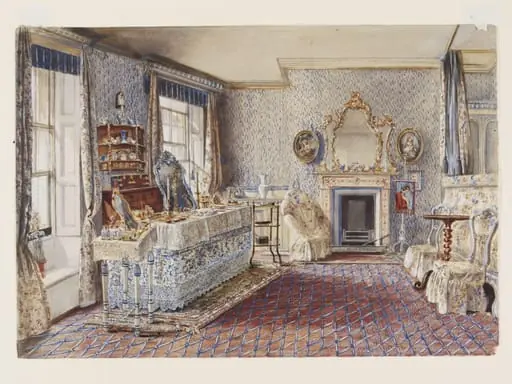
View of a room at Christ Church, Oxford is a watercolor work on paper by the British Romanticist artist George Pyne. It dates from 1855 and is held in the collection of the Victoria and Albert Museum. This watercolour, dated around 1855, depicts an interior space in Canterbury Quadrangle at Christ Church, Oxford.
About this work
The space looks like a Victorian sitting room, with plush chairs, a carpet, a piano, and matching fabrics.
This watercolor shows a room in an Oxford college around 1855. It’s one of several views of student quarters, painted in fine detail. The space looks like a Victorian sitting room, with plush chairs, a carpet, a piano, and matching fabrics.
The decorator picked a bold floral wallpaper border instead of plain walls. Every piece fits—rug, curtains and pictures—hinting the owner liked harmony.
See more rooms like this at the Victoria and Albert Museum.
Overview
This watercolour, dated around 1855, depicts an interior space in Canterbury Quadrangle at Christ Church, Oxford. It belongs to a series of detailed studies of student accommodations, capturing the domestic atmosphere of upper-class undergraduates during the mid-Victorian era. The scene is rendered with precision, emphasizing arranged furnishings and decorative harmony rather than architectural grandeur.
Subject & Meaning
The room reflects the private life of a well-to-do student, blending comfort with personal expression. The presence of a piano, watercolours on the walls, and coordinated textiles suggests an occupant engaged in cultural pursuits and attentive to aesthetic unity. Unlike typical institutional interiors, this space reveals individual taste, transforming a college room into a refined, self-directed sanctuary.
Technique & Style
Executed in fine watercolour, the work employs delicate washes and controlled linework to render textures: the plushness of upholstery, the sheen of varnished wood, and the pattern of wallpaper. The composition is orderly, with furniture arranged symmetrically around a central table. Light is suggested through subtle gradations, enhancing the quiet intimacy of the space without dramatic contrast.
History & Provenance
The drawing is part of a small group of interior studies made during the 1850s, likely by an artist connected to Oxford. Its survival and preservation indicate early recognition of its documentary value. It entered the collection of the Victoria and Albert Museum, where it remains as a record of domestic life in a prestigious academic setting during a period of social change.
Context
In mid-Victorian Oxford, student rooms were increasingly personalized as the university’s wealthier undergraduates sought to replicate middle-class home environments. The emphasis on matching textiles and displayed art reflects broader cultural trends valuing domestic order and cultivated taste. This room stands out for its cohesive design, contrasting with the more utilitarian or austere interiors common in institutional housing.
Legacy
The watercolour endures as a quiet testament to the individuality that could emerge within rigid academic structures. It offers insight into how young men of privilege shaped their surroundings to reflect identity and aspiration. As a record of material culture, it contributes to understanding the domestic rituals and aesthetic values of Victorian student life beyond the lecture hall.
Artist & collection